
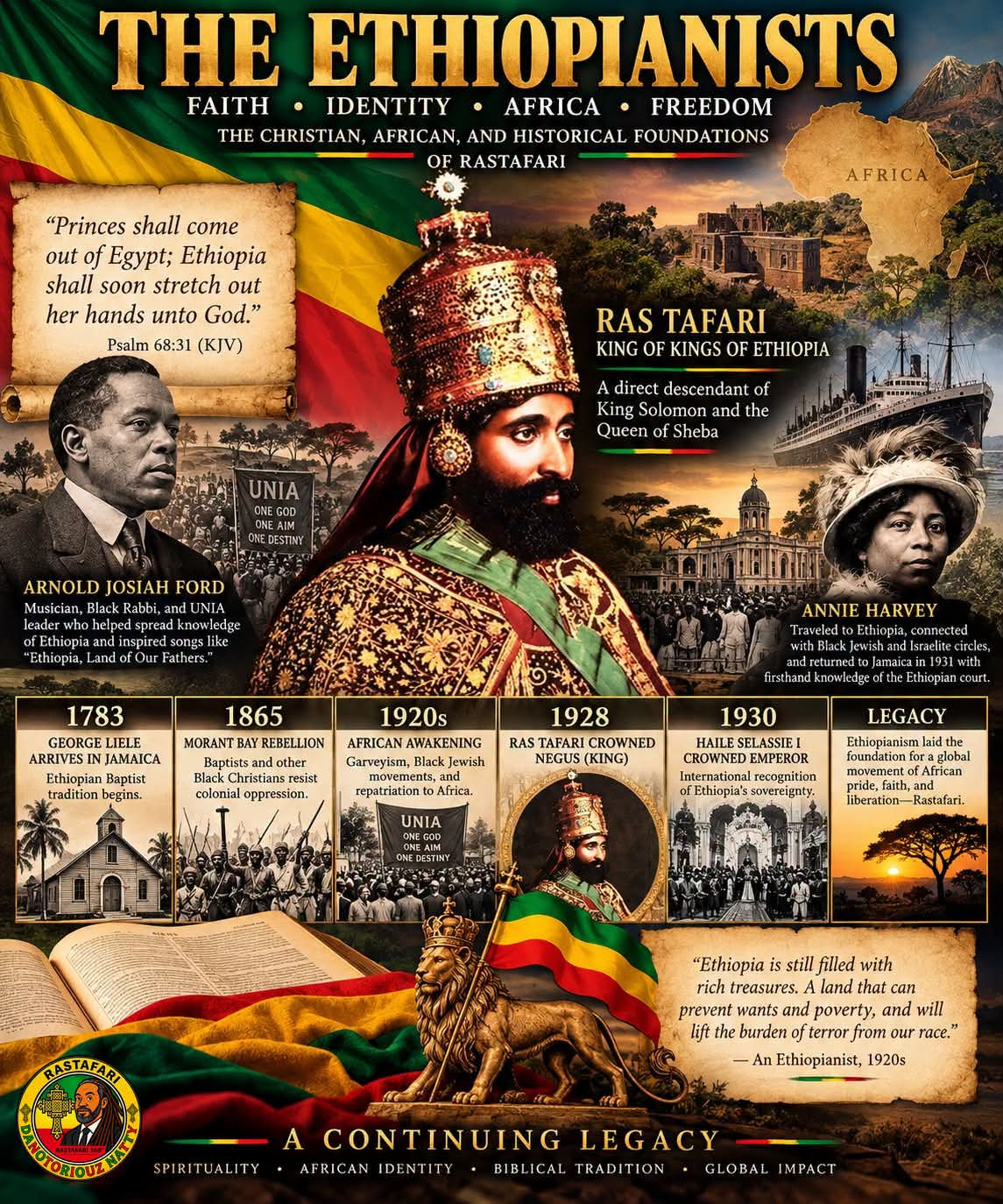
THE ETHIOPIANISTS: THE CHRISTIAN, AFRICAN, AND HISTORICAL FOUNDATIONS OF RASTAFARI
THE ETHIOPIANISTS: THE CHRISTIAN, AFRICAN, AND HISTORICAL FOUNDATIONS OF RASTAFARI
A Scholarly Examination of Chapter 7, “The Ethiopianists,” from Hélène Lee’s The First Rasta: Leonard Howell and the Rise of Rastafarianism, pages 53–61.
Introduction: Ethiopianism Existed Before RasTafari
To understand the historical emergence of the RasTafari movement in Jamaica, one must first understand Ethiopianism, a much older current of African religious consciousness, biblical interpretation, political liberation, and cultural identification.
Chapter 7 of Hélène Lee’s The First Rasta, titled “The Ethiopianists,” examines the intellectual and religious environment that preceded the emergence of Leonard Percival Howell as a pioneering RasTafari preacher.
The chapter introduces several important historical figures, including Arnold Josiah Ford, George Liele, Annie Harvey, Marcus Mosiah Garvey, and His Imperial Majesty Emperor Haile Selassie I.
Their histories demonstrate that RasTafari did not emerge in isolation. It developed within an established world of Black Christianity, African nationalism, Ethiopian identification, biblical interpretation, and resistance to European colonial domination.
However, an essential distinction must be maintained throughout this examination:
The historical foundations of Ethiopianism, the religious interpretations of early RasTafari pioneers, and the documented Christian beliefs of Emperor Haile Selassie I are three related but distinct subjects.
Understanding their relationship requires historical evidence rather than treating every interpretation advanced by an early RasTafari preacher as an established historical or theological fact.
I. Arnold Josiah Ford: Garveyism, Black Judaism, and the Ethiopian Homeland
One of the central figures introduced in Chapter 7 is Arnold Josiah Ford, a Barbadian-born musician, religious leader, and participant in Marcus Garvey’s Universal Negro Improvement Association (UNIA).
Ford was associated with the musical and ceremonial culture of the Garvey movement. Lee identifies him with the composition of Ethiopianist anthems, including Ethiopia, Land of Our Fathers.
These compositions expressed the conviction that Africa was not merely a continent from which enslaved people had been forcibly removed. Africa represented an ancestral homeland with a history, civilization, and future independent of European domination.
Ford’s religious identity is equally significant.
He became associated with the Black Jewish congregation Beth B’nai Abraham in Harlem, studied Hebrew, and eventually assumed the role of rabbi.
His interpretation of biblical history identified Black people with ancient Israel and interpreted the enslavement of Africans through the biblical experience of Israelite captivity.
However, the distinction between religious identification and historical genealogy must be recognized.
Ford’s conviction that Black people were the original Israelites was a religious and historical claim advanced within his movement. It does not establish that all Africans descended from ancient Israelites, nor does it invalidate the documented ancient history of Jewish populations outside Africa.
The Jewish history of Ethiopia, including the Beta Israel community, must also be examined independently of the racial theories developed by twentieth-century religious movements.
Ford’s relocation to Ethiopia
Ford eventually traveled to Ethiopia and became associated with the community of African Americans and West Indians who regarded the country as a possible homeland.
Lee describes a transatlantic network of musicians, religious leaders, professionals, and political activists who traveled to Ethiopia before the Italian invasion of 1935.
This network is historically important because it demonstrates that the African diaspora’s interest in Ethiopia preceded the international publicity surrounding Haile Selassie I’s imperial coronation.
Ethiopia was already an object of political admiration, religious identification, and repatriation aspirations.
The significance for RasTafari: Ethiopian identification was not invented by Leonard Howell. Howell entered a world in which Ethiopia had already acquired extraordinary spiritual and political importance.
II. George Liele: The Christian Roots of Jamaican Ethiopianism
Perhaps the most consequential historical discussion in Chapter 7 concerns George Liele, the African American Baptist preacher who migrated to Jamaica during the eighteenth century.
Liele was ordained in 1775 and arrived in Jamaica in 1783. He established a Baptist ministry that became associated with the Ethiopian Baptist tradition.
The American Baptist Historical Society and the Baptist World Alliance independently recognize his pioneering role in Black Baptist history and international Christian missionary activity.
This history establishes an important chronological fact:
1783
George Liele arrives in Jamaica
The foundations of the Ethiopian Baptist tradition develop.
1928
Ras Tafari crowned Negus
His elevation to kingship receives international attention.
1930
Haile Selassie I crowned Emperor
His imperial coronation becomes a defining event in early RasTafari interpretation.
Jamaican Christian Ethiopianism therefore existed for well over a century before Haile Selassie I became Emperor.
Christianity and African dignity
Liele’s ministry gave enslaved and free Black Jamaicans access to biblical teaching, religious organization, and a community of Christian fellowship.
The Ethiopian Baptist movement helped establish a religious identity in which Africans could recognize themselves as participants in biblical history.
This identification did not require the invention of another messiah.
The Ethiopian Baptists were Christians who proclaimed the Gospel of Jesus Christ.
Their identification with Ethiopia was an expression of biblical consciousness and African dignity, not an assertion that a future Ethiopian monarch would replace Jesus Christ.
That distinction is essential to understanding the religious inheritance from which RasTafari emerged.
III. Psalm 68:31 and the Biblical Meaning of Ethiopia
One of the most influential biblical passages in Ethiopianist history is Psalm 68:31.
“Princes shall come out of Egypt; Ethiopia shall soon stretch out her hands unto God.”
— Psalm 68:31, King James Version
For African Christians confronting slavery, racial oppression, and European assertions of racial superiority, this passage carried considerable significance.
It presented Ethiopia as a people and place recognized within sacred Scripture.
The passage also describes Ethiopia turning toward God.
It does not declare that Ethiopia is God, that an Ethiopian king must be worshipped, or that a future monarch will replace the Messiah.
The original biblical language and historical setting require careful interpretation. The geographical meaning of biblical Cush, often rendered Ethiopia in older English translations, cannot automatically be equated with every boundary of the modern Ethiopian state.
Nevertheless, the symbolic importance of Ethiopia in African Christian thought is undeniable.
Ethiopianism developed through the interaction of biblical interpretation, African historical memory, and the struggle for freedom.
Its Christian roots must not be erased simply because later movements developed different theological interpretations.
IV. Ethiopianism, Emancipation, and the Struggle for African Freedom
Lee connects Ethiopianist Christianity with Jamaica’s broader struggles against slavery and colonial domination.
The chapter discusses Baptist participation in abolitionist organizing, the formation of free communities after emancipation, and the Morant Bay Rebellion of 1865.
Paul Bogle, a Baptist deacon and leader of the rebellion, represents the relationship between Christian conviction and resistance to political injustice.
However, the history was not uniform. Baptist leaders differed in their political positions, and not every missionary or congregation opposed slavery in the same manner.
The historical record nevertheless establishes that Black Baptist institutions became important centers of education, communal organization, and resistance to colonial injustice. The Jamaica Baptist Union acknowledges this longstanding relationship between faith and freedom.
For the study of RasTafari, this reveals a significant continuity.
The demand for African dignity did not begin as a rejection of Christianity.
In important respects, it developed within African Christian communities whose members understood freedom, justice, and human dignity through Scripture.
V. Annie Harvey and the Transatlantic Transmission of Ethiopianism
Annie Harvey occupies a particularly interesting position in Lee’s account.
According to Chapter 7, Harvey and her husband, David Harvey, became associated with Black Jewish religious circles in the United States after previously living in Costa Rica.
They adopted an Israelite identity and eventually traveled to Ethiopia.
Lee reports that Annie Harvey returned to Jamaica in 1931, carrying knowledge of Ethiopia and its imperial court.
The significance of Harvey’s story lies in the movement of people, ideas, religious interpretations, and photographs across the Atlantic.
Ethiopianist ideas did not travel exclusively through books or newspapers.
They circulated through personal testimony, religious networks, migration, correspondence, and visual representations.
Annie Harvey and Leonard Howell
Lee suggests that Harvey’s network may have contributed to Howell’s acquisition of a photograph of Haile Selassie I.
The chapter includes testimony attributed to Henry Dunkley, an early follower of Howell, describing Howell’s contact with the Israelite community and his acquisition of an imperial photograph.
This is a valuable historical lead.
However, a distinction must be made between what the testimony supports and what remains speculative.
The testimony supports an association between Howell, the Israelite network, and the circulation of Haile Selassie I’s image.
It does not conclusively establish that Annie Harvey personally supplied Howell with the photograph or that she originated Howell’s messianic interpretation.
Lee herself presents parts of this reconstruction as possibilities rather than demonstrated facts.
Historical scholarship must preserve that uncertainty.
VI. The Coronation of Haile Selassie I and the Emergence of RasTafari
The coronation of His Imperial Majesty Emperor Haile Selassie I on November 2, 1930, was an event of international importance.
His Majesty’s accession represented the continuation of the Ethiopian monarchy and the assertion of Ethiopian sovereignty during an era when much of Africa remained under European colonial domination.
For African-descended communities in Jamaica, Ethiopia’s independent monarchy possessed extraordinary symbolic power.
Here was an African sovereign receiving international diplomatic recognition while much of the continent remained under foreign rule.
The distinction between the coronations of 1928 and 1930
Ras Tafari was crowned Negus, or King, on October 7, 1928.
Following the death of Empress Zewditu in 1930, he became Emperor and was crowned Haile Selassie I on November 2 of that year.
These were two separate events and must not be conflated.
The 1930 coronation included representatives of foreign governments, among them Prince Henry, Duke of Gloucester, representing his father, King George V of Britain.
The international publicity surrounding the coronation helped bring images of the Ethiopian Emperor to audiences throughout the African diaspora.
But the religious significance assigned to those images was not necessarily the significance intended by the Emperor himself.
That difference becomes central to understanding Leonard Howell.
VII. Leonard Percival Howell and The Promised Key
Lee reproduces an account from Howell’s 1935 publication, The Promised Key, in which the coronation of Haile Selassie I is presented through an explicitly messianic framework.
Howell describes the Emperor using biblical titles and portrays the coronation as a demonstration of divine authority.
His account incorporates imagery of European submission to the Ethiopian monarch.
The Duke of Gloucester is represented as kneeling before the Emperor and acknowledging him in terms associated with biblical prophecy.
This passage must be approached critically.
Historical reporting versus religious interpretation
The actual coronation was a state and religious ceremony involving Ethiopian imperial traditions, the Ethiopian Orthodox Tewahedo Church, and international diplomatic representatives.
Howell’s account transformed that historical event into a theological narrative.
The presence of British royalty at the coronation is historically established.
However, Howell’s dramatic description of the Duke’s words and conduct cannot be accepted as a verbatim historical record without independent contemporary corroboration.
The same caution applies to his descriptions of ceremonial objects and claims about their antiquity.
A historical event does not become evidence of a supernatural claim simply because a religious writer interprets it through biblical prophecy.
This is not a denial of Howell’s importance.
It is a recognition that Howell’s theological interpretation and Haile Selassie I’s actual conduct are separate categories of evidence.
VIII. The Royal Photograph: A Historical Artifact of Early RasTafari
Chapter 7, page 60, reproduces a photograph of Ras Tafari identified as an original picture distributed by Leonard Howell, courtesy of the Spanish Town Archives. The uploaded book page is the reference for this discussion.
One of the most important pieces of material evidence in the chapter appears on page 60.
It is a reproduction of an early photograph of Ras Tafari reportedly sold by Leonard Howell.
The image bears royal language identifying Ras Tafari as King of Kings of Ethiopia and invoking his claimed descent from Solomon and the Queen of Sheba.
Its historical significance is substantial.
The photograph demonstrates how an image of the Ethiopian monarch could be reproduced, circulated, and transformed into a symbol of religious identity.
It also illustrates the importance of visual culture in the early RasTafari movement.
For followers who had never visited Ethiopia, photographs offered a tangible connection to the African sovereign.
Yet the photograph itself did not establish the Emperor’s divinity.
It demonstrated Howell’s use of imperial imagery in spreading his message.
The distinction between the historical person represented in the photograph and the theological meaning assigned to him must remain clear.
IX. The Emperor’s Christian Faith and the Interpretations of His Followers
This is where historical study requires particular precision.
His Imperial Majesty Emperor Haile Selassie I was a baptized and practicing Christian of the Ethiopian Orthodox Tewahedo Church.
His imperial office was inseparable from Ethiopia’s Christian royal tradition.
His public religious identity, support for the Church, and statements concerning Christianity belong to the historical record.
By contrast, Leonard Howell and other early RasTafari preachers developed theological interpretations identifying the Emperor with divine or messianic figures.
Those interpretations are part of RasTafari history.
They are not, by themselves, evidence that Haile Selassie I professed those interpretations.
The New Testament provides a clear distinction between Jesus Christ and earthly rulers.
In 1 Timothy 2:5, Christ is identified as the one mediator between God and humanity.
In Acts 2:30–36, Peter’s proclamation identifies Jesus as the promised Davidic Messiah whom God raised from the dead.
And in Revelation 19:10, the command is explicit:
“Worship God.”
The use of royal titles such as King of Kings and Conquering Lion of Judah does not, by itself, prove that the bearer is Jesus Christ.
Royal titulature must be interpreted within its historical and political context.
Ethiopian imperial titles drew upon Solomonic tradition and the Christian symbolism of the monarchy.
A claim of descent from Solomon is a dynastic claim. It is not proof of divinity.
Similarly, a claim of descent from the biblical House of David does not establish that an individual is the resurrected Jesus Christ.
The Christian faith of Haile Selassie I must be studied through his documented words and actions, not replaced by theological claims made about him by others.
X. Ethiopianism Was Not One Uniform Religious Movement
Another important conclusion emerges from Chapter 7.
Ethiopianism encompassed different traditions whose beliefs were not always compatible.
Black Baptists, Garveyites, Black Jewish congregations, African repatriation advocates, and early RasTafari preachers could all identify with Ethiopia while disagreeing about theology, biblical ancestry, and political strategy.
Their shared identification with Ethiopia did not make them members of one denomination.
Nor did it mean they shared a common understanding of Haile Selassie I.
For some, Ethiopia represented African independence.
For others, it represented the fulfillment of biblical prophecy.
For others still, Ethiopia was a possible destination for repatriation.
And for some early RasTafari preachers, the Ethiopian Emperor became the object of a messianic religious interpretation.
These distinctions matter.
Treating Ethiopianism as a single theological system obscures its history.
Likewise, treating every Ethiopianist belief as an original teaching of RasTafari is historically inaccurate.
XI. Historical Corrections and Qualifications
Several passages in Chapter 7 require additional caution.
First, the date of George Liele’s Jamaican ministry. Lee emphasizes 1784, which is consistent with the beginning of his organized preaching activity, while other sources identify his arrival in Jamaica in 1783. These dates refer to different stages of his activity, not necessarily conflicting events.
Second, the coronation chronology. The distinction between the 1928 coronation as Negus and the 1930 coronation as Emperor must be preserved.
Third, the Duke of Gloucester. Page 58 contains a clear historical error in identifying the Duke of Gloucester as the future George VI. Prince Henry, Duke of Gloucester, and Prince Albert, the future George VI, were different sons of King George V. George VI became king in 1936.
Fourth, the historical meaning of Ethiopia. Biblical Cush, the Ethiopian Empire, the Ethiopian Orthodox Church, and the Ethiopianist concept of Africa are related but not interchangeable categories.
Fifth, the Beta Israel tradition. Traditions linking Ethiopian Jewry to Solomon and the Queen of Sheba should not be presented as genealogically established facts without qualification.
Sixth, Howell’s coronation narrative. His account is primary evidence for Howell’s religious message, but it is not automatically reliable primary evidence for every event he describes.
These corrections do not diminish the importance of Lee’s work. They help distinguish her historical reconstruction, the testimony of her sources, and independently established facts.
XII. Conclusion: Recovering the Historical Foundations of RasTafari
Chapter 7 of The First Rasta establishes a vital point for serious students of RasTafari history:
Ethiopianism preceded RasTafari, and Christianity was one of the central foundations of Ethiopianism.
George Liele and the Ethiopian Baptists were proclaiming the Gospel in Jamaica long before the birth of Ras Tafari Makonnen.
Marcus Garvey and the UNIA promoted African dignity, political independence, and Ethiopian identification before the imperial coronation of 1930.
Arnold Josiah Ford connected Garveyism, Black Jewish religious identity, and the aspiration to return to Africa.
Annie Harvey and other transatlantic figures helped circulate Ethiopianist ideas and information.
Leonard Percival Howell subsequently developed and propagated a distinct interpretation of the Ethiopian Emperor’s identity.
These developments are connected, but they are not identical.
Most importantly, the theological claims made by Howell must not be confused with the documented Christian faith of Emperor Haile Selassie I.
To study RasTafari seriously is to examine the movement’s origins without erasing the differences among its founders, its antecedents, and the Ethiopian monarch whose name it bears.
It is possible to recognize Howell’s historical importance without accepting every theological proposition he advanced.
It is possible to honor the African liberation aspirations of Ethiopianism while maintaining the historical and theological distinctions that its various adherents sometimes blurred.
And it is possible to venerate Haile Selassie I as an important Christian African sovereign without confusing veneration with the worship owed to God.
The history of RasTafari deserves more than inherited slogans. It deserves documentary evidence, chronological accuracy, theological literacy, and careful attention to the actual words of the people who shaped it.
That is the purpose of primary-source study.
Sources and further reading
Principal text: Hélène Lee, The First Rasta: Leonard Howell and the Rise of Rastafarianism, Chapter 7, “The Ethiopianists,” pp. 53–61. Analysis based on the supplied pages.
Additional historical references: American Baptist Historical Society, “George Liele, First Ordained Black Baptist”; Boston University, History of Missiology, “Liele, George”; National Library of Jamaica, “George Lisle (Liele)”; Baptist World Alliance, “George Liele, First Baptist Missionary.”
Primary sources identified for further verification: Leonard Percival Howell, The Promised Key (1935); the 1930 Ethiopian imperial coronation records and contemporary diplomatic reports; UNIA publications; and the original photographic material attributed to Howell in the Spanish Town Archives. These have not all been independently inspected for this article.

