9 AFRICAN LEADERS WHO CHANGED HISTORY — BUT LEFT BEHIND CONTROVERSIAL LEGACIES
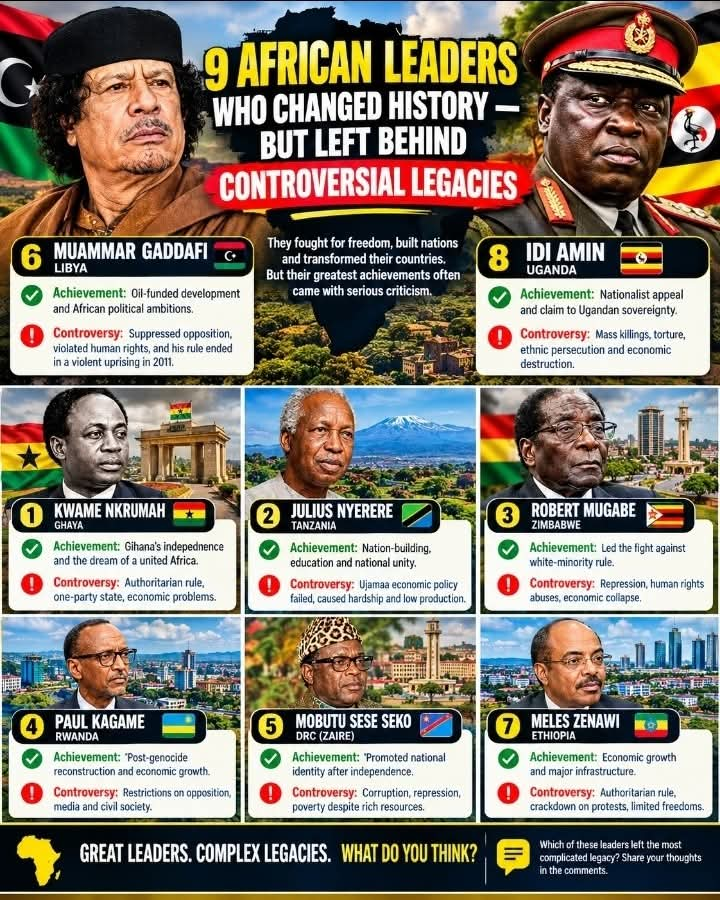
9 AFRICAN LEADERS WHO CHANGED HISTORY — BUT LEFT BEHIND CONTROVERSIAL LEGACIES
They fought colonialism, built nations, transformed economies, and challenged world powers. But some of their greatest achievements came alongside decisions that divided their people and shaped their countries for generations.
African history is filled with leaders whose legacies cannot be explained in simple terms. Some helped liberate their countries, others pursued ambitious development projects, and several became symbols of African independence and self-determination.
Yet their governments also faced serious criticism over authoritarianism, economic failures, human rights abuses, or political repression.
Here are nine African leaders whose achievements and controversies deserve a closer look.
- KWAME NKRUMAH 🇬🇭 — THE PAN-AFRICAN VISIONARY
Achievement: Ghana’s independence and the dream of a united Africa.
Kwame Nkrumah became one of the most influential figures in Africa’s struggle against colonialism. When Ghana gained independence from Britain on March 6, 1957, he became a powerful symbol of African self-government.
He championed Pan-Africanism, supported liberation movements across the continent, and helped establish the Organisation of African Unity in 1963.
However, his leadership also became increasingly authoritarian. Ghana became a one-party state in 1964, and Nkrumah was made president for life. His government restricted political opposition, while expensive development projects and economic difficulties contributed to mounting national problems.
In February 1966, he was overthrown in a military coup while abroad.
The historical question: Could Nkrumah’s dream of African unity have advanced further if his government had protected political freedoms and managed the economy more effectively?
- JULIUS NYERERE 🇹🇿 — THE FATHER OF TANZANIA
Achievement: Nation-building, education, and national unity.
Julius Nyerere led Tanganyika to independence in 1961 and became a central figure in the creation of Tanzania through its 1964 union with Zanzibar.
He promoted national unity in a country with many ethnic communities, expanded education, and pursued policies intended to reduce inequality. His emphasis on a shared national identity helped shape modern Tanzania.
However, his socialist experiment, known as Ujamaa, included collective farming and the relocation of rural communities into planned villages. These policies disrupted many people’s lives, and agricultural production suffered serious problems. Tanzania also experienced severe economic difficulties.
Nyerere eventually acknowledged that his economic policies had not worked as intended and voluntarily stepped down in 1985.
His legacy is therefore mixed: he helped build national unity and expand education, but his economic programme imposed substantial costs.
The historical question: Can a leader succeed in building a united nation while pursuing economic policies that fail to deliver prosperity?
- ROBERT MUGABE 🇿🇼 — THE LIBERATION HERO WHO BECAME AN AUTHORITARIAN RULER
Achievement: The struggle against white-minority rule.
Robert Mugabe emerged as a major figure in Zimbabwe’s liberation struggle against the white-minority government of Rhodesia.
When Zimbabwe gained internationally recognised independence in 1980, Mugabe became prime minister. His government initially pursued racial reconciliation and expanded access to education and healthcare.
But his legacy became increasingly troubled.
During the 1980s, government forces carried out a brutal campaign in Matabeleland and parts of the Midlands against perceived opponents, particularly supporters of the opposition-aligned Zimbabwe African People’s Union. Thousands of civilians were killed; estimates vary.
Later, Mugabe’s government increasingly restricted political opposition. From 2000, the chaotic and often violent seizure of commercial farms, alongside other economic and political problems, contributed to economic collapse and hyperinflation.
Mugabe, once celebrated as a liberation leader, was forced to resign in November 2017 after the military intervened in a succession crisis.
The historical question: How did a leader who helped liberate a nation become associated with repression and economic devastation?
- PAUL KAGAME 🇷🇼 — THE LEADER BEHIND RWANDA’S RECONSTRUCTION
Achievement: Post-genocide reconstruction and economic transformation.
Paul Kagame became a major political figure during the Rwandan Patriotic Front’s campaign that ended the 1994 genocide against the Tutsi.
Under his leadership, Rwanda pursued ambitious reconstruction, expanded public services, invested in infrastructure, and promoted technology and tourism. The country became widely recognised for its development efforts and public-sector reforms.
However, Kagame’s government has faced persistent criticism from human rights organisations and political observers over restrictions on opposition parties, independent media, and civil society.
Critics have also raised concerns about the treatment of political opponents and the wider regional consequences of Rwanda’s involvement in the Democratic Republic of the Congo.
Supporters point to Rwanda’s security, development, and institutional progress, while critics argue that these achievements have come alongside serious restrictions on political freedoms.
The historical question: How should the world evaluate a leader who has overseen significant reconstruction while facing allegations of political repression?
- MOBUTU SESE SEKO 🇨🇩 — THE RULER WHO PROMISED NATIONAL PRIDE
Achievement: Promoting national identity after independence.
Mobutu Sese Seko seized power in the Congo in 1965 and ruled for more than three decades.
He renamed the country Zaire in 1971 and promoted Authenticité, a campaign intended to strengthen national identity by rejecting certain colonial-era names and cultural influences.
But his government became notorious for personal rule, corruption, patronage, and repression.
State institutions weakened as wealth and political influence became concentrated around Mobutu and his associates. Despite the country’s enormous mineral resources, much of the population remained poor, and public services deteriorated.
Mobutu’s rule ended in 1997 when rebel forces led by Laurent-Désiré Kabila overthrew him.
His story illustrates the difference between promoting national pride and building institutions capable of serving ordinary citizens.
The historical question: Can a country become truly strong when its natural wealth benefits a narrow political elite rather than its population?
- MUAMMAR GADDAFI 🇱🇾 — THE REVOLUTIONARY WHO DREAMED OF A UNITED AFRICA
Achievement: Oil-funded development and African political ambitions.
Muammar Gaddafi came to power in Libya through a military coup in 1969, overthrowing King Idris I.
His government used oil revenues to finance infrastructure, education, healthcare, and development programmes. Libya experienced major improvements in several social indicators during his rule, although the extent to which these gains were sustained and fairly distributed remains a subject of debate.
Gaddafi also promoted African unity, supported the creation of the African Union, and advocated greater African independence from foreign influence.
However, his government suppressed political opposition, restricted civil liberties, and imprisoned or persecuted critics. His rule was also associated with serious human rights abuses.
In 2011, an uprising developed into an armed conflict, followed by NATO military intervention under a UN Security Council-authorised mandate to protect civilians. Gaddafi was captured and killed in October that year.
Libya subsequently experienced prolonged instability and political fragmentation.
The historical question: How should we assess a leader’s development record when political repression and the collapse of his government leave such a complicated legacy?
- MELES ZENAWI 🇪🇹 — THE ARCHITECT OF ETHIOPIA’S DEVELOPMENT DRIVE
Achievement: Economic growth and major infrastructure investment.
Meles Zenawi became Ethiopia’s leader after the overthrow of the Derg military regime in 1991. As prime minister from 1995 until his death in 2012, he presided over a period of rapid economic growth and major public investment.
His government expanded infrastructure, invested in roads and electricity generation, and pursued agricultural development. Ethiopia’s economic transformation attracted international attention.
Yet his administration was also criticised for authoritarian rule and restrictions on political competition.
After the disputed 2005 elections, security forces violently suppressed protests. Human rights organisations reported that approximately 200 people were killed, while opposition supporters and activists faced mass arrests.
His government also faced criticism over restrictions on the press and civil society.
Meles’s legacy therefore combines substantial economic and infrastructure ambitions with serious concerns about democratic accountability.
The historical question: Should economic growth be considered sufficient evidence of successful leadership when citizens have limited political freedom?
- IDI AMIN 🇺🇬 — THE MILITARY RULER WHO LEFT A LEGACY OF TERROR
Achievement: A nationalist appeal against foreign influence.
Idi Amin seized power in Uganda in a military coup in 1971, overthrowing President Milton Obote.
Amin presented himself as a defender of Ugandan sovereignty and African interests. In 1972, he ordered the expulsion of most of Uganda’s Asian minority, claiming that the country’s wealth should benefit indigenous Ugandans.
However, the expulsion devastated families and businesses, disrupted commercial networks, and contributed to serious economic damage.
His rule became infamous for political murders, torture, disappearances, ethnic persecution, and economic mismanagement. The number of people killed under his government remains disputed, but estimates commonly run into the hundreds of thousands.
In 1978, Amin’s invasion of Tanzania triggered a war that ended with Tanzanian forces and Ugandan exiles capturing Kampala in April 1979.
Amin fled Uganda and spent the remainder of his life in exile.
The historical question: What happens when a leader uses nationalism to justify policies that destroy lives, institutions, and economic stability?
- PAUL BIYA 🇨🇲 — THE LONG-SERVING PRESIDENT OF CAMEROON
Achievement: Political continuity and periods of economic and institutional development.
Paul Biya became president of Cameroon in 1982, succeeding Ahmadou Ahidjo. He has remained one of Africa’s longest-serving heads of state.
During his presidency, Cameroon continued developing its transport networks, public institutions, and extractive industries. His supporters have often presented political continuity as a source of stability in a country facing complex regional and linguistic divisions.
However, his long tenure has also drawn criticism over electoral fairness, restrictions on opposition activity, corruption, and the concentration of political power.
The Anglophone crisis, which escalated in 2016 following protests over the use of English in the legal and education systems, developed into a violent conflict. Separatist armed groups and government security forces have both been accused of abuses against civilians.
The conflict has displaced large numbers of people and caused a serious humanitarian crisis.
Biya’s legacy remains contested, particularly over whether prolonged political continuity has delivered enough accountability, inclusion, and security.
The historical question: When does political continuity become an obstacle to democratic renewal and meaningful reform?
THE BIG LESSON FROM THESE NINE LEADERS
African history teaches us that leadership is rarely as simple as calling someone a hero or a villain.
Some of these leaders helped secure independence, promote national unity, expand education, or rebuild devastated countries. Yet several also concentrated power, restricted political freedoms, pursued harmful economic policies, or presided over serious human rights abuses.
Their achievements deserve examination, but so do the people who suffered under their governments.
A leader’s legacy should be measured not only by the projects they built or the victories they celebrated, but also by the freedoms they protected, the institutions they strengthened, and the lives of ordinary people they improved.
💬 YOUR TURN:
Which of these nine leaders do you think left the most complicated legacy for their country and for Africa?
And here is a more challenging question:
Can a leader be remembered as a great nation-builder if their government also violated the rights of the people they ruled?
Share your thoughts respectfully in the comments. Let’s have an informed discussion about African history.
📌 Historical note: This post distinguishes documented achievements from major criticisms of each government. Some details, including death tolls, economic outcomes, and the interpretation of political legacies, remain disputed among historians and other researchers.

