
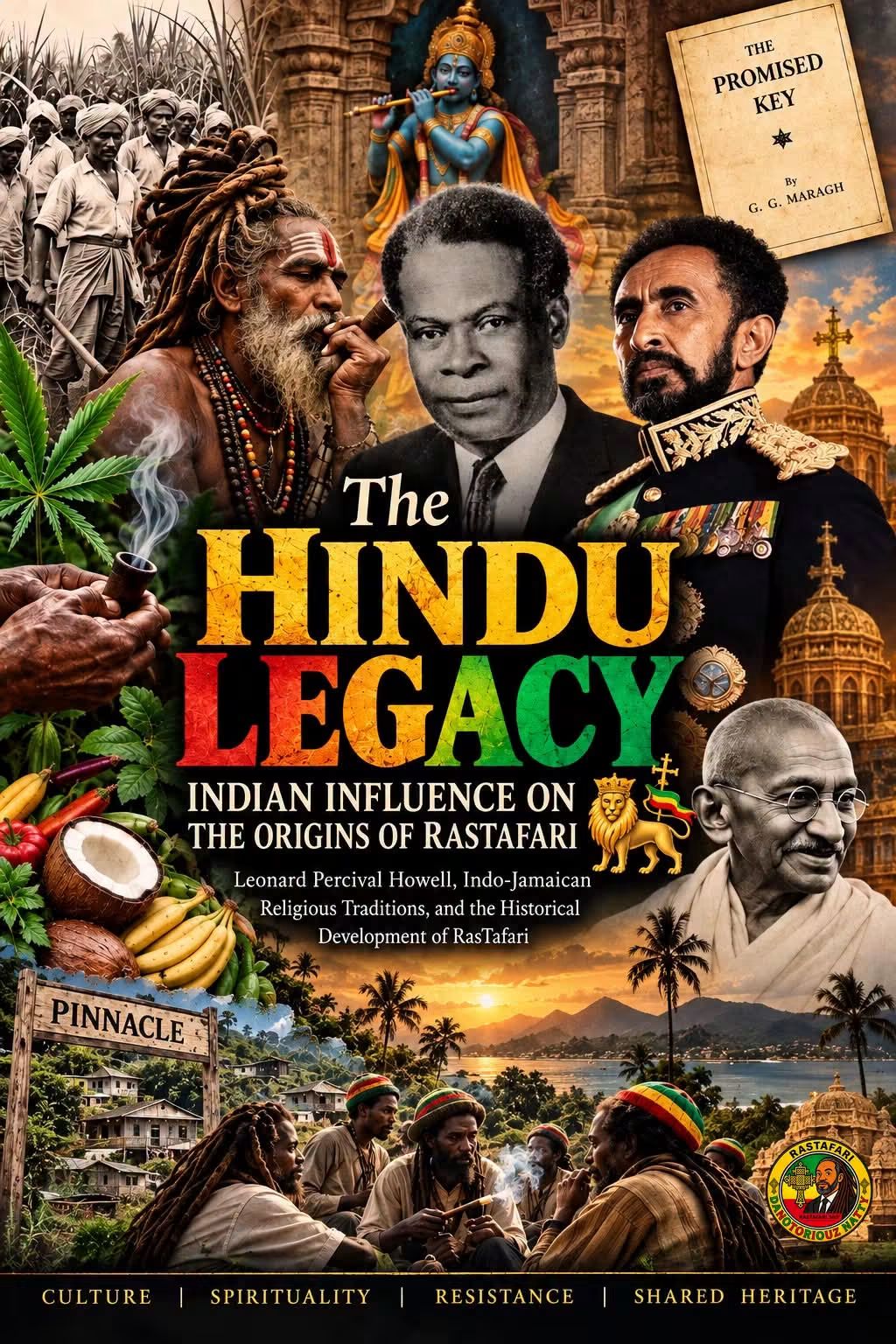
THE HINDU LEGACY: INDIAN INFLUENCE ON THE ORIGINS OF RASTAFARITHE HINDU LEGACY: INDIAN INFLUENCE ON THE ORIGINS OF RASTAFARI
THE HINDU LEGACY: INDIAN INFLUENCE ON THE ORIGINS OF RASTAFARI
Leonard Percival Howell, Indo-Jamaican Religious Traditions, and the Historical Development of RasTafari
An examination of the religious, cultural, and philosophical influences that helped shape early RasTafari, distinguishing the beliefs developed by its Jamaican pioneers from the documented Christian faith of Emperor Haile Selassie I.
Introduction: A Neglected Chapter of RasTafari History
The history of RasTafari is frequently presented through a predominantly African and biblical framework: Ethiopianism, Marcus Garvey, African liberation, resistance to colonialism, and the coronation of Emperor Haile Selassie I on November 2, 1930.
All these elements are essential to understanding the movement. However, they do not tell the complete story.
One of the most frequently overlooked influences on early RasTafari was the religious and cultural heritage of the Indian communities that had lived in Jamaica since the nineteenth century.
Indian traditions contributed to Jamaican society through language, food, religious ceremonies, cultural practices, and interactions with Afro-Jamaican communities. The extent to which those traditions shaped RasTafari theology remains a subject of historical debate.
A particularly important figure in this discussion is Leonard Percival Howell (1898–1981), widely recognized as one of the principal pioneers of organized RasTafari.
In Chapter 11, “The Hindu Legacy,” of The First Rasta: Leonard Howell and the Rise of Rastafarianism, historian and journalist Hélène Lee examines Howell’s relationships with Indo-Jamaicans and argues that Hindu religious concepts contributed substantially to his developing theology.
The chapter, pages 97–107, draws particular attention to the research of Ajai and Laxmi Mansingh, whose studies challenged accounts of RasTafari that neglected the movement’s Indian connections.
The historical importance of this subject extends beyond identifying similarities between Hinduism and RasTafari.
It raises a fundamental question:
How much of the religious identity constructed around Emperor Haile Selassie I originated in the beliefs and experiences of Jamaican interpreters rather than in the Emperor’s own teachings?
Answering that question requires distinguishing three different historical subjects:
- The religious traditions that influenced Leonard Howell and the other early pioneers.
- The beliefs and practices that subsequently developed within the diverse RasTafari movement.
- The personally professed Christian faith of Emperor Haile Selassie I, who belonged to the Ethiopian Orthodox Tewahedo Church.
These subjects are historically connected, but they are not interchangeable.
- The Arrival of Indians in Jamaica: The Historical Foundation
The Indian influence on Jamaica began long before RasTafari appeared in the 1930s.
Following the abolition of slavery in the British Empire and the emancipation of enslaved Africans, Jamaica’s plantation owners sought new sources of agricultural labor.
Many formerly enslaved Africans rejected plantation conditions and pursued independent employment, cultivation, or other means of economic survival.
Colonial plantation interests responded partly through the recruitment of indentured laborers from India.
On May 10, 1845, the first group of approximately 261 Indian indentured workers reached Old Harbour Bay aboard the Blundell Hunter.
Over subsequent decades, more than 36,000 Indian indentured migrants were brought to Jamaica. Immigration continued into the early twentieth century, with 1917 commonly identified as the end of the indenture-era migration period.
Indenture was not identical to chattel slavery, but it involved harsh working conditions, contractual restrictions, unequal power, and frequently exploitative treatment.
Nevertheless, Indian migrants established communities, preserved cultural traditions, and gradually became an integral part of Jamaican society.
Their contributions included food preparation, agricultural knowledge, vocabulary, music, religious observances, and forms of cultural expression.
They also brought Hindu traditions, including devotion associated with Rama, Krishna, Kali, and other deities, alongside the traditions of Indian Muslims and other communities.
This created opportunities for Afro-Jamaicans and Indo-Jamaicans to encounter one another’s religious ideas.
Hélène Lee argues that these encounters were particularly important in the Jamaican parishes where Howell spent his formative years.
Religious exchange between Africans and Indians
Plantation communities were not always divided into rigid cultural compartments.
Religious festivities, music, food, neighborhood gatherings, and personal relationships encouraged cultural exchange.
In The First Rasta, Lee describes Indian communities where Hindu religious stories were recited, devotional songs performed, and ceremonies conducted.
She reproduces accounts of Kali worship that included music, ritual offerings, cannabis consumption, and participation by invited Afro-Jamaican neighbors.
Such accounts demonstrate that African and Indian religious cultures could interact within shared social environments.
They do not, by themselves, establish that every practice subsequently adopted by RasTafari originated in Hinduism.
Nevertheless, they establish the social circumstances in which the transmission of certain ideas was possible.
The significance of this shared cultural environment becomes clearer when examining Leonard Howell himself.
- Leonard Percival Howell and His Indo-Jamaican Connections
Leonard Percival Howell was born in Clarendon, Jamaica, in 1898.
His experiences in Jamaica and overseas exposed him to multiple religious and political traditions, including Christianity, Ethiopianism, Pan-African nationalism, and anti-colonial movements.
He returned to Jamaica in the early 1930s and emerged as an influential advocate of the divinity of Emperor Haile Selassie I.
Howell’s activities brought him into repeated conflict with British colonial authorities. His preaching challenged both the legitimacy of colonial rule and the religious assumptions that supported it.
Historical scholarship documents the sustained campaign against Howell between 1932 and 1954, including his arrests, imprisonment, and the suppression of his religious community.
However, Howell’s ideological development cannot be understood solely through his opposition to British authority.
Lee emphasizes his familiarity with Indo-Jamaican communities and his apparent interest in Hindu religious practices.
Her account includes several noteworthy claims.
First, Howell’s childhood in Clarendon placed him near Indian agricultural communities.
Second, his experiences as a sailor exposed him to Indian workers and international religious ideas.
Third, he reportedly developed personal relationships with Indians in Jamaica, including individuals who participated in his religious activities.
Fourth, he adopted a name with apparent Indian linguistic associations.
These connections formed part of the foundation for the Hindu-influence thesis advanced by Lee and the Mansinghs.
Gangunguru Maragh: The significance of Howell’s adopted name
One of the most interesting details appears on pages 97–100.
Howell used the name G. G. Maragh, under which The Promised Key appeared around 1935.
After his imprisonment, he also became associated with the name Gangunguru Maragh, commonly shortened to Gong.
Lee presents the Mansinghs’ linguistic interpretation of the name as incorporating Indian-derived concepts associated with knowledge, virtue, spiritual teaching, and kingship.
This interpretation is important because it suggests Howell was doing more than casually borrowing words.
He may have been constructing a religious identity influenced by Indian concepts of spiritual leadership.
The name Maragh, however, must be treated carefully. Its use as a surname or pseudonym does not independently prove Howell’s religious beliefs or establish every proposed linguistic derivation.
The strongest historical conclusion is that Howell deliberately adopted Indian-associated language and identity markers.
The extent to which these expressed a coherent Hindu theology requires additional evidence.
- The Promised Key: The Formation of an Early RasTafari Theology
The Promised Key, attributed to G. G. Maragh, is among the most important documents associated with early RasTafari theology.
It provides evidence of the religious ideas Howell promoted during the movement’s formative years.
The text is available in a public-domain transcription through the Internet Sacred Text Archive.
The pamphlet was published around 1935, while Howell was imprisoned according to the chronology discussed by Lee.
The exact circumstances of its preparation and publication remain uncertain.
Lee asks whether Howell wrote the text before imprisonment, had followers arrange publication, or used a date intended to obscure its actual appearance.
These questions should not be mistaken for established answers.
What is clear is that The Promised Key contains ideas central to the emerging religious interpretation of Emperor Haile Selassie I.
The text has significant literary and ideological similarities to Fitz Balintine Pettersburg’s The Royal Parchment Scroll of Black Supremacy, a work associated with the earlier religious movement of Reverend Fitz Balintine Pettersburg, also known as Athlyi Rogers.
The earlier text employed the language of King Alpha and Queen Omega in relation to its own religious leadership.
In the Howell-associated adaptation, Emperor Haile Selassie I and Empress Menen became central figures within that theological framework.
This development demonstrates something historically important:
Early RasTafari theology was not constructed simply by repeating the teachings of the Ethiopian Emperor. It involved the reinterpretation of religious ideas already circulating in Jamaica, the United States, and the wider Black Atlantic world.
Howell participated in transforming those ideas into a distinct interpretation of Ethiopian kingship.
The result was a religious identity centered upon a living African monarch who represented an alternative to European colonial domination.
This does not mean every early RasTafari believer shared Howell’s precise theology. Archibald Dunkley, Joseph Hibbert, Robert Hinds, and other pioneers developed related but not necessarily identical understandings.
Scholars therefore recognize the movement as having multiple early voices, even while acknowledging Howell’s exceptional organizational importance.
- Hindu Divine Incarnation and the Interpretation of Haile Selassie I
Perhaps the most consequential part of “The Hindu Legacy” appears on pages 100–101.
There, Lee examines the argument that Hindu concepts of divine incarnation helped some early RasTafari pioneers understand the Ethiopian Emperor as a divine being.
In Hindu traditions, religious teachings concerning divine manifestation include the concept of avatāra, frequently understood as the descent or manifestation of a deity within the earthly world.
Rama and Krishna, for example, are understood in important Vaishnava traditions as manifestations or avatars of Vishnu.
The precise theological interpretation differs among Hindu traditions.
The Mansinghs argued that exposure to these concepts influenced the religious reasoning of Howell and some of his contemporaries.
Joseph Hibbert’s recollection
Lee recounts an interview conducted by the Mansinghs with Joseph Hibbert, one of the early RasTafari pioneers.
According to the recollection presented on page 101, Howell came to believe that different peoples recognized different divine figures.
In this interpretation, European Christians identified Jesus Christ, Indians revered Rama, Krishna, or Buddha, and Africans could recognize a divine representative of their own.
The coronation of Ras Tafari Makonnen offered a historical figure around whom this understanding could develop.
Hibbert’s account is especially important because it connects the divine-king interpretation directly to encounters with Indian religious concepts.
However, it must be read as retrospective testimony.
The fact that Hibbert recalled Howell’s thinking does not establish that every early RasTafari pioneer adopted the same explanation.
Nor does it mean that Hindu traditions uniformly regard Buddha, Rama, and Krishna in the same theological category. Lee’s account reflects the particular comparative understanding attributed to Howell.
A theology of cultural and racial restoration
For a population that had experienced slavery, colonial subjugation, racial discrimination, and religious representations dominated by European imagery, the appearance of a powerful African emperor carried tremendous symbolic significance.
Haile Selassie I represented African sovereignty at a time when much of Africa remained under European colonial control.
The Ethiopian monarchy also supplied a direct challenge to colonial assumptions of African inferiority.
In some early RasTafari preaching, these political and historical realities were transformed into explicitly theological claims about the Emperor’s identity.
This is where the Hindu-influence thesis becomes particularly significant.
The Mansinghs proposed that Howell’s interpretation of Haile Selassie I had affinities with the Hindu model of a divine incarnation or sacred king.
Lee develops this argument by examining Howell’s attempts to move beyond the racial and theological oppositions he encountered in colonial Christianity.
The theory is historically plausible as one contributing influence, but it should not be elevated into a proven single explanation for the emergence of RasTafari divinity claims.
African religious traditions, Afro-Christian Ethiopianism, biblical interpretation, Garveyism, and resistance to European imperial authority must also be considered.
Ennis Barrington Edmonds, for example, emphasizes the movement’s origins in the African diaspora’s traditions of resistance, Ethiopianism, and the conditions of colonial Jamaica.
The central distinction
Whatever Howell believed about divine kingship, his interpretation does not establish that Emperor Haile Selassie I considered himself an incarnation of God.
A religious movement’s claims about a historical person are not equivalent to that person’s own religious testimony.
This distinction becomes especially important when comparing Howell’s theology with the Emperor’s recorded statements.
- Ganja: From Indo-Jamaican Traditions to RasTafari Sacrament
One of the strongest examples of Indian cultural influence on RasTafari concerns cannabis, widely known in Jamaica as ganja.
The word ganja comes from South Asian linguistic traditions, including Hindi, and was established in Jamaica through the interaction of Indian migrants and the wider population.
Cannabis use in Jamaica predates the institutional development of RasTafari. Indian indentured workers are commonly credited with helping introduce or popularize cannabis consumption and associated practices during the nineteenth century.
The Smithsonian Institution acknowledges Indian influence on Jamaican ganja traditions and their subsequent importance within RasTafari religious life.
Religious cannabis use in Indian traditions
Within certain Hindu religious communities, cannabis has been used in devotional and ascetic settings.
Preparations such as bhang were associated with particular religious practices, including some traditions of devotion to Shiva and certain forms of folk worship.
The chapter describes gatherings associated with Kali worship that included ganja smoking and bhang consumption.
According to Lee, Howell may have encountered these practices through his associations with Indo-Jamaicans.
However, Lee’s suggestion that Howell personally consumed bhang is not the same as documentary proof that he did so.
Cannabis within early RasTafari
By the 1930s, cannabis had become associated with the emerging movement.
A particularly significant piece of evidence is a 1934 entry in the diary of Jamaica’s colonial governor, Edward Denham, documenting ganja smoking among RasTafari adherents in St. Thomas.
This is important because it establishes the practice within the movement’s earliest years, rather than attributing its introduction to the later popularity of reggae musicians.
Contemporary scholarship continues to examine whether Howell’s followers helped establish cannabis as a distinctively religious practice, while acknowledging disagreements about its exact origins.
Over time, ganja acquired meanings that extended beyond its South Asian cultural associations.
Within various RasTafari communities, cannabis became connected to meditation, spiritual reflection, communal reasoning, and biblical interpretations concerning plants and creation.
Among the biblical passages employed in its justification is Genesis 1:29, although that passage does not specifically identify cannabis.
Here, the distinction is essential:
The historical origin of a practice does not necessarily determine its subsequent religious meaning.
Indian communities influenced Jamaican cannabis culture. RasTafari adherents then developed their own theological interpretations of cannabis.
Neither fact proves that Emperor Haile Selassie I prescribed cannabis as a Christian sacrament.
That claim would require independent evidence from his teachings or religious practices.
- Dreadlocks: Indian Sadhus, African Traditions, and Historical Debate
Hindu ascetic tradition: jata, or matted hair
RasTafari: locks as religious and cultural identity
One of the most visually recognizable aspects of RasTafari is the wearing of dreadlocks.
In Chapter 11, Lee discusses the theory that Indian religious ascetics helped inspire the practice among Jamaican Rastafari.
Some Hindu ascetics, commonly called sadhus, wear long, matted hair known as jata.
Such hair can signify renunciation, spiritual discipline, devotion, or a rejection of conventional social expectations.
Lee notes that Indian sadhus were present in Jamaica before dreadlocks became widely associated with RasTafari.
She also cites the resemblance between Indian-associated terminology and particular early Jamaican descriptions of locked hair.
The question of direct influence
The similarities are historically interesting, but similarities alone do not demonstrate descent.
Dreadlocked and matted hairstyles also have histories in African cultures and other religious traditions.
Within RasTafari, biblical passages such as Numbers 6:5, associated with the Nazirite vow, became important justifications for allowing hair to grow uncut.
The lion of Judah and African resistance also contributed to the meaning of dreadlocks.
The Smithsonian Institution identifies Indian holy men as one proposed source of influence but does not present it as the only possible origin.
Barry Chevannes offers an important corrective in Rastafari: Roots and Ideology.
His research examines the movement’s early development and challenges simplified accounts of dreadlocks’ origins.
Chevannes also places considerable importance on the Youth Black Faith and the internal evolution of RasTafari practices.
Therefore, the evidence supports a cautious conclusion:
Indian ascetic traditions are one plausible source of influence on the development of RasTafari dreadlocks, but a direct, exclusive Indian origin has not been established.
The practice subsequently acquired specifically RasTafari meanings that cannot be reduced to Hinduism.
- Did the RasTafari Expression “Jah” Originate From the Hindu “Jai”?
One of the chapter’s most provocative claims appears on page 100.
Lee, discussing the Mansinghs’ interpretation, associates the Hindu expression Jai with the emergence of the RasTafari salutation Jah Rastafari.
The argument is that Hindu religious gatherings included devotional cries such as Jai Rama, Jai Krishna, and Jai Kali.
The word Jai expresses victory, praise, or acclamation.
According to the theory, early RasTafari adherents encountered this usage and adapted its form to their acclamation of Ras Tafari.
The proposed connection deserves examination, but it presents a linguistic difficulty.
The established biblical origin of “Jah”
The word Jah was already available within the biblical tradition.
It is conventionally associated with Yah, a shortened form of the divine name represented by the Hebrew letters YHWH.
The expression appears in older English Bible translations, notably Psalm 68:4 in the King James Version.
This usage predates the foundation of RasTafari by centuries.
In addition, the word Hallelujah contains the Hebrew element Yah, meaning praise directed to God.
Consequently, it would be historically incorrect to argue that the term Jah originated exclusively from the Hindu Jai.
What the Hindu theory might explain
The more defensible hypothesis concerns the style of acclamation, not necessarily the etymological origin of the name.
Repeated exposure to Hindu cries of praise may have influenced the form or delivery of certain early religious salutations.
However, establishing that possibility would require evidence of the actual transmission between particular Hindu and RasTafari communities.
The phonetic resemblance alone is insufficient.
Historical assessment: The biblical derivation of Jah is established. A supplementary influence from Hindu Jai on early RasTafari acclamations remains a hypothesis, not a demonstrated fact.
- Vegetarianism, Ital Living, and Hindu Dietary Traditions
Another possible Indian influence concerns dietary practices.
Many Hindu communities have developed vegetarian traditions connected to religious discipline, nonviolence, concepts of purity, and the avoidance of harm to living beings.
These dietary practices are not universal among Hindus, but they are historically important within several Hindu traditions.
Lee observes that early RasTafari adherents may have encountered such ideas through Indo-Jamaican communities.
This possibility is particularly relevant to the later emergence of Ital, the RasTafari concept of natural, life-supporting food and living.
Ital practices frequently emphasize minimally processed foods, plant-based diets, and avoidance of substances regarded as harmful.
However, Ital is not simply another name for Hindu vegetarianism.
Its development also reflects African foodways, Jamaican agricultural traditions, biblical dietary interpretations, and RasTafari concepts of bodily and spiritual purity.
Some Rastafari consume fish; others maintain stricter vegetarian or vegan diets.
Practices differ across communities and individual adherents.
The historical evidence therefore supports Indian dietary influence as a plausible contributing factor, not as a complete explanation.
An additional caution
Lee discusses the claim that cannabis makes the body particularly sensitive to toxins associated with alcohol and meat.
That assertion should not be treated as an established medical or nutritional fact.
A historical text may accurately document what a community believed without scientifically establishing the belief itself.
- Karma, Rebirth, and Howell’s Religious Philosophy
One of Lee’s broader arguments concerns Howell’s understanding of spiritual transformation.
On pages 100–101, she proposes that Indian concepts of karma, rebirth, and cyclical existence provided alternatives to the forms of Christian dualism Howell had encountered.
Her argument is that Hindu philosophical ideas enabled Howell to imagine the transformation of an oppressed person into someone possessing dignity, authority, and sacred identity.
In colonial Jamaica, this had political implications.
An African-descended population subjected to racial domination could envision a radically different social and spiritual order.
The appearance of an independent African emperor helped make that vision tangible.
From oppression to sovereignty
For Howell, the coronation of Haile Selassie I could be interpreted as evidence that the racial and political hierarchy upheld by the British Empire was not permanent.
The colonial world had placed Europeans in positions of authority while subordinating African peoples.
The Ethiopian monarchy offered a competing symbol of legitimate power.
Lee interprets Indian cyclical concepts as contributing to Howell’s capacity to imagine such a reversal.
This is an interpretive thesis rather than a fact that can be demonstrated solely by the coronation or by Howell’s use of Indian expressions.
Indeed, similar concepts of liberation and reversal existed in the biblical Exodus narrative, African religious thought, Black nationalism, and millennial Christian movements.
The biblical promise that the last shall become first, for example, provided a powerful religious framework for those resisting oppression.
There was no necessity for Howell to derive the possibility of historical reversal exclusively from Hindu cosmology.
Nevertheless, India may have supplied additional conceptual resources.
A distinction between Hindu rebirth and RasTafari language
Hindu traditions generally understand karma and rebirth through varied philosophical accounts of action, consequence, spiritual existence, and liberation.
RasTafari concepts of transformation, by contrast, often emphasize liberation in the present world rather than escape from a cycle of reincarnation.
The two traditions may share certain themes without expressing identical theological systems.
Therefore, the claim that Howell incorporated Hindu ideas is more defensible than the broader assertion that early RasTafari was fundamentally a Hindu theology expressed through African symbols.
- Mahatma Gandhi and Howell’s Anti-Colonial Thinking
Mahatma Gandhi represented another possible source of inspiration.
Gandhi’s struggle against British imperialism demonstrated that colonial domination could be challenged through mass organization, civil resistance, economic independence, and noncooperation.
On pages 102–103, Lee discusses Howell’s admiration for Gandhi.
According to Howell’s son Blade, his father developed a strong interest in the Indian leader and the philosophy of nonviolence.
Lee interprets this interest as an influence on Howell’s social and political strategy.
Importantly, Gandhi’s ideas were not simply abstract moral principles.
They involved efforts to develop economic independence and weaken colonial control through collective action.
This aspect of Gandhian thought closely parallels some of Howell’s practical concerns.
Pinnacle and economic independence
Howell established an organized RasTafari settlement at Pinnacle in the hills of St. Catherine.
The community developed agriculture, communal economic activity, and an alternative social structure outside many conventional colonial institutions.
Pinnacle became one of the most important practical expressions of early RasTafari aspirations.
Howell’s Ethiopian Salvation Society provided an organizational basis for the movement, while the community pursued greater economic autonomy.
Historical research establishes that colonial authorities regarded Howell’s movement as a serious challenge and repeatedly attempted to suppress it.
The comparison with Gandhi is meaningful, but it should not be exaggerated.
Howell’s movement and Gandhi’s Indian independence struggle operated in different political and social circumstances.
Furthermore, Howell’s alleged admiration for Gandhi does not establish that every aspect of Pinnacle’s organization was derived from Gandhian philosophy.
Their shared emphasis on economic independence and resistance to imperial domination is the more firmly defensible connection.
- The Indo-Jamaican Presence Within Early RasTafari Communities
One of the most significant contributions of Lee’s chapter is its attempt to recover Indo-Jamaican individuals from the margins of RasTafari history.
According to her research, Indian participation was not confined to supplying cultural influences from a distance.
Some Indo-Jamaicans reportedly interacted directly with Howell and his followers.
The figure known as Laloo
Pages 99–100 describe an individual called Laloo who was associated with Howell.
Lee presents accounts suggesting that Laloo served as a bodyguard and may have contributed Hindi-Urdu expressions to Howell’s prayers.
The author’s discussion also acknowledges uncertainty concerning Laloo’s precise identity.
Because the name was relatively common, the available evidence does not conclusively identify the individual.
Nevertheless, the testimony suggests that Howell’s association with Indian communities extended beyond passive observation.
The testimony of Countryman
Pages 103–105 introduce a second important figure, a Jamaican known as Countryman, whose family background included Indian ancestry.
Countryman became associated with the Jamaican film Countryman, released in 1982.
Lee recounts her conversations with him about Howell.
Countryman reportedly remembered Howell under the name Gonga and described him as a healer.
According to this testimony, Howell employed natural preparations, treated wounds, and assisted Indian agricultural workers suffering from leg ulcers.
Countryman also recalled a community of Indian followers who admired Howell.
These recollections are particularly valuable because they portray Howell not simply as a preacher addressing Afro-Jamaicans, but as someone whose activities crossed ethnic and cultural boundaries.
However, the testimony was collected decades after the events described.
It should be corroborated, where possible, through contemporary records, additional witnesses, and documentary evidence.
The importance of oral history
Oral testimony can preserve experiences that colonial documents ignored or deliberately minimized.
This is particularly important when examining marginalized communities whose activities were not systematically documented.
At the same time, oral histories can contain inaccuracies in chronology, identity, and interpretation.
The proper historical approach is neither to dismiss such testimony nor to accept every detail uncritically.
It is to compare the testimony with independently available evidence.
- The African Foundations of RasTafari Must Not Be Erased
Recognizing Indian contributions does not justify replacing an African-centered historical narrative with an exclusively Hindu one.
RasTafari arose in a society shaped profoundly by the history of African enslavement, emancipation, colonial domination, Christianity, and demands for African liberation.
The movement’s fundamental concerns included African dignity, repatriation, resistance to Babylon, and the significance of Ethiopia as an independent African nation.
Its founders drew extensively upon biblical imagery, Ethiopianism, and Black nationalist thought.
African-derived religious practices and cultural expressions also contributed to its development.
Ennis Barrington Edmonds identifies African and Afro-Christian religious traditions, Ethiopianism, Garveyism, and the experience of marginalization as indispensable to understanding RasTafari’s emergence.
Barry Chevannes likewise documented the importance of Jamaican religious movements, social resistance, and the development of new cultural practices within Rastafari communities.
These histories do not cancel the Indian influence.
Rather, they demonstrate that RasTafari developed through interaction among multiple traditions.
Cultural influence is not identical to theological identity
Three propositions can be true simultaneously:
Indian communities influenced Jamaican culture.
Certain Hindu practices and philosophical concepts may have contributed to early RasTafari.
RasTafari nevertheless developed as a distinct Afro-Jamaican religious and political movement rather than a branch of Hinduism.
The historical objective should be to recognize all contributing influences in their proper proportions.
- Howell’s Theology Versus the Christian Faith of Emperor Haile Selassie I
This distinction is central to understanding the relationship between early RasTafari and the Ethiopian Emperor.
Leonard Howell and several other Jamaican pioneers proclaimed the divinity of Haile Selassie I.
However, the Emperor’s own religious identity was rooted in Ethiopian Orthodox Tewahedo Christianity.
The Ethiopian Orthodox Church worships the Holy Trinity and confesses Iyesus Kristos as the incarnate Word of God.
Within that tradition, an emperor may possess sacred responsibilities, participate in elaborate religious coronation ceremonies, and be associated with biblical imagery without being considered God incarnate.
The titles employed by the Ethiopian monarchy must therefore be understood within their historical and religious context rather than treated automatically as declarations of personal divinity.
The 1930 coronation
Haile Selassie I was crowned Emperor of Ethiopia on November 2, 1930.
His coronation was conducted within the religious framework of Ethiopian Orthodox Christianity.
The ceremony incorporated the Church’s liturgical traditions, ecclesiastical authority, prayer, and the solemn obligations associated with Christian kingship.
The fact that his coronation incorporated Christian religious ceremonies does not establish a claim that the Emperor was Jesus Christ.
Yet the coronation became a decisive event in the formation of RasTafari theology in Jamaica.
Jamaican preachers interpreted the event through biblical prophecy, African nationalism, and their own developing religious ideas.
As Lee’s chapter suggests, some may also have drawn upon Hindu concepts of divine kingship and incarnation.
These interpretations belonged to the developing religious movement.
They should not automatically be attributed to the Emperor.
Haile Selassie I’s 1967 statement
In a 1967 Canadian Broadcasting Corporation interview conducted by Bill McNeil, the Emperor addressed claims concerning his divinity.
He stated:
I am a man, that I am mortal, and that I will be replaced by the oncoming generation.
He also cautioned against assuming that a human being emanated from a deity.
The interview is especially significant because it records the Emperor’s direct response to beliefs about his supposed supernatural identity.
This is evidence of his own stated position.
It does not require historians to deny that some RasTafari adherents continued to interpret him differently.
It does require an accurate distinction between what those followers believed and what the Emperor personally affirmed.
The 1968 interview with Dr. Oswald Hoffmann
In a subsequent Christmas interview with Dr. Oswald Hoffmann, Haile Selassie I explained why he followed Jesus Christ.
He described the exemplary life of Christ, the importance of Christian faith, salvation, forgiveness, and humanity’s obligations to God.
When discussing his personal experiences, the Emperor spoke about how Christian faith had sustained him during Ethiopia’s invasion and the country’s struggle against foreign domination.
The interview provides substantial evidence that the Emperor understood his own religious life through Christian discipleship.
He described Christianity not merely as a cultural affiliation, but as a guiding source of personal conviction and moral responsibility.
What the comparison establishes
The contrast is historically significant.
Leonard Howell and early RasTafari interpretations Haile Selassie I’s documented position
Some pioneers proclaimed the Emperor divine. The Emperor explicitly described himself as mortal.
Howell’s theology may have incorporated Hindu concepts of incarnation. The Emperor publicly professed Christian faith.
Jamaican preachers interpreted the coronation as fulfillment of particular religious expectations. The coronation took place within Ethiopian Orthodox Christian tradition.
Some followers regarded the Emperor as a divine savior. The Emperor identified Jesus Christ as central to salvation and Christian life.
This comparison does not establish that every RasTafari adherent believed precisely what Howell taught.
Nor does it resolve theological disputes about the Emperor’s identity for those whose beliefs rest on revelation rather than historical testimony.
It does establish that Howell’s religious interpretations should not be represented as the Emperor’s own teachings.
The historical record must allow the Emperor to speak for himself.
- Assessing the Evidence: What Can Actually Be Established?
The Hindu-influence thesis contains claims of differing strengths.
A rigorous historical assessment should separate well-documented facts from reasonable hypotheses and speculative conclusions.
Historical claim Assessment
Indian indentured migrants settled in Jamaica beginning in 1845. Well established
Indo-Jamaican communities contributed religious and cultural traditions to Jamaica. Well established
Howell adopted the name G. G. Maragh and had significant Indian associations. Documented, although details of individual relationships remain uncertain
Ganja entered Jamaican culture through substantial Indian influence. Strong historical support
Hindu cannabis traditions influenced early RasTafari religious practice. Plausible; exact transmission debated
Indian sadhus directly originated RasTafari dreadlocks. Disputed
Hindu Jai gave rise to the biblical name Jah. Not established; the biblical term predates RasTafari
Hindu incarnation concepts influenced Howell’s divine-king theology. Supported by retrospective testimony and comparative analysis, but not conclusively demonstrated
Howell admired Gandhi. Reported through family testimony
The Emperor endorsed Howell’s Hindu-influenced theology. No supporting evidence presented
Haile Selassie I professed Ethiopian Orthodox Christianity. Well established
This distinction matters because a historical argument does not become stronger by overstating its evidence.
A careful analysis can recognize significant Indian influence without treating every similarity as proof of direct borrowing.
Likewise, acknowledging African and Christian sources does not justify excluding the documented contributions of Indo-Jamaican communities.
- Why the Hindu Legacy Was Later Minimized
Lee argues that the Indian dimension of early RasTafari became less visible as the movement developed a stronger and more explicitly African-centered collective identity.
This interpretation deserves attention.
During the formative years, Howell and his associates operated within a culturally diverse colonial society.
They encountered influences from Africa, the Caribbean, Europe, India, and the United States.
Yet as RasTafari developed, its struggle against racial oppression and its identification with Ethiopia increasingly dominated its public representation.
Groups such as the Nyabinghi and the Bobo Ashanti emphasized African identity and resistance to European colonial culture.
In that setting, practices with complex or mixed cultural origins could acquire new explanations grounded primarily in Africa or the Bible.
This phenomenon is not unique to RasTafari.
Religious movements frequently reinterpret older customs through the theological language and cultural priorities of later generations.
It is also possible that some early Indian influences were simply forgotten rather than deliberately suppressed.
Therefore, the claim of systematic historical erasure requires more evidence than the demonstration that a particular influence received insufficient attention.
Nevertheless, Lee’s work makes an important contribution by bringing Indo-Jamaican participants and possible Hindu influences back into the historical discussion.
- RasTafari as a Historical Movement and a Diverse Religious Tradition
The history of RasTafari should not be reduced to the biography of Leonard Howell.
Although Howell was a crucial pioneer, the movement developed through multiple preachers, communities, theological interpretations, and periods of change.
Its subsequent history included the growth of Nyabinghi communities, Bobo Ashanti, the Twelve Tribes of Israel, and numerous independent Rastafari groups and individuals.
These communities have not maintained one uniform interpretation of the Emperor, Iyesus Kristos, the Bible, or religious practice.
Some explicitly identify Haile Selassie I with God.
Others emphasize his historical leadership, African sovereignty, or spiritual significance without necessarily adopting every theological position associated with Howell.
Still others understand RasTafari within a more explicitly Christian framework.
Accordingly, the existence of Hindu influence in Howell’s thought cannot be used to define the beliefs of every person who identifies with RasTafari.
The movement has a history, but it is not a single, unchanging theology.
Understanding that diversity is essential both to responsible scholarship and to informed contemporary discussion.
- Conclusion: Understanding RasTafari Through Historical Evidence
The history of RasTafari is richer and more complex than accounts that attribute its development to one leader, one religion, or one cultural influence.
Leonard Percival Howell emerged from an environment shaped by African resistance, Christianity, Ethiopianism, Pan-Africanism, anti-colonial politics, and the cultural exchanges of colonial Jamaica.
Indo-Jamaican communities formed part of that environment.
Their influence is particularly visible in language, cannabis culture, and religious practices that circulated within Jamaican society.
Their possible contribution to Howell’s understanding of divine kingship, spiritual transformation, dietary discipline, and forms of worship warrants serious historical consideration.
The research of Ajai and Laxmi Mansingh, and Hélène Lee’s treatment of it in The First Rasta, provides an important foundation for that examination.
At the same time, the evidence must be evaluated carefully.
Not every proposed Hindu connection is proven.
Not every RasTafari practice has one identifiable origin.
Not every teaching attributed to Howell can be extended to the entire movement.
Above all, the religious beliefs developed by Leonard Howell and other Jamaican pioneers must be distinguished from the documented teachings of Emperor Haile Selassie I.
The Emperor’s coronation, political leadership, and international prominence inspired a movement far beyond Ethiopia’s borders.
That movement developed interpretations of his identity which he did not necessarily share.
In his own recorded statements, Haile Selassie I professed his faith in Iyesus Kristos and explicitly rejected the suggestion that he personally emanated from a deity.
Recognizing these facts does not diminish Howell’s significance as a historical figure or RasTafari’s importance as an African diasporic movement of cultural and political resistance.
It instead restores the distinction between historical influence, religious interpretation, and individual testimony.
The Hindu legacy is therefore not evidence that RasTafari lacks African foundations.
It is evidence that its early development occurred within a complex, interconnected world.
To understand the origins of RasTafari accurately, we must examine what its pioneers taught, identify the traditions that influenced them, and distinguish their interpretations from the Emperor’s own words.
Historical truth requires all three.
Sources and further reading
The following sources provide the documentary and scholarly foundation for this article. Specific proposals drawn from Lee’s Chapter 11 are attributed to her discussion and should be checked against the chapter’s endnotes, beginning on page 297, before being used as definitive primary-source evidence.
- Hélène Lee. The First Rasta: Leonard Howell and the Rise of Rastafarianism. Translated by Lily Davis and Hélène Lee. Lawrence Hill Books, 2003. Chapter 11, “The Hindu Legacy,” pp. 97–107. The chapter’s central source for Howell’s Indian connections, the Mansinghs’ research, and the Countryman testimony.
- Ajai Mansingh and Laxmi Mansingh. “Hindu Influences on Rastafarianism.” Caribbean Quarterly, 1985, pp. 96–115. A foundational scholarly examination of the proposed Hindu influence on RasTafari beliefs, practices, and concepts.
- G. G. Maragh (Leonard Howell). The Promised Key, circa 1935. An early theological document attributed to Howell. Read the historical text.
- Barry Chevannes. Rastafari: Roots and Ideology. Syracuse University Press, 1994. Essential scholarship on the movement’s Jamaican religious foundations, early adherents, and contested cultural origins.
- Ennis Barrington Edmonds. Rastafari: From Outcasts to Culture Bearers. Oxford University Press, 2003. A major account of the African diasporic, political, and cultural foundations of RasTafari.
- “The Suppression of Leonard Howell in Late Colonial Jamaica, 1932–1954.” New West Indian Guide, vol. 87, 2013, pp. 62–93. Peer-reviewed research on Howell’s religious organizing, colonial surveillance, and suppression. Read the research article.
- National Library of Jamaica. “History Notes: The Indians.” Historical overview of Indian indenture, migration, and cultural contributions to Jamaica. National Library history notes.
- Verene A. Shepherd. Transients to Settlers: The Experience of Indians in Jamaica, 1845–1950. A major historical study of Indian indenture and settlement, cited in the institutional history of Indian migration.
- Smithsonian Institution. “Dread History: The African Diaspora, Ethiopianism, and Rastafari.” Discusses theories of the origin of dreadlocks and the historical relationship between Indian migrants and Jamaican ganja culture. Smithsonian historical resource.
- Felipe Neis Araujo. “Ganja and the Laws of Men: Cannabis Decriminalization and Social (In)Justice in Jamaica.” 2023. Examines cannabis, early Rastafari use, and the development of Jamaican prohibition and legalization debates. .
- Haile Selassie I. Interview conducted by Bill McNeil, CBC, 1967. Recorded evidence of the Emperor’s explicit response to divinity claims. Interview transcript and recording.
- Haile Selassie I. Christmas interview with Dr. Oswald Hoffmann, 1968. The Emperor discusses his personal Christian faith and commitment to Jesus Christ. Interview transcript.
- Clinton A. Hutton, Michael A. Barnett, D. A. Dunkley, and Jahlani A. H. Niaah, editors. Leonard Percival Howell and the Genesis of Rastafari. 2015. A collection of historical scholarship dedicated to Howell’s life and the movement’s formation. .
Research note: This article uses the supplied photographs of pages 97–107 and corroborating published material. It does not claim to have independently inspected Lee’s numbered endnotes or the complete Mansingh article. Claims dependent on those references have therefore been identified as attributed interpretations or oral testimony rather than verified primary-source facts.

