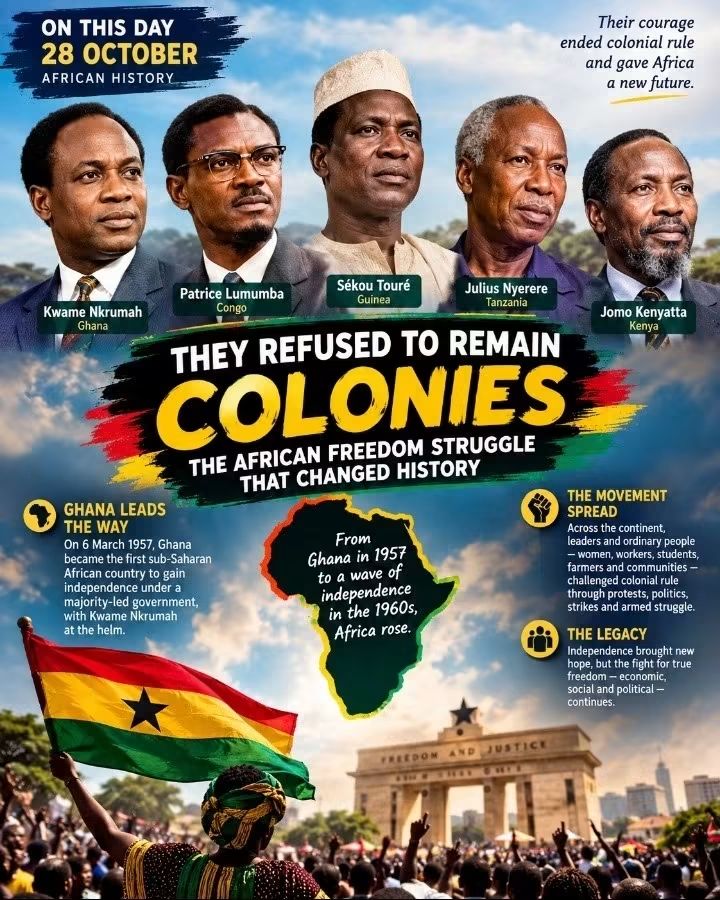
THEY REFUSED TO REMAIN COLONIES: THE AFRICAN FREEDOM STRUGGLE THAT CHANGED HISTORY
🌍 THEY REFUSED TO REMAIN COLONIES: THE AFRICAN FREEDOM STRUGGLE THAT CHANGED HISTORY
ON THIS DAY — 28 OCTOBER | AFRICAN HISTORY
What happens when an entire continent begins to demand freedom from foreign rule? What happens when people who have been denied political power decide that their future must belong to them?
Across Africa, generations of men and women challenged European colonial rule through political movements, mass protests, strikes, intellectual resistance, and armed struggles. Their determination helped transform the continent and reshape world history.
Although 28 October is not a specific anniversary of African independence, it is an opportunity to reflect on the wider struggle that led to the liberation of dozens of African nations.
🌍 GHANA: THE INDEPENDENCE THAT INSPIRED A CONTINENT
On 6 March 1957, the Gold Coast became independent Ghana, making it the first country in sub-Saharan Africa to emerge from colonial rule under a majority-led government in the postwar independence era.
At the centre of this achievement was Kwame Nkrumah, who mobilised mass political support and championed the idea that African peoples should determine their own future.
Ghana’s independence sent a powerful message across the continent: colonial rule was not permanent, and independence was achievable.
Nkrumah also promoted Pan-Africanism, believing that African countries could strengthen their freedom through cooperation and unity.
But Ghana’s achievement was not the work of one man alone. Market women, workers, farmers, students, political organisers, and ordinary citizens all contributed to the independence movement.
🔥 THE STRUGGLE SPREAD ACROSS AFRICA
Ghana’s independence was part of a much larger movement. During the 1950s and 1960s, African nationalism accelerated as colonial powers faced growing demands for self-government.
Here are some of the leaders and movements that helped change the continent:
🇬🇳 Sékou Touré — Guinea
In 1958, Guinea rejected continued membership in France’s proposed French Community arrangement in a referendum and became independent on 2 October 1958. Touré became its first president. Guinea’s decision demonstrated that an African territory could reject a colonial power’s preferred political arrangement, although independence also brought serious economic and diplomatic challenges.
🇨🇩 Patrice Lumumba — Congo
When the Belgian Congo became independent on 30 June 1960, Lumumba became its first prime minister. He spoke against colonial humiliation and demanded genuine national sovereignty. His government was soon engulfed in the Congo Crisis, and Lumumba was assassinated in January 1961. His life and death became enduring symbols of the struggles surrounding independence and foreign influence.
🇰🇪 Jomo Kenyatta and the Kenyan independence movement
Kenya gained independence from Britain on 12 December 1963, following decades of political mobilisation and a violent struggle against colonial rule, including the Mau Mau uprising and Britain’s brutal counterinsurgency campaign. Kenyatta became the country’s first prime minister. Kenya’s path to independence involved mass participation, repression, imprisonment, armed resistance, and difficult political negotiations.
🇩🇿 Ahmed Ben Bella and the Algerian liberation struggle
Algeria’s independence followed a devastating war against French rule that began in 1954. The National Liberation Front (FLN) organised the struggle, while figures including Ahmed Ben Bella became prominent in the movement. After the 1962 independence referendum and the end of French colonial rule, Ben Bella became Algeria’s first president. The war left deep scars and cost many lives.
🇹🇿 Julius Nyerere — Tanganyika
Tanganyika gained independence from Britain on 9 December 1961, with Nyerere playing a central role through the Tanganyika African National Union. He later became the first president of independent Tanganyika and, following the 1964 union with Zanzibar, the first president of Tanzania. His political vision emphasised African unity, self-reliance, and social development.
🇿🇼 Joshua Nkomo and Robert Mugabe — Zimbabwe
Zimbabwe’s road to majority rule took longer than that of many African countries. After a prolonged liberation struggle and negotiations, the country achieved internationally recognised independence in April 1980, following elections in which Mugabe’s party won. Nkomo and other nationalist leaders were also central to the struggle, which involved armed conflict, civilian suffering, and deep political divisions.
✊🏿 INDEPENDENCE WAS A CONTINENT-WIDE MOVEMENT
The freedom struggle was not limited to famous presidents and revolutionary leaders.
Women organised demonstrations, raised funds, sustained political networks, and participated in resistance. Workers used strikes to challenge colonial economies. Students and writers questioned the belief that Europeans had a right to govern African societies. Farmers, veterans, religious leaders, and community organisers helped turn demands for change into mass movements.
Some countries gained independence through negotiations and constitutional change. Others experienced prolonged armed conflict. In several places, independence came with enormous loss of life.
The year 1960 became known as the Year of Africa because 17 African countries gained independence that year. This wave of change weakened the political foundations of European colonialism across the continent.
Yet independence did not automatically end poverty, racial inequality, foreign economic influence, political repression, or conflict. Many new nations inherited borders drawn under colonial rule, economies designed around exporting raw materials, and institutions that were not built to serve independent African populations.
Freedom from colonial government was a historic achievement, but building fair, peaceful, and prosperous societies remained a continuing challenge.
🌍 THE LEGACY THAT STILL MATTERS
The African independence movements changed more than the flags flying over government buildings. They challenged racial hierarchies, strengthened international opposition to colonialism, encouraged liberation movements elsewhere, and helped transform the United Nations as newly independent African countries joined the international community.
Their history reminds us that independence was not simply handed to Africa. It was won through political organisation, sacrifice, negotiation, resistance, and the determination of millions of ordinary people.
The question is not only how African nations became independent. It is also how the aspirations of those freedom fighters can be understood in the present.
💬 LET’S DISCUSS:
Which African independence leader or freedom movement do you believe deserves greater recognition in world history — Kwame Nkrumah, Patrice Lumumba, Sékou Touré, Julius Nyerere, the Algerian liberation movement, the Mau Mau resistance, or someone else?
Tell us who you would choose and why in the comments. Let’s use history to learn from the people who helped change a continent.

