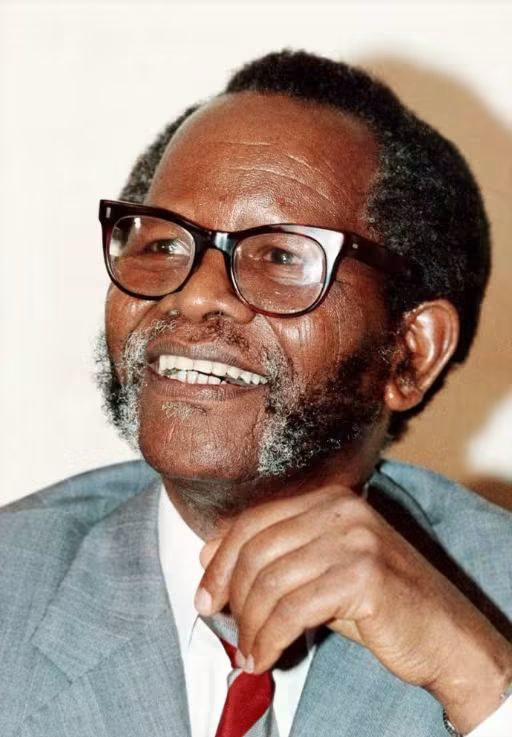
Today would’ve been the 109th birthday of former African National Congress (ANC) president Oliver Reginald Kaizana Tambo.
Today would’ve been the 109th birthday of former African National Congress (ANC) president Oliver Reginald Kaizana Tambo.
Born in Bizana in the village of Nkantolo, eastern Pondoland, he was brought up in a polygamist home. His father Mzimeni Tambo had four wives and ten children. Oliver’s mother Julia was his father’s third wife.
During his childhood years, he attended Anglican and Methodist mission schools, including the prestigious St Peter’s College in Rosettenville, Johannesburg, and enrolled at the University of Fort Hare where he obtained a BSc degree in 1941. While studying for his honours degree, he and several other students including the likes of Nelson Mandela, were expelled for leading a student class boycott in support of a demand to form a democratically elected students’ representative council (SRC). In 1942, he went back to his high school alma mater where he taught science and mathematics.
In 1944, he became one of the founding members of the African National Congress Youth League (ANCYL) and was elected its first secretary. In 1946, he was elected to the Provincial Executive Committee of the ANC in the Transvaal, which was followed by his ascension to the National Executive Committee in 1948, along with Walter Sisulu. Them being part of the NEC boded well for the ANCYL as they tried to agitate the ANC into doing more to challenge the apartheid regime.
In 1952, Tambo and Mandela established the country’s first black law firm. Their firm was known for championing the cause of the disenfranchised, and many came from all over the country to seek their services. In 1953, Tambo became National Secretary of the ANC in place of the banned Sisulu; the following year he took up the Secretary General position. The government banned him but that didn’t prevent his political activities as he was part of the National Action Committee which drafted the Freedom Charter.
Unfortunately, he couldn’t attend the Congress of the People which convened in June 1955 due to his banning restrictions. This is where the Freedom Charter was adopted. In 1956, he was arrested on treason charges and was part of the famous 1956 Treason Trial, he was later acquitted. He got married to Adelaide Tshukudu, a nurse from Top Location in the Vaal Triangle, on 5 December 1956. In 1958, Tambo became Deputy President of the ANC, he was served with a five-year banning order in 1959.
After the 1960 Sharpeville massacre and subsequent state of emergency and the government banning political organisations and jailing its members, the ANC sent Tambo into exile. He first went to London, UK, where and his family settled in Muswell Hill. He joined with Yusuf Dadoo from the South African Indian Congress (SAIC) and representatives of the Pan Africanist Congress (PAC) and the South West Africa National Union (SWANU) to form the South African United Front (SAUF). Their first success was to help force south Africa out of the commonwealth in March 1961. In 1964, he moved from Dar es Salaam, Tanzania to Lusaka, Zambia, where the ANC set up its head office. In 1965, he established a Mkhonto we Sizwe (MK) training camp in Morogoro, Tanzania.
Following the death of ANC President Chief Albert Luthuli in 1967, Tambo was appointed acting President. In 1968, Tambo saw off the Luthuli Detachment as they crossed the Zambezi along with the Zimbabwean People’s Revolutionary Army (ZIPRA) on their Ill-fated Wankie Campaign. At the watershed ANC Consultative Conference in Morogoro in 1969, Tambo tendered his resignation following the reading of the Hani memorandum which criticised the ANC leadership over its failures. Chris Hani and six of the signatories were suspended but were later reinstated. The conference attendees returned a vote of confidence in Tambo and he regained his position as acting president.
During the 1970s, Tambo gained a reputable international image. This helped him form friendships with leaders of newly independent countries and counted on their help in helping the ANC achieve its goals. The frontline states of Angola, Botswana, Lesotho, Mozambique, Tanzania, Zambia and Zimbabwe suffered from consistent attacks from the apartheid regime which sought to keep out communist influence in Southern Africa. The 1976 Soweto Youth Uprisings swelled the ranks of the ANC with the arrival of youngsters eager to take up the cause of liberation. He approached the Tanzanian government for a piece of land to establish a school for exiles. The Solomon Mahlangu Freedom College (SOMAFCO) was founded in Mazimbu, Tanzania.
During the turbulent 1980s, as the resistance to apartheid grew, the ANC in exile experienced mutinies as the young cadres wanted to be deployed back home to fight. Conditions in the camps in Angola were deteriorating, including extra-judicial executions, torture and imprisonment of suspected spies made leading the ANC difficult for Tambo. At the 1985 Consultative Conference in Kabwe, Zambia, heavily guarded by Zambian troops should commandos from South Africa be sent to attack ANC delegates, Tambo appealed to the ANC to consider the seizure of power and the support for a negotiated settlement. These moves were seen as simultaneous elements of the struggle to bring about the demise of apartheid. He was formally elected President of the ANC at this conference. It was also here that the liberation movement allowed membership to all races.
Tambo’s ‘Render South Africa Ungovernable’ speech following the 1985 July State of Emergency. He urged all South Africans to make Apartheid unworkable and the country ungovernable. That same year, he and the ANC met a high-power delegation of the captains of industry from South Africa. The meeting took place in Ndola, on late former Zambian President Kenneth Kaunda’s game farm. They also met with Dr Sam Motsuenyane and the National African Confederation of Commerce in Zamibia. Tambo’s punishing work schedule took a toll on his body and he suffered a severe stroke in 1989. He was rushed to London for treatment. Against his doctor’s orders, he continued working at the same intensity as before.
With the unbanning of political organisations in 1990, and the ongoing negotiations with the apartheid government, Tambo and his family returned to South Africa in December 1990. In 1991, while undergoing medical treatment in Sweden, he suffered another stroke which took his speech. At the ANC’s first conference on home soil since its unbanning, Tambo declined to stand for any position, opening the way for Nelson Mandela to assume the Presidency, deputised by Walter Sisulu.
Despite his ailing health, Tambo continued his work for the ANC. In the early hours of 24 April 1993, Tambo suffered a fatal heart attack. He received a state funeral and is buried in Benoni. He left behind his wife Adelaide (1929-2007) and three children: Nomatemba (Thembi), Daluxolo (Dali) and Tselane. Tambo’s death came just 14 days after the assassination of Chris Hani.
In October 1997, Over-Vaal House, the historic Cape Dutch-style residence located on the Bryntirion Estate in Pretoria, was renamed Oliver Tambo House. Originally used as the official home for the Administrator of the Transvaal Province, it now functions as the official residence for the Deputy President of South Africa. On 27 October 2006, Johannesburg International Airport was renamed Oliver Reginald Tambo International Airport. The Haringey Council renamed their park the O.R. Tambo Recreation Ground. The Tambo’s London home was purchased by the government in 2010 as a historic monument. He and his wife’ graves were declared National Heritage sites in October 2012. The ANC safe house in Lusaka, Zambia was declared a national monument by the Zambian government in 2017 and is open to the public as the Oliver Tambo Heritage House. #OliverTambo #ANC #OnThisDay #birthday

