7 AFRICAN LEADERS WHO CHANGED HISTORY AND BECAME GLOBAL SYMBOLS OF FREEDOM!
🌍 7 AFRICAN LEADERS WHO CHANGED HISTORY AND BECAME GLOBAL SYMBOLS OF FREEDOM!
Before the world celebrated their victories, many of these African leaders faced colonial oppression, imprisonment, political persecution, or assassination. Their struggles helped reshape Africa and inspired freedom movements far beyond the continent.
Africa’s history is filled with extraordinary men and women who challenged colonial rule, fought racial discrimination, and demanded the right of African people to determine their own future.
Some witnessed their countries gain independence. Others died before seeing their dreams fully realized. Yet their names became part of the worldwide story of liberation.
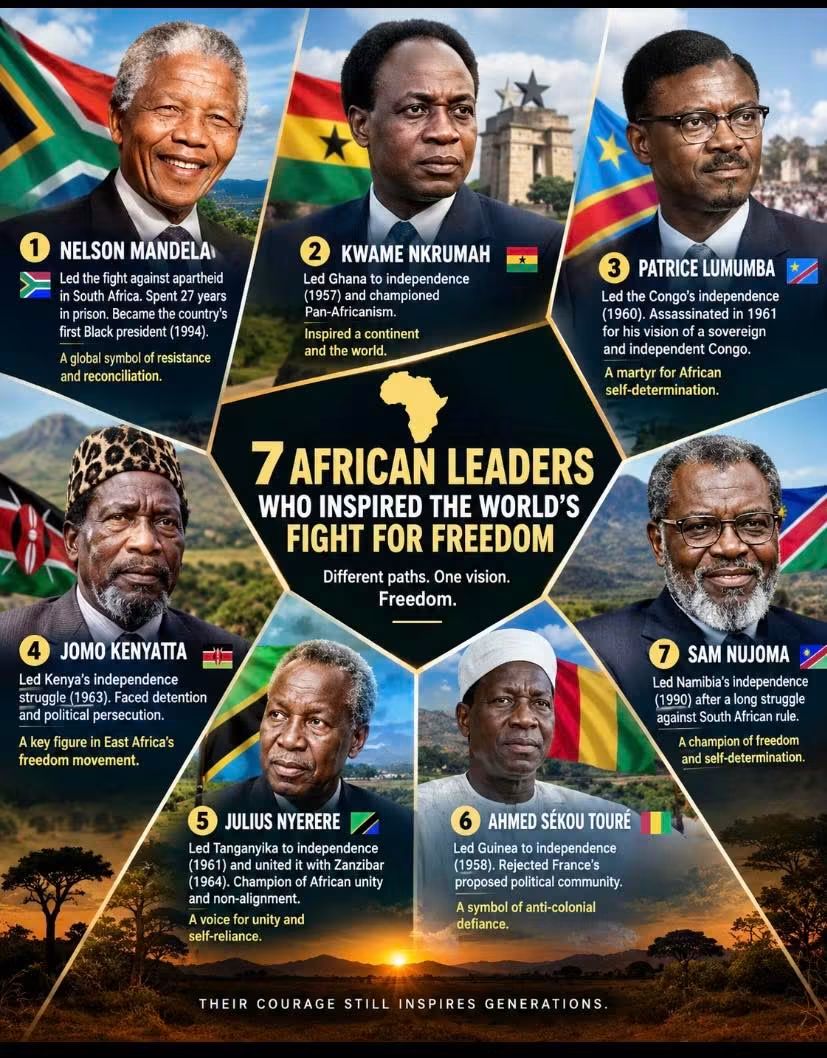
Here are seven African leaders whose struggles left a lasting mark on history. 👇
🇿🇦 1. NELSON MANDELA — THE MAN WHO BECAME A GLOBAL SYMBOL OF FREEDOM
Born on July 18, 1918, Nelson Mandela became one of the most recognizable figures in the struggle against apartheid in South Africa.
Apartheid was a system of institutionalized racial segregation and white minority rule that denied the Black majority equal political rights and imposed severe restrictions on their lives.
Mandela joined the African National Congress (ANC) and became a leading figure in the movement against apartheid. As repression intensified, he also helped establish Umkhonto we Sizwe, the ANC’s armed wing, in 1961.
In 1964, Mandela was sentenced to life imprisonment following the Rivonia Trial. He spent 27 years in prison, much of that time on Robben Island.
His imprisonment transformed him into an international symbol of resistance. Campaigners across the world demanded his release and called for an end to apartheid.
Mandela was released on February 11, 1990. Rather than allowing South Africa’s painful past to prevent negotiations, he worked with other political leaders toward a democratic transition.
In 1993, he shared the Nobel Peace Prize with F. W. de Klerk. In 1994, Mandela became South Africa’s first democratically elected Black president.
His historic achievement was not his alone: millions of South Africans, including activists, workers, students, and other political leaders, had contributed to the struggle.
His legacy: Mandela became a worldwide symbol of resistance to racial oppression, political reconciliation, and democratic freedom.
🇬🇭 2. KWAME NKRUMAH — THE AFRICAN LEADER WHO HELPED INSPIRE A CONTINENT
When Kwame Nkrumah led the Gold Coast to independence from British colonial rule on March 6, 1957, the country became Ghana.
Ghana was the first country in sub-Saharan Africa to gain independence from colonial rule in the postwar era, making its achievement a major inspiration for other African independence movements.
Nkrumah believed that political independence should be followed by economic development and greater African unity.
He became a leading advocate of Pan-Africanism, the idea that African peoples and people of African descent share important historical interests and should cooperate in pursuing freedom, dignity, and development.
In 1963, he played a prominent role in the creation of the Organization of African Unity, the predecessor of today’s African Union.
However, his legacy was complicated. His government became increasingly authoritarian, political opposition was restricted, and he was overthrown in a military coup in 1966 while abroad.
Despite these controversies, his contribution to African independence and Pan-African political thought remains historically significant.
His legacy: Nkrumah helped turn Ghana’s independence into a powerful message that colonial rule was neither permanent nor inevitable. His ideas influenced generations of African nationalists.
🇨🇩 3. PATRICE LUMUMBA — THE CONGOLESE LEADER WHO DIED BEFORE HIS DREAM COULD BE FULFILLED
Patrice Emery Lumumba became one of the most important figures in the Democratic Republic of the Congo’s struggle for independence from Belgium.
The Congo’s colonial experience under Belgian rule had been marked by severe exploitation and coercion. Independence became a defining demand for a new generation of Congolese nationalists.
Lumumba helped lead the country toward independence, which was achieved on June 30, 1960. He became the Congo’s first prime minister.
His independence speech challenged the colonial narrative that portrayed freedom as a gift bestowed by Belgium. Instead, he emphasized the suffering, resistance, and sacrifices of the Congolese people.
But independence did not bring immediate stability.
The country experienced mutiny, secessionist conflict, political rivalry, and foreign intervention during the Congo Crisis.
Lumumba was removed from office, captured by his opponents, and assassinated on January 17, 1961, with the involvement of Congolese adversaries and Belgian actors. The circumstances and international dimensions of his death became a major historical controversy.
His assassination turned him into a symbol of the dangers faced by leaders attempting to assert genuine national sovereignty during the Cold War.
His legacy: Lumumba remains a powerful symbol of Congolese independence and the struggle for African political self-determination.
🇰🇪 4. JOMO KENYATTA — THE LEADER AT THE CENTER OF KENYA’S INDEPENDENCE STRUGGLE
Jomo Kenyatta became a central figure in Kenya’s movement toward independence from British colonial rule.
Colonial land policies had dispossessed many African communities, while political and economic inequalities intensified demands for change.
During the 1950s, Kenya experienced the Mau Mau uprising, an armed revolt against British colonial authority led principally by members of the Kikuyu community, alongside a broader struggle over land and political power.
British authorities detained Kenyatta in 1952 and prosecuted him in a controversial trial, accusing him of directing the Mau Mau movement. He denied the accusation.
He remained detained or restricted for years before returning to active politics.
Kenya achieved independence on December 12, 1963, and became a republic in 1964, with Kenyatta as its first president.
His leadership helped guide the transition from colonial rule to independent government.
However, his legacy is debated. His administration concentrated political power, restricted opposition, and failed to resolve all the inequalities surrounding land ownership.
His legacy: Kenyatta became a major figure in Kenya’s national independence story, although the struggle involved many other political leaders, grassroots activists, and ordinary Kenyans.
🇹🇿 5. JULIUS NYERERE — THE LEADER WHO CHAMPIONED INDEPENDENCE AND AFRICAN UNITY
Julius Nyerere, widely known as Mwalimu, meaning “teacher” in Swahili, became one of Africa’s most influential independence-era leaders.
He led Tanganyika’s movement toward independence from British rule, achieved on December 9, 1961.
Nyerere became prime minister and later president. In 1964, Tanganyika united with Zanzibar to form the United Republic of Tanzania.
He promoted African unity, nonalignment during the Cold War, and a political philosophy known as Ujamaa, which emphasized community, social responsibility, and collective development.
Nyerere also supported liberation movements fighting white minority rule and colonialism in southern Africa. Tanzania became an important base for several African liberation organizations.
However, his domestic record was mixed. Ujamaa policies involved widespread villagization, sometimes carried out coercively, and the country’s economic performance suffered serious difficulties.
His commitment to independence and regional liberation therefore needs to be understood alongside the limitations and consequences of his domestic policies.
His legacy: Nyerere became an influential advocate of African unity, regional cooperation, and liberation from colonial rule.
🇬🇳 6. AHMED SÉKOU TOURÉ — THE LEADER WHO REJECTED FRANCE’S PROPOSED POLITICAL COMMUNITY
Ahmed Sékou Touré led Guinea toward independence from France in 1958.
That year, French President Charles de Gaulle offered France’s overseas territories the opportunity to join a proposed French Community. Guinea, under Touré’s leadership, voted against the proposal and chose immediate independence.
Guinea became independent on October 2, 1958.
The decision was historic because Guinea became the first French sub-Saharan African territory to reject de Gaulle’s proposed arrangement and opt for immediate independence.
The French government withdrew its administration and much of its assistance, creating serious early challenges for the new state.
Touré became an important symbol of anti-colonial defiance to many supporters across Africa.
However, his government later became highly authoritarian. Political opponents faced persecution, and many Guineans fled the country.
His history demonstrates that a leader could challenge colonial domination while also restricting freedoms within an independent state.
His legacy: Touré’s rejection of the French Community became a landmark in the history of African decolonization, even as his later rule remains deeply controversial.
🇳🇦 7. SAM NUJOMA — THE LEADER WHO HELPED BRING NAMIBIA TO INDEPENDENCE
Sam Nujoma became one of the leading figures in Namibia’s long struggle for independence.
Namibia, then known as South West Africa, had been administered by South Africa after the First World War under an international mandate. South Africa continued its control after the United Nations called for an end to its authority.
Nujoma helped establish the South West Africa People’s Organization (SWAPO) in 1960 and became its leading figure.
SWAPO campaigned for independence through international diplomacy and, from 1966, an armed struggle against South African rule.
The conflict continued for decades, shaped by Cold War politics, regional warfare, and international pressure.
Namibia finally achieved independence on March 21, 1990, and Nujoma became its first president.
His achievement was the culmination of a long struggle involving Namibian communities, political organizers, liberation fighters, diplomats, and international supporters.
However, his political legacy, like those of other independence-era leaders, must also be assessed in light of the concentration of political power and the challenges of democratic governance.
His legacy: Nujoma became a central figure in Namibia’s independence movement and the country’s emergence as a sovereign state.
━━━━━━━━━━━━━━━━━━
🌍 WHAT CONNECTS THESE SEVEN AFRICAN LEADERS?
Their histories reveal several important lessons:
✅ 1. Freedom was rarely granted without a struggle. Political organizing, protests, negotiations, international pressure, and—in some cases—armed resistance all played roles in ending colonial rule and apartheid.
✅ 2. African independence changed world history. Ghana’s independence helped inspire other movements, while the struggles in South Africa, Namibia, and the Congo drew international attention to racial oppression and colonial power.
✅ 3. African liberation was a collective achievement. These leaders became famous, but millions of ordinary people—workers, students, women, farmers, activists, and freedom fighters—also made sacrifices that changed history.
✅ 4. Independence and democracy are not the same thing. Several leaders who fought colonial rule later presided over governments that restricted political opposition. Recognizing these contradictions makes history more accurate, not less meaningful.
✅ 5. Their influence crossed national borders. The ideas of Pan-Africanism, self-determination, racial equality, and national sovereignty connected African liberation struggles with movements elsewhere in the world.
🔥 THE BIG QUESTION:
African leaders helped challenge colonial rule and racial oppression, but the meaning of freedom did not end when a flag was raised or a country gained independence.
Freedom also raises questions about justice, political participation, economic opportunity, and the rights of ordinary citizens.
Which of these seven leaders do you think had the greatest influence on the global struggle for freedom—and what historical evidence supports your choice?
Share your thoughts in the comments. Let’s discuss African history with facts, respect, and an open mind.
📚 History is more than remembering famous names. It is understanding the struggles, achievements, contradictions, and sacrifices behind them.

