THE DARK WARNING: WHAT PAN-AFRICAN LEADERS TRIED TO TELL AFRICA BEFORE THEY DIED
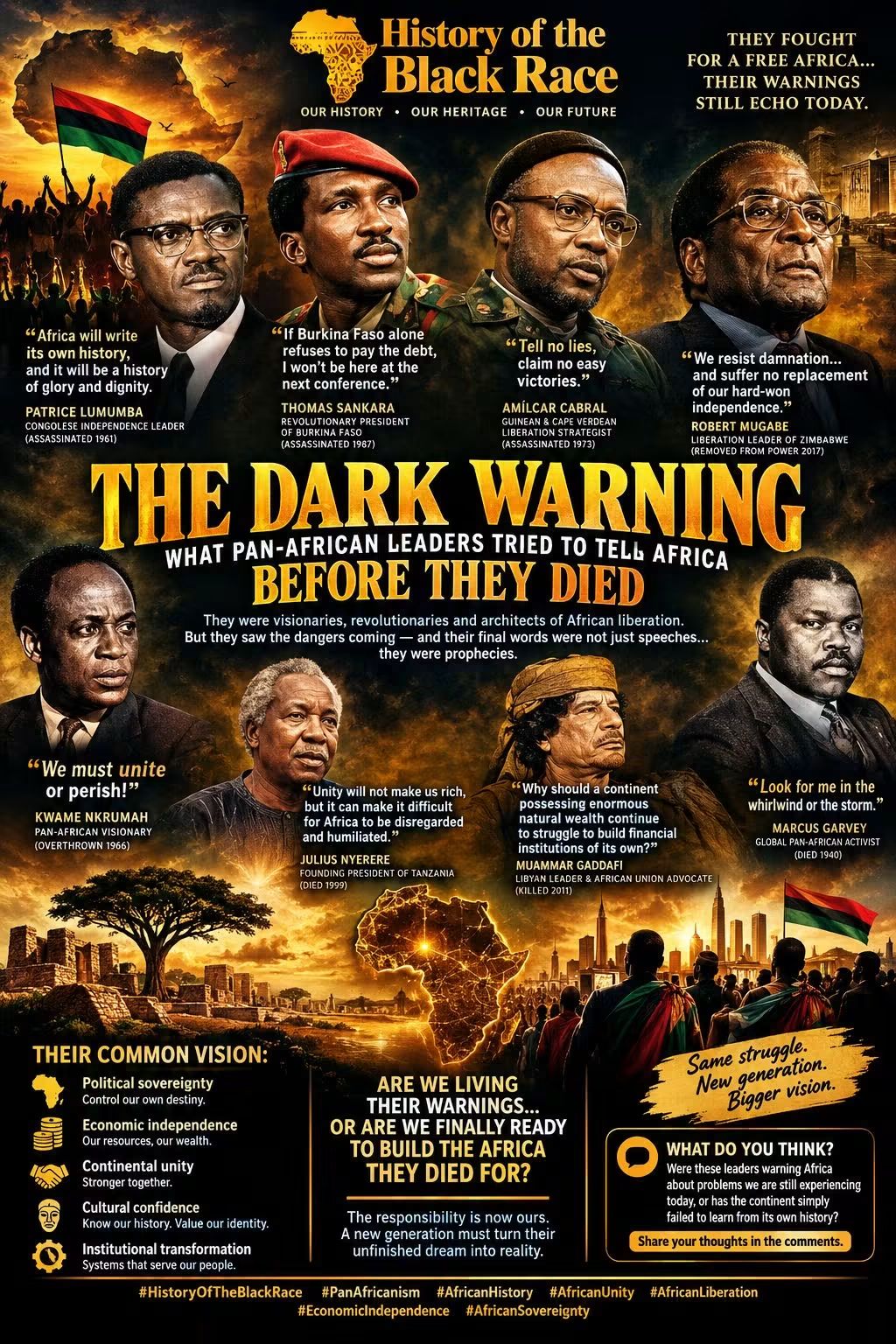
THE DARK WARNING: WHAT PAN-AFRICAN LEADERS TRIED TO TELL AFRICA BEFORE THEY DIED
They were visionaries, revolutionaries, and architects of African liberation. They challenged empires, confronted foreign domination, and dreamed of a continent that would control its own destiny. But many of them died before witnessing the Africa they fought so desperately to build.
What if some of Africa’s greatest leaders had already identified the dangers threatening the continent today?
Before their voices were silenced by assassinations, military coups, political persecution, or forced exile, these leaders left behind powerful messages about African unity, economic independence, foreign interference, and the consequences of allowing the continent to remain divided.
Decades later, their words still raise uncomfortable questions.
Were they simply making political speeches, or were they warning future generations about the dangers Africa would eventually face?
1. Patrice Lumumba: Africa Must Write Its Own History
THE CONGOLESE INDEPENDENCE LEADER
When Patrice Emery Lumumba became the first Prime Minister of an independent Congo in 1960, he represented a new generation of African leaders determined to end colonial domination.
But his vision extended far beyond political independence. He understood that a nation could possess its own flag, national anthem, and government while remaining economically dependent on foreign interests.
His determination to defend Congo’s sovereignty placed him in direct conflict with powerful domestic and international interests.
In January 1961, Lumumba was assassinated after being removed from power and detained.
Before his death, he wrote a remarkable letter to his wife, Pauline, expressing his conviction that Africa would eventually reclaim its dignity.
One of his most memorable statements was:
“Africa will write its own history, and it will be a history of glory and dignity.”
Lumumba’s message remains relevant. Political independence means little if a nation cannot control its natural resources, protect its institutions, and determine its own economic future.
He was killed, but the question he left behind remains unanswered: Who truly controls Africa’s destiny?
2. Thomas Sankara: The Danger of Economic Dependence
THE REVOLUTIONARY PRESIDENT OF BURKINA FASO
Thomas Sankara was among the most uncompromising voices for African self-reliance.
As president of Burkina Faso, he promoted agricultural development, local production, women’s rights, public health, and national dignity.
He believed Africa could not achieve genuine independence while remaining trapped in a system of economic dependence.
At the July 1987 summit of the Organization of African Unity in Addis Ababa, Sankara delivered one of the most memorable speeches in modern African political history.
He challenged African leaders to reconsider the burden of foreign debt, arguing that repayment could undermine the continent’s ability to develop.
He also warned that if African nations continued to face their financial problems individually, they would remain vulnerable to external pressure.
His position was particularly striking because he understood that economic dependence could become another instrument of political control.
On October 15, 1987, less than three months after that historic speech, Sankara was assassinated in a coup.
His death remains one of the most painful chapters in Africa’s revolutionary history.
Today, his central question still confronts the continent: How can Africa become economically independent while depending so heavily on external financing, imported goods, and foreign-controlled economic structures?
3. Amílcar Cabral: Independence Requires More Than a Flag
THE GUINEAN AND CAPE VERDEAN LIBERATION STRATEGIST
Amílcar Cabral understood something that many liberation movements discovered too late: removing colonial rulers does not automatically eliminate colonial structures.
As the leader of the African Party for the Independence of Guinea and Cape Verde (PAIGC), Cabral helped organize one of Africa’s most significant liberation struggles against Portuguese colonial rule.
He believed that independence required political consciousness, cultural confidence, education, organization, and the ability of ordinary people to determine their future.
In his final New Year’s message of 1972–1973, he emphasized discipline and political responsibility.
His famous principle remains one of the most powerful lessons of revolutionary leadership:
“Tell no lies, claim no easy victories.”
Cabral was assassinated on January 20, 1973, before Guinea-Bissau achieved internationally recognized independence in September of that year.
His message carries an important lesson for modern Africa: liberation is not complete simply because foreign flags have disappeared. A nation must also transform the institutions, economic arrangements, and systems of thought inherited from colonial rule.
4. Robert Mugabe: The Struggle for Land and National Sovereignty
THE LIBERATION LEADER OF ZIMBABWE
Robert Mugabe remains one of the most controversial figures in modern African history.
A central figure in Zimbabwe’s liberation struggle, he became the country’s first Prime Minister after independence in 1980 and later served as president for decades.
His political legacy includes the struggle against white-minority rule, the redistribution of land, authoritarian governance, political repression, and severe economic decline.
Yet one subject remained central to much of his political rhetoric: the right of African nations to determine their own affairs without external domination.
At the United Nations General Assembly in September 2017, shortly before his removal from power, Mugabe delivered a speech defending national sovereignty and criticizing what he regarded as the unequal treatment of smaller nations by powerful countries.
His broader warning was that political independence should not become an empty achievement while external powers continue to influence the economic and political direction of African states.
His legacy must be examined honestly, including both his liberation credentials and the consequences of his rule.
But the question of African sovereignty remains important: Can a country be genuinely independent if it cannot determine what happens to its land, resources, and economy?
5. Kwame Nkrumah: Unite or Remain Vulnerable
THE PAN-AFRICAN VISIONARY
Kwame Nkrumah understood that the greatest weakness of Africa was not a lack of resources, intelligence, or potential.
It was division.
As Ghana’s first president, Nkrumah became one of the strongest advocates of continental political unity.
He believed that African nations emerging from colonialism would struggle to defend their sovereignty individually against powerful international interests.
His famous declaration captured his vision:
“We must unite or perish.”
Nkrumah envisioned a united Africa with stronger political institutions, coordinated economic policies, shared infrastructure, and collective bargaining power.
He understood that a continent fragmented into dozens of competing political and economic units would struggle to negotiate with the world’s major powers on equal terms.
His government was overthrown in a military coup in February 1966 while he was abroad.
Nkrumah died in exile in 1972, but his dream of continental unity remains unfinished.
Today, Africa has 55 African Union member states, enormous natural resources, and a combined population of more than a billion people.
Yet trade barriers, political disagreements, weak regional integration, and competing national interests continue to limit the continent’s collective strength.
Was Nkrumah wrong about the importance of unity, or have we simply failed to take his warning seriously?
6. Julius Nyerere: Unity Is Africa’s Protection
THE FOUNDING PRESIDENT OF TANZANIA
Julius Nyerere was another African leader who understood the strategic importance of continental cooperation.
Unlike those who viewed independence as the final destination, Nyerere recognized that African freedom required continuous cooperation.
He once expressed the limitations of individual national strength through a powerful observation:
“Unity will not make us rich, but it can make it difficult for Africa to be disregarded and humiliated.”
His argument was straightforward: Africa might not become wealthy simply by uniting, but a united continent would have a stronger voice in international affairs.
Nyerere supported African liberation movements and played an important role in the development of Pan-African institutions.
His vision reminds us that unity is not merely an emotional slogan. It is a political and economic strategy.
A continent that negotiates collectively has greater opportunities to defend its interests than one whose nations negotiate separately.
7. Muammar Gaddafi: The Unfinished Dream of African Financial Independence
THE LIBYAN LEADER AND AFRICAN UNION ADVOCATE
Muammar Gaddafi remains one of the most debated figures in African political history.
Beyond his rule in Libya, he promoted an ambitious vision of African political and economic integration.
He advocated stronger continental institutions, an African financial system, and greater independence from international financial structures.
His support for the idea of a unified African currency became part of a wider debate about the continent’s financial sovereignty.
However, claims that his death was simply the result of a plot to stop a gold-backed African currency should not be presented as established historical fact. The circumstances surrounding Libya’s 2011 conflict were complex, involving domestic rebellion, international military intervention, and competing geopolitical interests.
Gaddafi was captured and killed in October 2011.
His death marked the end of his political ambitions, but the larger question he raised remains relevant:
Why should a continent possessing enormous natural wealth continue to struggle to build financial institutions capable of serving its own development?
8. Marcus Garvey: The Struggle Must Continue
THE GLOBAL PAN-AFRICAN ACTIVIST
Long before many modern African states achieved independence, Marcus Garvey was already preaching a message of Black dignity, economic empowerment, self-determination, and global African solidarity.
Although he died in London in 1940, his ideas influenced generations of African nationalists and Black liberation movements around the world.
His famous words remain deeply symbolic:
“Look for me in the whirlwind or the storm.”
Garvey believed that the liberation of African people required more than political sympathy. It required organization, economic strength, cultural confidence, and a determination to control their own institutions.
His message was not limited to the African continent. He envisioned a worldwide movement connecting people of African descent through a shared struggle for dignity and empowerment.
His legacy reminds us that the struggle for African liberation did not begin with independence and did not end when colonial flags came down.
THE MISSING PIECE: HAVE WE LEARNED ANYTHING FROM THEIR WARNINGS?
When we examine the messages of these leaders, a common vision emerges.
They came from different countries, generations, and political traditions. Some were revolutionary socialists, others nationalists, and some pursued different approaches to African development.
They did not agree on everything.
But several fundamental concerns connected their visions:
- Political sovereignty: African nations must determine their own political destiny.
- Economic independence: Natural resources should contribute to African development and prosperity.
- Continental unity: African countries must cooperate to strengthen their international position.
- Cultural confidence: African people must recognize the value of their own history, knowledge, and identity.
- Institutional transformation: Independence must produce systems that serve ordinary African people rather than merely replace one ruling class with another.
These were not supernatural prophecies. They were political warnings rooted in their understanding of colonialism, international power, and the weaknesses of fragmented African states.
And perhaps that makes their messages even more important.
They were observing real problems and urging future generations to confront them.
THE QUESTION AFRICA MUST ANSWER
Today, we celebrate these leaders.
We put their faces on posters, print their names on T-shirts, quote their speeches, and describe them as heroes of African liberation.
But how often do we practice the principles they defended?
We speak about African unity while our governments struggle to cooperate.
We celebrate economic independence while importing products we have the resources and knowledge to manufacture.
We praise our natural wealth while many communities living above those resources remain trapped in poverty.
We speak about sovereignty while foreign economic interests continue to play significant roles in our development decisions.
And perhaps the greatest tragedy is that many of the problems these leaders identified remain part of Africa’s political and economic reality.
The responsibility now belongs to a new generation.
Africa does not need another generation that simply worships its past heroes. It needs a generation willing to study their ideas, examine their mistakes, build stronger institutions, develop its industries, protect its resources, and turn the unfinished dream of independence into reality.
Lumumba wanted Africa to write its own history. Nkrumah wanted it united. Sankara wanted it self-reliant. Cabral wanted it intellectually liberated. Nyerere wanted it respected. Their methods differed, but their struggle raised one fundamental question: What does freedom mean if a people cannot control their own destiny?
Perhaps the greatest way to honour these men is not to keep repeating their names, but to complete the work they left unfinished.
AFRICA’S FUTURE MUST NOT BE ANOTHER GENERATION’S UNFINISHED DREAM.
What do you think? Were these leaders warning Africa about problems we are still experiencing today, or has the continent simply failed to learn from its own history?
Share your thoughts in the comment sec


🖤
LikeLiked by 1 person