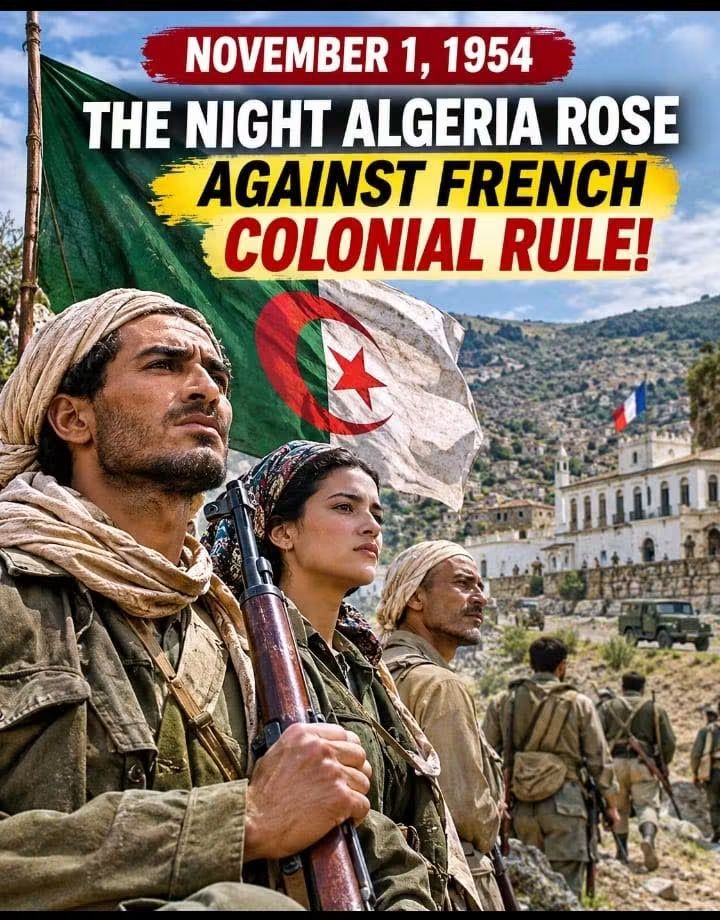
THE NIGHT ALGERIA ROSE AGAINST FRENCH COLONIAL RULE!
THE NIGHT ALGERIA ROSE AGAINST FRENCH COLONIAL RULE! 🇩🇿🔥
November 1, 1954 – The Beginning of the Algerian War of Independence
On November 1, 1954, Algeria entered one of the most important and bloodiest chapters in its struggle for freedom.
In the early hours of that morning, Algerian independence fighters launched coordinated attacks against French colonial installations, military positions, police posts and other targets across different parts of Algeria.
It was the beginning of an eight-year war that would eventually bring an end to more than 130 years of French colonial domination.
But why did Algeria take up arms against France?
THE ROOTS OF THE STRUGGLE
France invaded Algeria in 1830 and gradually established colonial control over the territory.
Over the following decades, French colonial rule transformed Algerian society. European settlers acquired significant political and economic privileges, while the indigenous Algerian population faced land dispossession, political exclusion, discriminatory laws and unequal access to opportunities.
Although Algeria was officially divided into French departments, the majority of its indigenous Muslim population did not enjoy equal political rights with European settlers.
Algerians increasingly demanded political representation, equality and eventually independence.
The brutal repression of Algerian demonstrations in May 1945, particularly the massacres in Sétif, Guelma and Kherrata, deepened the conviction among many nationalists that French colonial rule would not peacefully grant them freedom.
THE NIGHT THE REVOLUTION BEGAN
By 1954, a group of Algerian nationalists had concluded that armed resistance was necessary.
The National Liberation Front (FLN), known in French as Front de Libération Nationale, emerged as the organization leading the revolutionary struggle.
On the night of October 31 into November 1, 1954, FLN fighters launched coordinated attacks in several parts of Algeria, particularly in the Aurès Mountains and Kabylia.
These attacks became known as Toussaint Rouge, meaning “Red All Saints’ Day.”
The FLN also issued a historic proclamation calling for the restoration of an independent Algerian state.
Its objective was clear: to end French colonial domination and establish an independent, sovereign Algeria.
The uprising was initially carried out by a relatively small number of fighters with limited weapons and resources. However, its political significance was enormous.
FRANCE RESPONDED WITH FORCE
The French government refused to accept Algerian independence.
Instead, it deployed additional troops, expanded military operations and attempted to crush the growing rebellion.
The conflict escalated into a brutal war involving guerrilla warfare, bombings, assassinations, military reprisals, mass arrests and widespread human rights abuses.
French forces used torture, forced displacement and collective punishment. The FLN also carried out assassinations and attacks that killed civilians.
Ordinary Algerian families suffered enormously as the conflict spread across the country.
The war eventually became an international issue, attracting attention from African and Asian countries that were also fighting against colonial domination.
EIGHT YEARS OF RESISTANCE
The struggle was not led by one individual. Several important figures emerged, including:
- Ahmed Ben Bella – One of the prominent founders of the FLN and later Algeria’s first president.
- Larbi Ben M’hidi – A revolutionary leader who played a major role in organizing the independence struggle.
- Mostefa Ben Boulaïd – One of the principal organizers of the November 1954 uprising.
- Didouche Mourad – An important revolutionary commander who died fighting in 1955.
- Krim Belkacem – A major independence leader who later signed the Evian Accords on behalf of the Algerian provisional government.
- Djamila Bouhired – A prominent Algerian woman who became internationally known for her participation in the independence struggle.
Women also played important roles as fighters, couriers, nurses, intelligence operatives and organizers.
ALGERIA FINALLY WON ITS INDEPENDENCE
After eight years of devastating conflict, France and the Algerian independence movement reached an agreement.
On March 18, 1962, the Evian Accords were signed, establishing a ceasefire that took effect the following day.
On July 1, 1962, Algerians voted overwhelmingly in favour of independence in a referendum.
On July 5, 1962, Algeria officially proclaimed its independence from France.
More than a century of French colonial rule had finally come to an end.
However, independence came at an enormous human cost. The war left deep scars, displaced communities and transformed both Algeria and France.
WHY NOVEMBER 1 STILL MATTERS
Today, November 1 is commemorated in Algeria as the anniversary of the outbreak of the Revolution.
It represents the beginning of the armed struggle that eventually secured Algerian independence.
The Algerian Revolution also became an important symbol of African liberation, inspiring other movements fighting against colonial domination across the continent.
Algeria’s story reminds us that independence was not simply handed to African nations. In many cases, it was achieved through decades of resistance, sacrifice and struggle.
A QUESTION FOR HISTORY LOVERS:
After 132 years of French colonial rule and eight years of devastating war, Algeria finally became independent in 1962.
But here is the question:
WAS ALGERIA RIGHT TO TAKE UP ARMS AGAINST FRENCH COLONIAL RULE, OR COULD INDEPENDENCE HAVE BEEN ACHIEVED THROUGH PEACEFUL NEGOTIATIONS?
🇩🇿 NEVER FORGET THE STRUGGLE FOR ALGERIAN INDEPENDENCE!

