THE WHISTLE-BLOWER
THE WHISTLE-BLOWER
(Fourteenth edition – 19 April 2026)
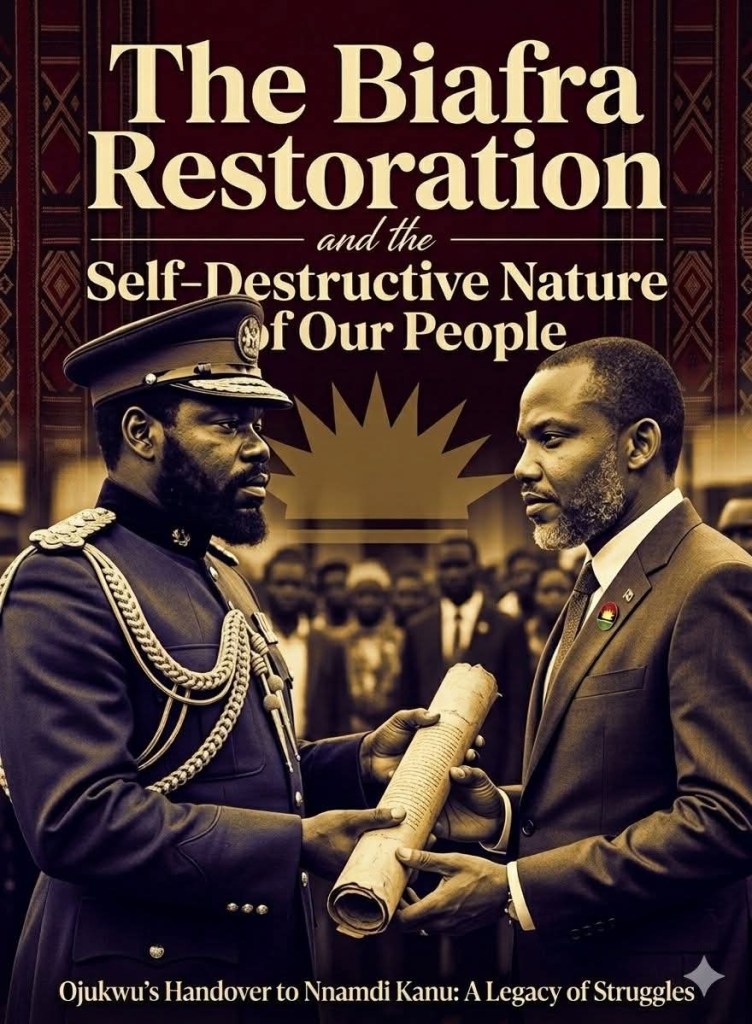
The Biafra Restoration and the Self-Destructive Nature of Our People.
Dearest gentle reader.
A servant can never be greater than his master, a house that rises against itself cannot stand, and you cannot reap where you did not sow. These eternal truths serve as a somber mirror for the journey of a people marked by unparalleled industry and resilience, yet frequently undone by internal fractures.
The quest for Biafran restoration is not merely a political or territorial struggle; it is a battle against a recurring historical ghost, the tendency toward self-sabotage.
The Echoes of Betrayal: From Ojukwu to Kanu
History has a haunting way of repeating itself when its lessons are ignored. During the Biafran Civil War, the visionary leadership of Dim Chukwuemeka Odumegwu Ojukwu was not only challenged by external forces but was eroded by internal treachery. At the height of the struggle, when unity was the only currency for survival, there were those within who traded intelligence for favor and safety for subversion. The betrayal Ojukwu faced from “our own” created cracks in the foundation of the rising sun, turning a collective dream into a tragic memory.
Today, we see the same script being performed by different actors. The Directorate of State (DOS) and segments of the movement now find themselves at a crossroads where ego and power struggles often overshadow the primary objective. We witness gullible members being led astray by rhetoric that favors factionalism over the freedom of Mazi Nnamdi Kanu. When a movement begins to eat its own, it signals to the world that it is not yet ready for the responsibility of nationhood. You cannot restore a nation with the same hands that are busy pulling down its champions.
The Three Cardinal Diseases
To understand why the dream of Biafra remains elusive, we must look inward at the cultural and psychological “diseases” that have plagued the collective Igbo spirit. These are not flaws of intellect, but flaws of character:
- Greed: The “nwa boy” mentality, once a tool for economic empowerment, has in many cases mutated into an insatiable hunger for immediate gain. When individuals prioritize personal enrichment over the collective survival of the people, the cause becomes a commodity to be sold to the highest bidder.
- Jealousy: There is a toxic resistance to the rise of a singular leader. The democratic “Igbo Enwe Eze” (The Igbo have no king) philosophy is a prideful heritage, but when misapplied, it manifests as a refusal to follow anyone who dares to lead. If one person climbs, others reach out not to assist, but to pull them back to the level of the rest.
- Envy:The success of a brother is often viewed as a personal slight. This envy fuels the “saboteur” culture, where individuals would rather see the entire house burn down than see a neighbor take the seat of honor.
To deepen the analysis of the Biafran restoration, we must examine the intersection of historical precedents and the psychological barriers that continue to stall the movement. The struggle is as much a spiritual and cultural reckoning as it is a political one.
The Structural Sabotage: A Historical Pattern
The betrayal of Ojukwu was not merely a series of isolated incidents; it was a systemic failure. During the Civil War, the “Saboteur” or Sabo phenomenon became a defining trauma. Men who were entrusted with the defense of sectors or the procurement of essential resources often prioritized personal survival or post-war relevance over the immediate survival of the Republic.
In the contemporary context, the friction within the Directorate of State (DOS) and the fracturing of loyalty toward Mazi Nnamdi Kanu reflect a lack of institutional discipline. When a movement is driven by “gullible members” those who prioritize emotional outbursts and social media rhetoric over strategic silence and unity it becomes easy for external adversaries to plant seeds of discord. A movement that cannot protect its internal hierarchy from gossip and ego-driven infighting is a movement that provides its enemies with the blueprints for its own house.
The Anatomy of the Three Cardinal Diseases.
To understand why Biafra remains elusive, we must perform a sociological autopsy on the three traits you identified:
- Greed The Monetization of the Struggle In modern times, the struggle has become, for some, a lucrative industry. Greed manifests when individuals use the plight of the people to solicit funds that never reach the grassroots. When “freedom” becomes a business model, those profiting from the process have no incentive to reach the finish line. As the saying goes, “you cannot reap where you did not sow,” yet many seek to harvest the prestige of leadership without sowing the seeds of sacrifice.
- Jealousy The ‘Crabs in a Bucket’ Syndrome. This is the refusal to let a singular vision lead. In the Igbo political DNA, there is a fierce egalitarianism that is beautiful in peace but deadly in war. Jealousy arises when one person like Kanu gains global prominence. Instead of rallying behind the spearhead, others spend their energy trying to blunt the tip of the spear so they can feel equally sharp. This internal competition ensures that no single voice is ever loud enough to command international diplomacy.
- Envy. The Destruction of the ‘Other’. Envy goes a step beyond jealousy; it is the desire to see a brother lose even if it doesn’t help you win. It is the root of the “informant” culture. If a certain faction cannot lead the restoration, their envy drives them to ensure the other faction fails, even if that failure results in collective bondage for all.
The Verdict: The Price of Change
The “self-destructive nature” you highlight is essentially a crisis of Collective Trust. The Biafran sun cannot rise over a people who are still hiding daggers behind their backs while they salute the flag.
If there is no shift from individualism to communalism, the attitudes of the past will continue to haunt the future. Restoration requires a “clean heart” a departure from the greed that sells brothers for silver, the jealousy that hates leadership, and the envy that sabotages progress. Until the house stops rising against itself, it remains vulnerable to every wind that blows.
The Path to the Rising Sun
Biafra will remain a distant mirage if the spirit of the people does not undergo a radical transformation. A nation is not just a boundary on a map; it is a covenant of trust between people.
If we do not cure ourselves of the greed that sells secrets, the jealousy that divides our ranks, and the envy that hates progress, we will continue to wander in a self-imposed wilderness. The restoration of Biafra begins not with a declaration, but with a reformation of the heart. Until we learn to stand as one house, we will continue to be masters of our own destruction.