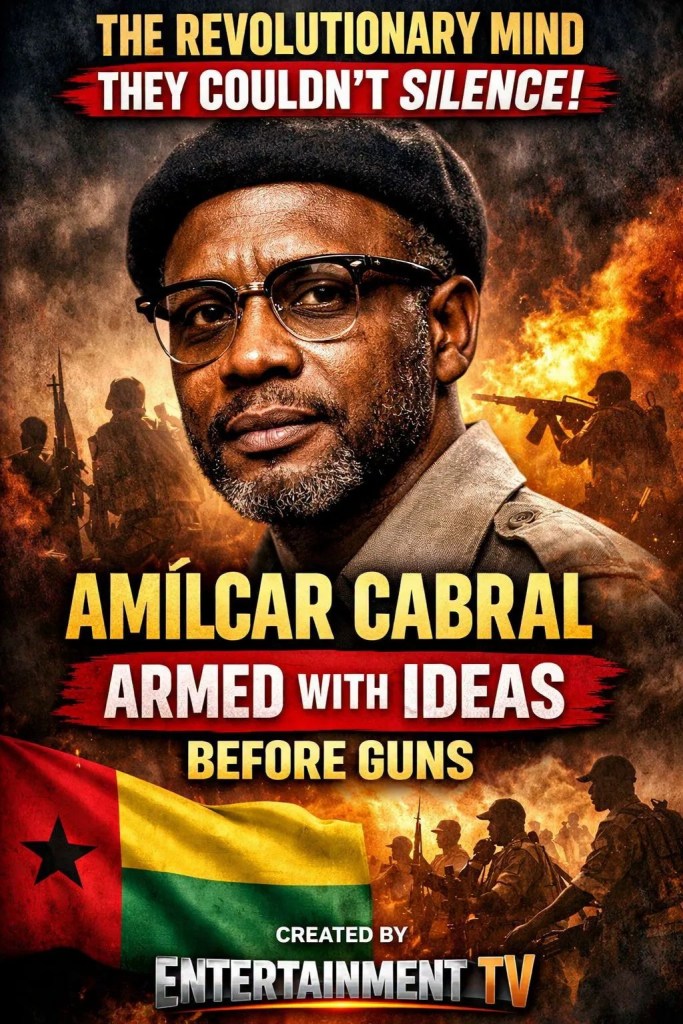
THE MAN WHO ARMED A NATION WITH IDEAS BEFORE GUNS — WHO WAS Amílcar Cabral?
🔥 THE MAN WHO ARMED A NATION WITH IDEAS BEFORE GUNS — WHO WAS Amílcar Cabral? 🇬🇼🇨🇻
Most revolutions begin with weapons.
His began with knowledge, discipline, and truth.
This is a verified, professional overview of one of Africa’s most influential revolutionary thinkers and the leading figure in the struggle for the independence of Guinea-Bissau and Cape Verde.
🌍 EARLY LIFE & FAMILY BACKGROUND
Amílcar Cabral was born on September 12, 1924, in Bafatá, then a Portuguese colony.
Father: Juvenal António Lopes da Costa Cabral — Cape Verdean schoolteacher
Mother: Iva Pinhel Évora — Cape Verdean
His upbringing connected him to both Guinea-Bissau 🇬🇼 and Cape Verde 🇨🇻, shaping a dual cultural identity.
During his early years, he witnessed:
Severe drought and famine
Widespread poverty
Systemic colonial neglect
These experiences profoundly influenced his political awareness and lifelong commitment to justice.
🎓 EDUCATION & INTELLECTUAL DEVELOPMENT
Cabral studied agronomy at the Instituto Superior de Agronomia in Lisbon, Portugal.
While in Lisbon, he became part of a circle of African intellectuals and future leaders, including:
Agostinho Neto
Eduardo Mondlane
This environment played a critical role in shaping his anti-colonial ideology and strategic thinking.
🌾 AGRONOMY & SOCIAL INSIGHT
After completing his studies, Cabral returned to Guinea-Bissau and worked as an agronomist.
He conducted an extensive agricultural survey that:
Took him across rural communities
Enabled direct engagement with local populations
Exposed the economic structures underpinning colonial exploitation
This experience gave him a rare combination of technical expertise and grassroots understanding, which later informed his revolutionary strategy.
✊🏾 FORMATION OF THE PAIGC
In 1956, Cabral co-founded the African Party for the Independence of Guinea and Cape Verde (PAIGC).
Initially committed to peaceful political action, the movement shifted direction after the Pidjiguiti Massacre, where Portuguese forces killed striking dockworkers.
This event marked a turning point, leading to the adoption of armed resistance.
🔫 THE LIBERATION STRUGGLE
By the early 1960s, Cabral had organized one of Africa’s most effective liberation movements against Portuguese rule.
Key elements of his leadership included:
Building disciplined and structured guerrilla forces
Establishing “liberated zones” with functioning:
Educational systems
Healthcare services
Administrative structures
Promoting political education among fighters
Enforcing strict respect for civilian populations
His approach combined military strategy with nation-building, setting a unique standard for liberation movements.
🌍 INTERNATIONAL ENGAGEMENT
Cabral played a significant diplomatic role in securing global support.
He engaged with:
African governments
Socialist states
International anti-colonial networks
He also presented the case for independence at international platforms, including the United Nations, helping to globalize the struggle.
🧠 POLITICAL PHILOSOPHY
Cabral is widely regarded as a major political thinker. His core ideas include:
Culture as Resistance: National identity is central to liberation
Substance Over Symbolism: Independence must deliver real social and economic change
Accountable Leadership: Post-independence leaders must not replicate colonial systems
He emphasized integrity and transparency, stating:
“Hide nothing from the masses. Tell no lies. Expose lies whenever they are told.”
❤️ PERSONAL LIFE
Cabral maintained a relatively private personal life.
He was married (commonly associated with Ana Maria Cabral)
He had children
He was known for discipline, humility, and intellectual rigor
💔 ASSASSINATION
On January 20, 1973, Cabral was assassinated in Conakry, Guinea.
The attack was carried out by individuals within his own movement
It is widely believed that Portuguese colonial intelligence had involvement
His d@ath occurred shortly before the realization of the independence he fought for.
🕊️ INDEPENDENCE & LEGACY
Guinea-Bissau declared independence in 1973, which was officially recognized in 1974 following political change in Portugal.
Today, Amílcar Cabral is remembered as:
One of Africa’s most influential revolutionary thinkers
A leader who combined intellectual depth with practical execution
A symbol of disciplined, ethical leadership
His legacy continues to influence:
Political theory
Anti-colonial studies
African history and identity
📌 DISCLAIMER
This content is provided strictly for educational and historical purposes. Readers are encouraged to conduct further independent research for deeper understanding. The aim is to promote awareness of African history and its influential figures.
AfricanHi