
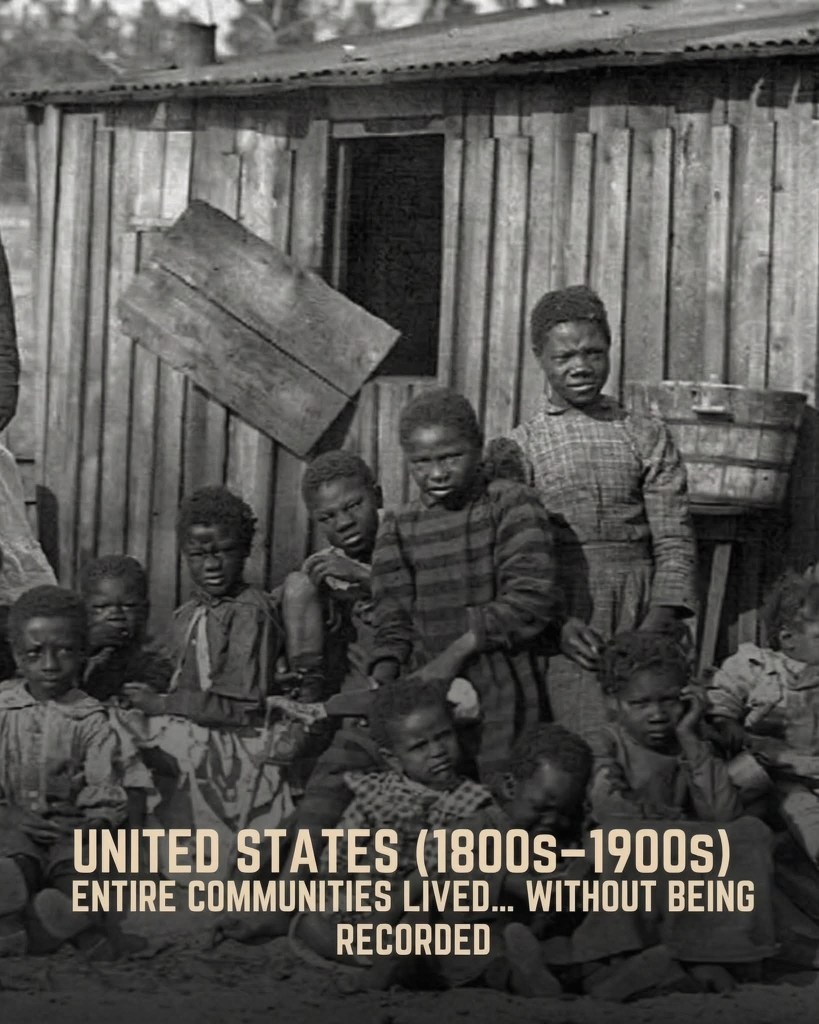
Long before our stories were called hidden history, Black communities were already living full lives that official records barely paused to notice.
Long before our stories were called hidden history, Black communities were already living full lives that official records barely paused to notice.
The silence did not begin because Black life lacked meaning. It began because the nation was far more committed to recording power than it was to recording Black people in all their fullness.
That is why so much of this history reaches us in pieces. A surname in fading ink, a church on an old road, a family photograph with no names on the back, and a cemetery plot that outlasted the memory of the hands that once tended it.
After emancipation in 1865, formerly enslaved Black men and women moved into freedom carrying far more than survival. They carried trade skills, kinship ties, spiritual traditions, agricultural knowledge, political hope, and a determination to build lives that slavery had tried to deny.
Across the South and beyond, Black communities formed in city blocks, farming settlements, church grounds, and newly claimed neighborhoods. People created institutions that could hold a people together when the wider nation offered little protection and even less fairness.
Churches were not just places of worship. They were meeting houses, schools, mutual aid centers, political classrooms, and sacred proof that Black people were making a world in the middle of hostility.
Schools mattered for the same reason. To teach a child to read in those years was not a small domestic act, but part of a much larger struggle over who would have the right to knowledge, memory, and self-definition.
Families built businesses where they could. They farmed, sewed, preached, taught, barbered, cooked, hauled goods, cared for children, and found ways to make community life stand upright under pressure.
Yet the archive was never neutral. Records were shaped by who held authority, who counted as important, who had access to clerks and newspapers, and whose losses were considered worth preserving.
For Black Americans in the late nineteenth and early twentieth centuries, documentation was often partial from the start. The National Archives notes that federal census records exist for African Americans, but records before and after emancipation can be limited, uneven, or shaped by systems that treated Black people as property, categories, or statistical objects before they were treated as full persons in the record.
Even when names appeared, names alone did not tell the story. A census line could confirm that somebody existed, but not reveal what they dreamed, what they survived, how they loved, or what they built with neighbors once the enumerator moved on.
Some records were never created in the first place. Others were misheard, misspelled, destroyed, scattered, or buried in local files that did not center Black life as history worth keeping.
That is why so many descendants inherit fragments instead of full narratives. They find evidence of presence without the richness of personality, labor, humor, sorrow, conflict, faith, and joy that made those lives complete.
And still, fragment does not mean emptiness. A broken record is not proof of a broken people.
Black communities did not wait for perfect documentation to become real. They were real in the sound of Sunday shoes on wooden floors, in fields worked by free hands after centuries of theft, in women organizing households and institutions at once, and in children learning letters their grandparents had once been forbidden to claim.
What official history often minimized was the ordinary greatness of everyday Black life. Not every ancestor entered the record through a famous speech, a court case, or a moment of public crisis, but their lives still shaped the country that formed around them.
A great deal of American history rests on labor that was never properly credited and on communities that were seen most clearly when others wanted something from them. When there was no immediate use for Black humanity in the official story, the details were too often allowed to drift away.
That drifting is one of the deepest losses. When a people are repeatedly remembered through catastrophe but not through daily life, future generations can begin to inherit trauma more easily than inheritance.
But our history has never lived only in government files. It has survived in Bibles, funeral programs, land disputes, church anniversaries, oral history, school photographs, family reunions, and the names elders kept repeating so they would not disappear.
The Freedmen’s Bureau records matter in part because they preserved marriages, labor contracts, and other details for newly freed African Americans at a moment when formal recognition carried enormous weight. Those records are precious not because they tell everything, but because they show how much had to be fought for simply to be written down.
That struggle over the record is also a struggle over dignity. To be documented fully is not the same as being free, but to be erased or flattened in the archive is another form of dispossession.
So when we ask how many Black lives shaped this country without acknowledgment, the answer is almost certainly more than the nation has been willing to face. Entire communities helped build America while remaining footnotes, curiosities, or absences in the histories that later generations were taught.
That is why this story is not only about the past. It is about what it means, even now, to recover people from silence without pretending silence means they were small.
They were never invisible. They were made harder to see by a culture that too often treated Black endurance as background and Black achievement as incidental.
Still, what was not fully recorded was not fully lost. It lives wherever descendants keep searching, wherever archives are reopened, wherever old photographs are studied with care, and wherever someone refuses to believe that a missing file means a missing life.
Our task is not just to remember famous moments. It is to honor the unnamed builders, the misfiled families, the communities left outside the frame, and the generations whose full stories were worthy even when the record failed them.
Black history does not end where the textbook grows quiet. There are still lives waiting to be pieced back together, still communities waiting to be spoken of with the dignity they earned, and still lessons waiting for us in the spaces where the official record fell short.
I invest a lot of time researching and sharing these important stories. If you’d like to support the work behind them, here’s the link:
 Hi welcome to my website