
Colonial Rule in Africa (Late 1800s–1940s)
Colonial Rule in Africa (Late 1800s–1940s)
Imagine waking up one morning and discovering that strangers from another continent had arrived to redraw your land, control your people, take your resources, and decide your future without ever asking for your permission.
That was the reality for Africa during the age of colonialism.
Before Europeans conquered Africa in the late 1800s, the continent was not empty, uncivilized, or lost. Africa was home to powerful kingdoms, trading empires, ancient cultures, and organized political systems. Empires such as the Mali Empire, Songhai Empire, and kingdoms like the Kingdom of Benin had long histories of governance, trade, military power, art, and education. Cities such as Timbuktu were already centers of learning while parts of Europe were still struggling through the Middle Ages.
But by the late 19th century, Europe had changed dramatically.
The Industrial Revolution transformed European economies. Factories needed raw materials — rubber for machines, cotton for textiles, palm oil for industries, gold and diamonds for wealth and expansion. European countries became hungry for power, resources, and global dominance. Africa became the target.
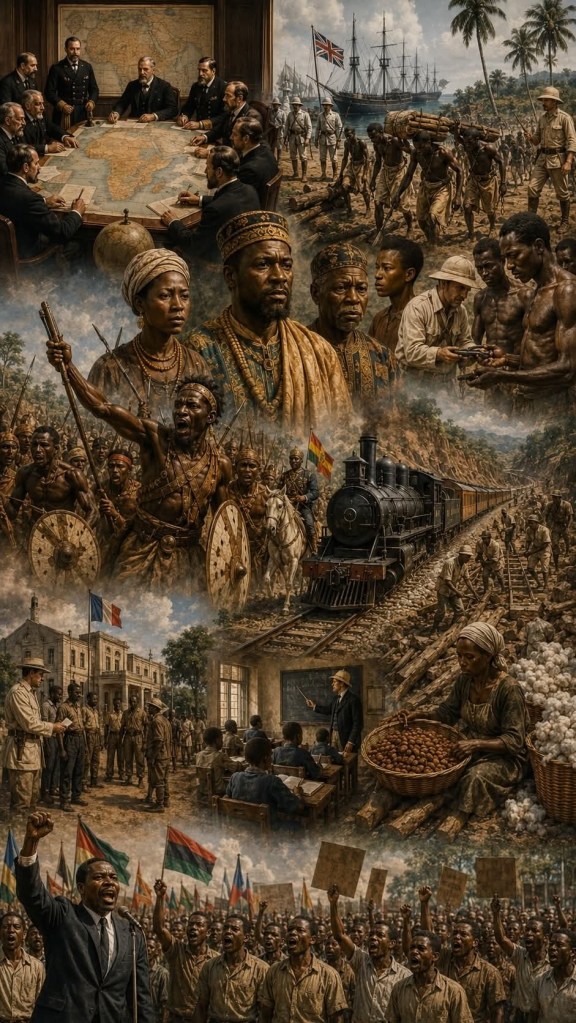
Then came one of the most shocking moments in world history: the Berlin Conference of 1884–1885.
European leaders gathered in Berlin to divide Africa among themselves like property. Not a single African leader was invited. Imagine foreigners sitting around a table, drawing borders across your homeland with pens and rulers, ignoring your tribes, languages, cultures, and histories.
To them, Africa was not a home to millions of people.
It was a prize.
The British took territories from Egypt to Nigeria to South Africa.
The French occupied vast areas of West and Central Africa.
Belgium, under King Leopold II, seized the Congo.
Germany, Portugal, Italy, and Spain claimed their own portions too.
By 1914, nearly the entire continent had fallen under European control except Ethiopia and Liberia.
And colonialism was not simply about flags or maps.
It was about control.
The Europeans introduced systems designed to benefit Europe first, not Africans.
Africans were forced to grow cash crops instead of food for their families.
Farmers who once cultivated diverse local crops now had to produce cocoa, cotton, coffee, or rubber for export to Europe. Entire economies were redesigned around European needs.
In places like the Congo, colonial brutality reached horrifying levels. Under Leopold’s rule, millions of Congolese people suffered forced labor, torture, amputations, starvation, and death in the rubber trade. Villages were burned. Families were destroyed. Human beings became tools for profit.
Colonial governments imposed taxes on Africans — taxes payable only in European currency. This forced many Africans into labor mines, plantations, and rail construction projects under terrible conditions.
And then there was the psychological impact.
Colonialism attacked African identity itself.
Europeans often portrayed African cultures as inferior. African languages, religions, traditions, and political systems were suppressed or mocked. Colonial schools taught many Africans that European civilization was superior while African traditions were backward. Over time, this created deep cultural wounds and identity struggles that lasted long after independence.
Yet, despite oppression, Africans resisted.
Resistance happened in many forms — military battles, protests, spiritual movements, and political organization.
In East Africa, the Maji Maji Rebellion united different ethnic groups against German rule.
In West Africa, Samori Touré fought fiercely against French expansion.
And in one of the greatest moments of African resistance, Ethiopia defeated Italy at the Battle of Adwa. That victory shocked the world because an African nation had defeated a European colonial army during the height of imperialism.
Still, European military technology — machine guns, rifles, and organized armies — gave colonial powers enormous advantages.
Colonialism also created borders that ignored African realities.
Ethnic groups that had lived separately for centuries were suddenly forced into one colony.
Meanwhile, some ethnic communities were split across several countries.
These artificial borders later contributed to political instability, ethnic tension, and civil wars after independence.
Even the infrastructure built during colonialism served European interests first.
Railways did not connect African communities to each other for development.
They connected mines to ports.
Roads were designed to transport raw materials to Europe.
Colonial economies were structured to extract wealth outward, not build prosperity inward.
Then came the two World Wars.
Thousands of Africans fought for European powers during World War I and World War II. African soldiers saw the hypocrisy clearly: Europeans spoke about freedom and democracy while denying Africans basic rights in their own lands.
After World War II, African nationalism exploded.
Educated Africans, workers, students, and returning soldiers began demanding independence.
Leaders such as Kwame Nkrumah, Jomo Kenyatta, and Patrice Lumumba inspired movements across the continent.
The colonial system that once looked invincible slowly began to collapse.
But the effects of colonialism did not disappear when flags changed.
Many African nations inherited weak economies dependent on raw material exports.
They inherited borders they did not design.
They inherited political systems shaped for control rather than democracy.
And they inherited social divisions that colonial powers had often deepened intentionally.
Even today, when we discuss poverty, corruption, ethnic conflict, language divisions, or economic dependency in parts of Africa, the shadow of colonialism is still present.
Colonialism was not just a period of foreign rule.
It was a system that transformed Africa’s politics, economies, cultures, and future.
Yet despite everything exploitation, violence, and oppression Africa survived.
Its people resisted.
Its cultures endured.
And its nations eventually rose to reclaim their independence.
That resilience remains one of the greatest stories in human history.
 Hi welcome to my website
Very nice.
LikeLiked by 1 person