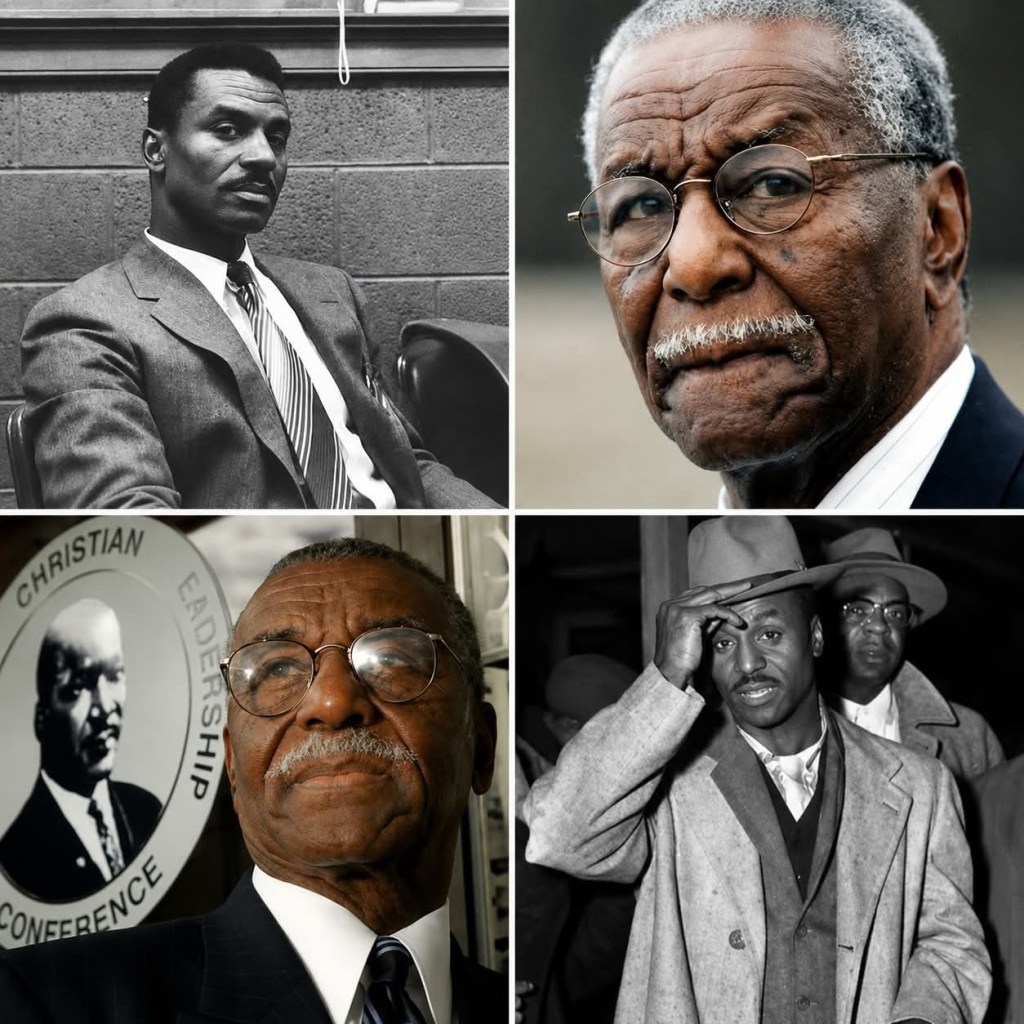
On Christmas night in 1956,
On Christmas night in 1956, the KKK blew up his house with 16 sticks of dynamite while his family was inside. He walked out of the rubble without a scratch, told a Klan-affiliated cop he wasn’t leaving town, and led a protest the next morning.
That sentence sounds like legend, but Fred Shuttlesworth lived it in flesh, blood, dust, and broken timber.
The explosion tore through the Bethel Baptist parsonage in Birmingham, Alabama, where Shuttlesworth lived beside the church he pastored. His family was inside, along with others, when the blast destroyed the home and damaged the church next door.
It was Christmas night, the kind of night when children should have been safe, when a home should have felt like shelter, when Black families should not have had to wonder whether courage would cost them their roof.
But Birmingham in 1956 was not interested in giving Black people peace.
The bomb was not random. It came after Shuttlesworth and the Alabama Christian Movement for Human Rights prepared to challenge segregation on Birmingham buses, following the Supreme Court’s ruling against segregated buses in Montgomery.
That is what made the attack so chilling.
The men behind it were not simply trying to destroy a house. They were trying to kill a movement before it could stand up in public.
They knew that Shuttlesworth was not a quiet preacher. They knew he was organizing Black citizens, filing lawsuits, calling mass meetings, and teaching people that faith did not require them to bow down to Jim Crow.
So they came for the place where his children slept.
The blast was powerful enough to wreck the house, yet Shuttlesworth survived without serious injury. The Equal Justice Initiative records that no one inside suffered serious injury, even though sixteen sticks of dynamite had been used in the attack.
For a man of faith, that survival carried meaning.
For Black Birmingham, it carried another kind of message too.
If they could bomb his house and still not make him leave, then maybe the fear that had ruled the city was not as permanent as it looked.
A police officer reportedly told Shuttlesworth he should get out of town. The story is remembered with the added weight that the officer was tied to the same racist forces that wanted him gone.
But Shuttlesworth did not treat survival like a warning to run.
He treated it like a command to continue.
He made it clear he was staying in Birmingham, and by the next morning, he was back in the fight. Several hundred protesters challenged segregated seating on Birmingham buses the day after the bombing, and the action led to arrests.
That is the part we have to sit with.
Not just the dynamite. Not just the miracle of walking out alive. Not just the courage of speaking back to danger.
The next morning.
That is where the fullness of Fred Shuttlesworth’s character reveals itself.
Anybody can sound brave after the story is over. Shuttlesworth had to decide what courage meant while the smell of the explosion still hung in the air.
He had to look at the remains of his home and choose whether the next chapter would be fear or forward movement.
He chose forward.
Birmingham was one of the hardest places in America to make that choice.
The city was known for violent resistance to Black equality, and Bethel Baptist Church became a repeated target because of its connection to Shuttlesworth and the local freedom movement. The U.S. Civil Rights Trail notes that Bethel served as headquarters for the Alabama Christian Movement for Human Rights and that segregationists targeted the church multiple times.
This was not a city where Black resistance could hide behind symbolism.
Every meeting had consequences. Every march had consequences. Every public demand told white Birmingham that Black citizens were no longer asking permission to be human.
And Shuttlesworth was often the man standing closest to the consequence.
He had become pastor of Bethel Baptist Church in 1953, and from that pulpit he helped turn a church into a command center for justice. The sermons mattered, but so did the planning, the lawsuits, the carpools, the courage-building, and the discipline it took to keep people moving under threat.
That is something our people understand deeply.
The Black church was never only a Sunday place.
It was a schoolhouse when doors were closed, a courthouse when justice was denied, a community center when the city turned its back, and a war room when freedom required strategy.
Shuttlesworth stood in that tradition.
He was not asking Black people to be reckless. He was asking them to stop mistaking fear for wisdom.
Before the bombing, Alabama had already tried to shut down organized Black resistance by banning the NAACP from operating in the state. Shuttlesworth helped create the Alabama Christian Movement for Human Rights in 1956 so the work could continue under another name.
That detail matters.
When the state tried to close one door, he helped build another.
That is one of the oldest patterns in Black history.
When they denied us schools, we built classrooms in churches and homes.
When they locked us out of political power, we organized voter drives.
When they tried to scare us into silence, we sang, marched, sued, prayed, and returned the next day.
Fred Shuttlesworth belonged to that lineage of people who understood that survival alone was not enough.
He wanted transformation.
He wanted buses where Black riders did not have to move to the back.
He wanted schools where Black children did not have to inherit humiliation.
He wanted public spaces where citizenship did not change color at the doorway.
That dream did not make him safe.
In September 1957, Shuttlesworth tried to enroll his daughters at Phillips High School in Birmingham. He was attacked with bicycle chains and brass knuckles by a white mob while trying to integrate the school.
His wife, Ruby, was also injured during that violent attack, and their daughter Ruby Fredricka suffered a fractured ankle, according to civil rights accounts.
Think about the weight of that moment.
A father took his daughters to school.
That should have been ordinary.
A mother stood with her family.
That should have been protected.
A child tried to walk toward education.
That should have been welcomed.
Instead, Birmingham answered with chains, fists, brass knuckles, and blood.
This is why the story of Shuttlesworth cannot be reduced to a few dramatic facts.
The miracle is not only that he survived a bombing.
The miracle is that he survived repeated attempts to break his spirit and still refused to teach his children bitterness as their inheritance.
He knew anger. He had every right to it.
But he also understood that the movement needed discipline, because one reckless act from the oppressed would be used to excuse generations of cruelty from the oppressor.
That is what made nonviolence so demanding.
It was not passive.
It was not weak.
It was a decision to stand in front of violence without letting violence own the meaning of the moment.
By 1957, Shuttlesworth had helped found the Southern Christian Leadership Conference alongside Martin Luther King Jr., Ralph Abernathy, Joseph Lowery, and others. He later served as an important SCLC figure while continuing to push Birmingham to the center of the national civil rights struggle.
But he was never simply a supporting character in someone else’s movement.
Fred Shuttlesworth was a force.
He pushed when others hesitated.
He pressed Birmingham when many national leaders knew how dangerous the city was.
He understood that if America could be made to look directly at Birmingham, the country would have to decide whether it wanted democracy or denial.
That vision helped shape the Birmingham Campaign of 1963.
The campaign, also known as Project C for confrontation, used marches, boycotts, arrests, and direct action to challenge segregation in one of the South’s most resistant cities. Britannica notes that Birmingham’s reputation made it a strategically important place for the SCLC’s campaign.
And again, Shuttlesworth was not watching from a safe room.
He was in the streets.
He was in the meetings.
He was among the people who knew that the price of national attention might be Black bodies on the pavement.
When Birmingham police turned fire hoses and dogs on demonstrators, the images shocked the world. But those images did not reveal something new to Black Birmingham.
They revealed to the nation what Black people had been living with all along.
Shuttlesworth himself was injured during the Birmingham demonstrations. The Children’s Defense Fund remembers him among the leaders who faced police dogs, fire hoses, arrests, and the violence surrounding Birmingham’s civil rights struggle.
The point was to make Black people afraid to gather.
But every blow made the truth harder to hide.
Every arrest made the injustice more visible.
Every child marching downtown became a living question America could not answer honestly: why did it take this much suffering for Black citizens to be treated like citizens?
The Birmingham Campaign helped push the country toward the Civil Rights Act of 1964, but the victory was not neat and the cost was not light.
Only months after the campaign, the Sixteenth Street Baptist Church bombing killed four Black girls: Addie Mae Collins, Cynthia Wesley, Carole Robertson, and Denise McNair.
That pain must stay in the story.
Black history should never be softened so much that the sacrifice disappears.
But it should also never be told in a way that makes our people seem only wounded.
We were wounded, yes.
But we were also organized.
We were strategic.
We were prayerful.
We were brave in ways that shook the walls of America.
Fred Shuttlesworth’s life proves that courage is not always polished.
Sometimes courage is a preacher standing in the wreckage of his own home.
Sometimes it is a father walking his daughters toward a school that does not want them.
Sometimes it is a community gathering again after the windows have been blown out.
Sometimes it is waking up the morning after terror and refusing to let terror plan your day.
Later in life, Shuttlesworth continued his ministry and justice work beyond Birmingham, including in Cincinnati, where he pastored and worked for housing access. His life after the famous battles reminds us that civil rights was never only about lunch counters and bus seats.
It was about the whole structure of dignity.
A home.
A school.
A vote.
A job.
A safe street.
A church that could gather without being bombed.
A child who could dream without being trained to shrink.
In 2008, Birmingham’s airport was renamed Birmingham-Shuttlesworth International Airport, placing his name on one of the city’s most public gateways.
There is a deep lesson in that.
The city that once tried to blow him out of existence now has to speak his name to travelers.
The name Birmingham wanted to silence became part of the city’s map.
But an airport is not enough.
A plaque is not enough.
A renamed building is not enough if we stop telling the story behind the name.
Because the danger now is not always forgetting completely.
Sometimes the danger is remembering too lightly.
We say “civil rights leader” and move on.
We say “survived a bombing” and move on.
We say “marched with Dr. King” and move on.
But Fred Shuttlesworth deserves more than a quick sentence.
He deserves to be remembered as the man who stood in the ashes of a Christmas-night bombing and chose the next morning anyway.
He deserves to be remembered as a husband and father whose family paid for freedom in ways most people will never see on a monument.
He deserves to be remembered as a Black pastor who understood that faith without action could become another kind of silence.
And he deserves to be taught to our children as proof that Black history is not small, simple, or finished.
It is still waiting in courthouse records, church basements, family memories, old photographs, and names we walk past without understanding.
Fred Shuttlesworth walked out of rubble because he survived.
But he walked back into Birmingham because he believed future generations deserved more than survival.
That is the lesson.
Our ancestors did not endure all of that just so we could know the famous parts.
They endured so we would keep teaching the hidden parts, the hard parts, the brave parts, and the names that were almost buried under dust, dynamite, and silence.
Related image references for the post: Fred Shuttlesworth with Martin Luther King Jr. and Ralph Abernathy during the Birmingham Campaign.
Fred Shuttlesworth planning with civil rights leaders during the Birmingham Campaign.
The bombed home of Fred Shuttlesworth beside Bethel Baptist Church.
I put a lot of effort into researching and sharing stories that matter. If this page has taught you something, you can support the work here:
https://buymeacoffee.com/africanamericanhistory
Every coffee truly helps.