History they will never let us know
Around 1756, in the Eboe region of what is now southeastern Nigeria, eleven-year-old Olaudah Equiano was home with his sister while their parents worked in the fields.
Strangers came. Before either child could cry out, they were seized, bound, and carried into the forest.
Olaudah never saw his parents again.
For months, he was passed from trader to trader, moving deeper into unfamiliar territory. He and his sister were separated. She was sold one direction. He was taken another.
Then came the ship.
He witnessed at least three kidnapped Africans attempt suicide by jumping into the ocean rather than face a life of enslavement. One was caught and whipped “unmercifully.” Fox News
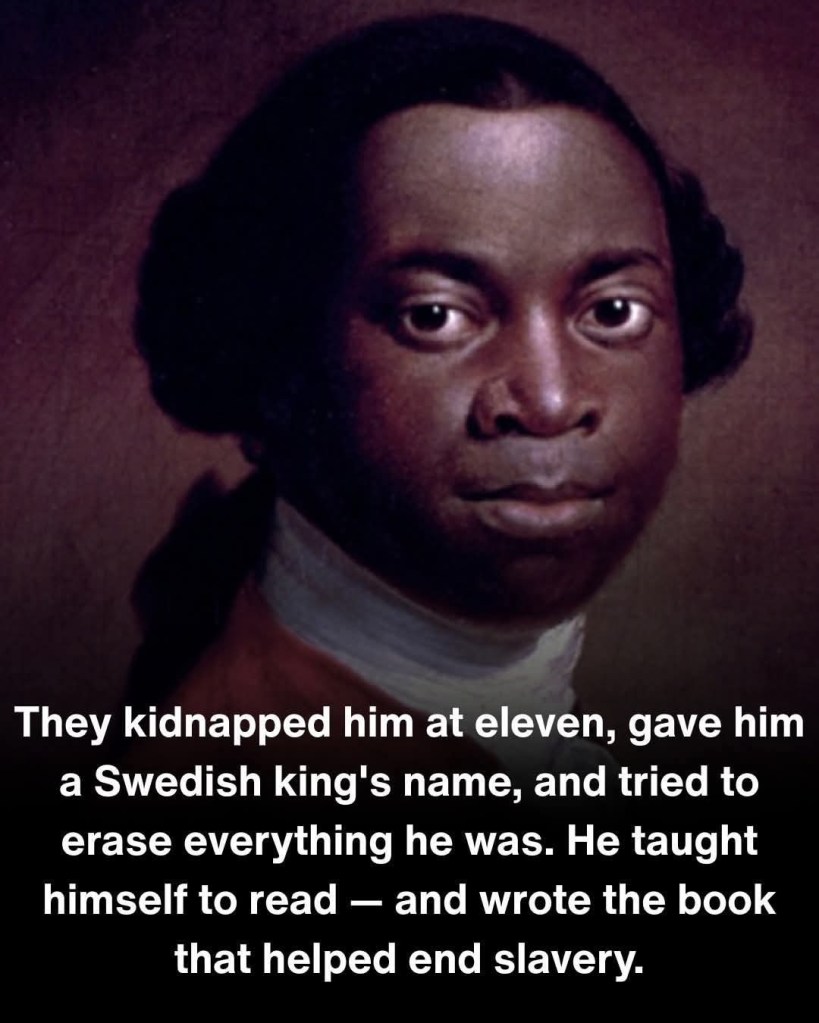
Olaudah survived the Middle Passage. When the ship reached Barbados, he was held for several days — then transported on to Virginia, where he was sold. He was enslaved by a sea captain, Michael Henry Pascal, who gave him the name Gustavus Vassa — the name of a Swedish king, given to an African boy as a kind of casual cruelty. Brain & Life
For the next decade, he was enslaved across the Americas and the Atlantic world — on plantations, aboard warships during the Seven Years’ War, through sea battles where he risked death not as a soldier but as property.
But one of his enslavers allowed him basic education, likely to make him more useful.
Equiano seized it.
He absorbed English voraciously. Read the Bible, navigation manuals, literature — anything he could access. Taught himself mathematics. Studied commerce. Memorized prices and shipping routes. And slowly, quietly, a plan formed.
In 1763, he came under the ownership of Robert King, a Quaker merchant who allowed him to conduct small trades and keep a portion of the profits. For three years, Equiano saved every penny, calculated every cost, and denied himself everything except one dream.
On July 11, 1766, he purchased his freedom. He paid exactly what King had paid for him. After fifteen years of bondage, he was legally free. aol
He moved to London. Continued working as a sailor and merchant. Traveled the Mediterranean, the Caribbean, and even the Arctic on a polar expedition. In 1792, he married Susanna Cullen of Ely, with whom he had two daughters. He built a self-made life in a society that had once classified him as property. Fox News
And he never forgot the millions still suffering.
By the 1780s, the abolitionist movement in Britain was gaining momentum — but facing a devastating problem: most Britons had never met an enslaved person. Slavery happened “over there.” The public could ignore it. Powerful merchants and plantation investors flooded newspapers with propaganda claiming enslaved Africans were inferior, that slavery was economically necessary, that the trade was a civilizing force.
Abolitionists needed something no propagandist could dismiss.
They needed firsthand testimony in the enslaver’s own language.
In 1789, Equiano published The Interesting Narrative of the Life of Olaudah Equiano; or, Gustavus Vassa, the African, Written by Himself — which became the first internationally popular slave narrative. Brain & Life
It was nearly 350 pages. And it was a weapon.
Equiano described his loving family in Africa. His sister’s face. The beauty of Eboe culture. He made it impossible to dismiss Africans as “savages” — and then he described the ship. The hold. The death. The casual cruelty. Written in clear, elegant English that was itself proof the “inferior race” argument was a lie.
He also dismantled the economics — showing through his own trading experience that free labor was at least as efficient as enslaved labor. He made the abstract concrete. Readers didn’t see “slaves.” They saw Olaudah — a boy ripped from his family, a man who had bought his own freedom, a human being no different from themselves.
The autobiography ran through nine English editions and one American printing during his lifetime. Equiano traveled Britain giving speeches to packed crowds. Supporters bought copies to distribute to politicians and clergy. Critics attacked him viciously — which only proved how much they feared his words. Brain & Life
Literary scholars and historians credit Equiano’s work with establishing the genre and format of the “slave narrative,” which other authors would use as a model for their own stories. Frederick Douglass, Harriet Jacobs, Solomon Northup — all followed the path Equiano blazed. Fox News
Equiano died on March 31, 1797, in London — before Britain abolished the slave trade in 1807, before emancipation came to British colonies in 1833. He did not live to see the full result. Brain & Life
But his book was cited in parliamentary debates. Quoted in sermons. Read in homes across Britain and America. It helped shift an empire’s conscience.
They kidnapped him at eleven. They gave him a Swedish king’s name. They tried to erase his identity, his culture, his humanity.
He learned their language. He mastered their commerce. He wrote their system’s indictment in words they couldn’t refute.
And in doing so, he helped write the ending of the slave trade itself.
That’s not survival. That’s revolution.
- History they will never let us know


What a powerful and deeply moving account of resilience, courage, and the triumph of the human spirit. Olaudah Equiano’s journey from a kidnapped child to a respected author and abolitionist is both heartbreaking and inspiring.
LikeLiked by 1 person
Yeah
LikeLiked by 1 person
It morally brought the greatest lesson for all nation
LikeLiked by 1 person