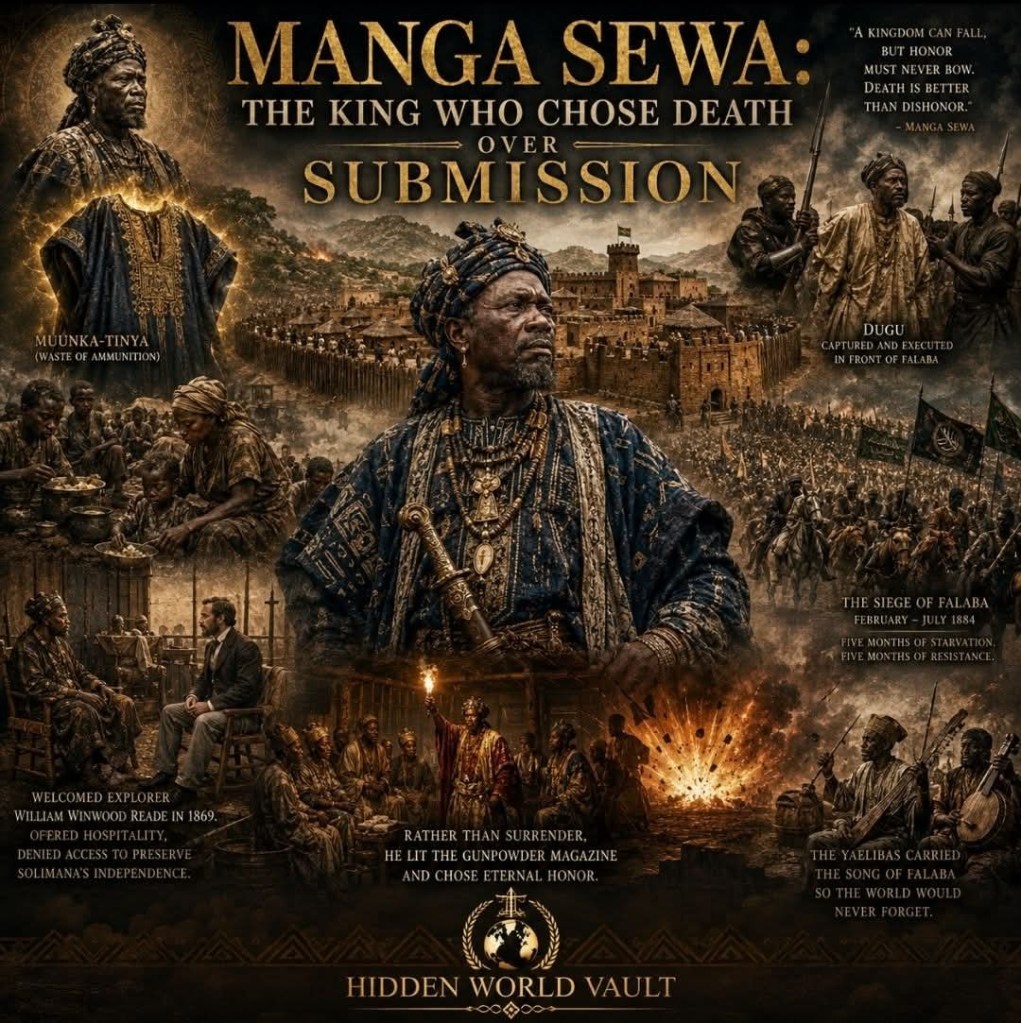
MANGA SEWA: THE KING WHO CHOSE DEATH OVER SUBMISSION
MANGA SEWA: THE KING WHO CHOSE DEATH OVER SUBMISSION
Many people know Manga Sewa as the Yalunka ruler who blew himself up during the Siege of Falaba in 1884.
Few know why.
To understand his final act, we must look beyond the explosion and into the world he was trying to protect.
Manga Sewa ruled Solimana from the fortified city of Falaba, one of the most important commercial centers in northeastern Sierra Leone. His kingdom maintained trade with Futa Jallon, Limba territories, and neighboring states, while carefully balancing relations with foreign powers.
Then came the army of Samori Touré.
This was not merely a battle between two kings. It was a confrontation between two expanding political visions. Samori sought to incorporate Falaba into the growing Wassoulou Empire. Manga Sewa fought to preserve the sovereignty, traditions, and independence of Solimana.
For five relentless months, Falaba resisted.
The city was surrounded.
Food disappeared.
The people reportedly survived on rats, boiled leather sandals, and woven mats.
According to Yalunka oral tradition, starvation eventually broke the king’s spirit. Hoping to save his people, Manga Sewa considered surrender.
But history took a dramatic turn.
His own son, Sewa Saio, reportedly denounced the idea, accusing his father of abandoning the honor of Solimana. Whether every detail has been preserved exactly as it occurred cannot be confirmed, but this powerful tradition reflects the immense moral pressure placed upon African rulers, where surrender was often viewed as a greater disgrace than death itself.
Another tragedy deepened the crisis.
Manga Sewa secretly sent his younger brother, Dugu, through enemy lines to seek reinforcements from neighboring Koranko allies. The mission failed. Dugu was captured and publicly executed by Samori’s forces within sight of Falaba’s walls; a devastating act of psychological warfare intended to crush the defenders’ remaining hope.
Oral traditions also preserve another fascinating belief.
They say Manga Sewa possessed a sacred war garment known as Muunka-Tinya—”the waste of ammunition.” It was believed to render its wearer invulnerable to bullets and blades. Whether understood literally or symbolically, the story reveals how deeply spiritual authority and political leadership were intertwined.
As long as the king lived, many believed surrender was impossible.
His death would free his people from that obligation.
So Manga Sewa gathered members of the royal household, elders, and court praise-singers inside the kingdom’s gunpowder magazine.
He lit the fuse.
The explosion destroyed much of the fortress and ended one of the most remarkable last stands in Sierra Leonean history.
Yet Manga Sewa was more than a warrior.
Historical accounts suggest he introduced important administrative reforms, separating the governance of Falaba from the wider Solimana state so that local officials could manage civic affairs while the monarchy focused on diplomacy, defense, and trade.
He also welcomed European explorer William Winwood Reade to Falaba in 1869, offering hospitality while refusing to grant unrestricted access to the interior; carefully protecting Solimana’s commercial interests and political independence.
His death did not save his kingdom.
But it ensured that his dignity could not be conquered.
Today, Manga Sewa is remembered not because he won the siege, but because he refused to let others define the end of his story.
His life reminds us that African resistance was not only fought with weapons. It was fought with diplomacy, political reform, cultural identity, and an unshakable belief that some principles were worth more than life itself.