THE GAMBIA: EVERYTHING YOU NEED TO KNOW ABOUT AFRICA’S SMALLEST MAINLAND NATION | HISTORY , EMPIRES , LEADERS , POLITICS , CULTURE & HIDDEN FACTSTHE GAMBIA: EVERYTHING YOU NEED TO KNOW ABOUT AFRICA’S SMALLEST MAINLAND NATION | HISTORY , EMPIRES , LEADERS , POLITICS , CULTURE & HIDDEN FACTS
🇬🇲 THE GAMBIA: EVERYTHING YOU NEED TO KNOW ABOUT AFRICA’S SMALLEST MAINLAND NATION | HISTORY , EMPIRES , LEADERS , POLITICS , CULTURE & HIDDEN FACTS
“The soul of a nation is found not only in its history, but in its people, traditions, languages, music, and everyday life.”
In Part I, we explored The Gambia’s ancient history, empires, colonial era, and the slave trade.
In Part II, we examined independence, every national leader, military rule, and the country’s return to democracy.
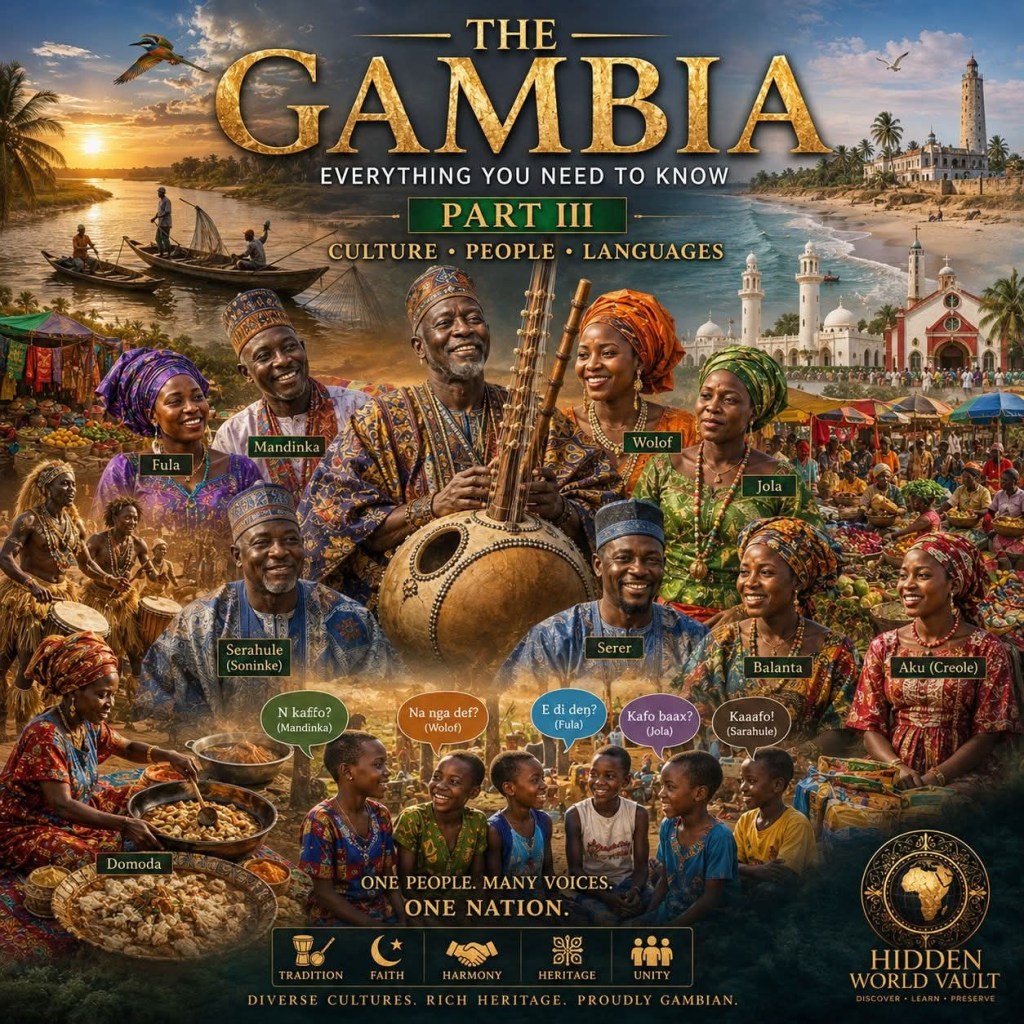
In this chapter, we discover the people who make The Gambia one of West Africa’s most culturally vibrant nations.
- The People of The Gambia
Although The Gambia occupies only a tiny area on Africa’s map, it is home to remarkable ethnic diversity.
For centuries, merchants, farmers, herders, scholars, fishermen, and craftsmen have lived together along the Gambia River.
Unlike many countries that experienced prolonged ethnic conflict, The Gambia has largely maintained peaceful coexistence among its communities.
Family ties, trade, Islam, intermarriage, and long-standing cultural traditions have strengthened national unity.
- The Major Ethnic Groups
● Mandinka
The Mandinka are the largest ethnic community.
Their ancestors became established throughout the region during the expansion of the Mali Empire.
Traditionally, Mandinka communities are known for:
- Agriculture
- Trade
- Islamic scholarship
- Rich oral traditions preserved by griots.
Many famous West African historical families trace their roots to the wider Mandé cultural world.
● Fula (Fulɓe)
The Fula are found across much of West Africa.
Historically renowned as cattle herders, many Gambian Fula are now also farmers, teachers, religious scholars, and business owners.
Pulaar remains one of the country’s major languages.
● Wolof
The Wolof have played an enormous role in commerce and urban life.
Although they are not the largest ethnic group, Wolof has become one of the country’s most influential languages, especially in Banjul and Serekunda.
● Jola (Diola)
The Jola are indigenous to the Senegambia and Casamance region.
They are especially known for:
- Rice cultivation
- Strong community traditions
- Rich cultural ceremonies
Historically, many Jola communities maintained indigenous religious beliefs before the spread of Islam and Christianity.
● Serahule (Soninke)
The Serahule, also known as Soninke, belong to the wider Mandé cultural family.
Their ancestors were associated with long-distance trade dating back to the era of the ancient Ghana Empire.
Today they remain respected entrepreneurs and traders throughout West Africa.
● Other Communities
The Gambia is also home to:
- Serer
- Balanta
- Manjago
- Aku (Creole descendants of liberated Africans)
- Bainunka
- Bambara
Each community contributes to the country’s cultural richness.
- Languages
Although English is the official language inherited from British rule, everyday life is multilingual.
The most widely spoken languages include:
- Mandinka
- Wolof
- Pulaar
- Jola
- Sarahule
Many Gambians speak two, three, or even four languages fluently.
Multilingualism is one of the country’s greatest strengths.
- Religion
Approximately 95% of Gambians are Muslims.
Islam arrived gradually through merchants and scholars over many centuries.
The remaining population consists mainly of Christians alongside followers of traditional African religions.
Religious tolerance is one of The Gambia’s defining characteristics.
Mosques and churches often exist peacefully within the same communities.
National celebrations frequently bring together people of different faiths.
- Music: The Sound of The Gambia
Music occupies a central place in Gambian society.
Among the country’s greatest cultural treasures is the kora.
The kora is a beautiful 21-string instrument combining features of a harp and a lute.
For centuries it has been played by hereditary griots, who preserve history through music and storytelling.
Other traditional instruments include:
- Balafon
- Djembe
- Tama (talking drum)
- Sabar drums
These instruments accompany ceremonies, weddings, festivals, and historical performances.
- Griots: The Living Libraries
Long before books became common, history survived through oral tradition.
Professional historians known as griots memorized centuries of genealogy, history, poetry, and royal traditions.
Their role remains respected throughout Senegambia today.
Without griots, much of West Africa’s early history would have been lost forever.
- Traditional Food
Gambian cuisine reflects centuries of cultural exchange.
Popular dishes include:
● Domoda — peanut stew.
● Benachin (Jollof) — one-pot rice cooked with vegetables and meat or fish.
● Super Kanja — okra stew.
● Plasas — leafy vegetable stew.
● Chereh — steamed millet couscous.
Fresh fish from the Atlantic Ocean also plays an important role in the national diet.
- Economy
The Gambian economy depends on several major sectors.
Agriculture
Groundnuts remain one of the country’s most important exports.
Farmers also produce:
- Rice
- Millet
- Maize
- Vegetables
- Fishing
The Atlantic coastline and Gambia River provide valuable fishing resources.
Both local consumption and exports contribute to the economy.
- Tourism
Tourism has become one of The Gambia’s largest sources of foreign income.
Visitors are attracted by:
● Beautiful Atlantic beaches.
● More than 500 bird species.
● Kachikally Crocodile Pool.
● Kunta Kinteh Island.
● River cruises.
● Rich music and culture.
For many Europeans, The Gambia is affectionately known as “The Smiling Coast of Africa.”
- Fascinating Facts
● Elections Using Marbles
The Gambia is famous for its unique voting system.
Instead of paper ballots, voters traditionally cast glass marbles into metal drums representing candidates.
The system was designed to reduce invalid votes and improve transparency.
■ “The” Gambia
The country’s official English name begins with a capitalized “The.”
This distinction was retained after independence to avoid confusion with Zambia.
■ Sacred Crocodiles
The Kachikally Crocodile Pool in Bakau is one of the country’s most famous cultural sites.
Local traditions associate the crocodiles with blessings, healing, and fertility.
■ Roots
Alex Haley’s famous novel Roots introduced millions around the world to the story of Kunta Kinte, whose ancestral home is associated with the Gambian village of Juffureh.
Today, Kunta Kinteh Island serves as an enduring memorial to the Atlantic slave trade.
■ Traditional Wrestling
Although football is the country’s most popular modern sport, traditional wrestling remains one of The Gambia’s oldest cultural traditions.
Competitions attract enthusiastic crowds and preserve centuries-old customs.
- Why The Gambia Matters
The Gambia may be Africa’s smallest mainland nation, but its historical influence reaches far beyond its borders.
Its river connected ancient kingdoms.
Its ports linked Africa with the wider world.
Its people preserved traditions stretching back centuries.
Its democracy survived enormous challenges.
Its cultural heritage continues to inspire Africans across the continent and throughout the diaspora.
The Gambia reminds us that greatness is not measured by land area.
It is measured by the resilience of its people, the richness of its culture, and the depth of its history.
- Final Thoughts
From the ancient Stone Circles of Senegambia to the Mali Empire, from the horrors of the Atlantic slave trade to the triumph of democratic renewal, The Gambia has experienced nearly every chapter of African history.
Its story is one of resilience.
Its people are its greatest treasure.
And although small in size, The Gambia occupies a truly significant place in the history of Africa and the wider world.
As Hidden World Vault always reminds us: understanding history is not simply about remembering the past, it is about appreciating the people whose stories continue to shape our future.
References
- UNESCO World Heritage Centre – Stone Circles of Senegambia; Kunta Kinteh Island and Related Sites.
- Encyclopaedia Britannica – The Gambia.
- Arnold Hughes & David Perfect, A Political History of The Gambia.
- David P. Gamble, The Gambia.
- Nehemia Levtzion, Ancient Ghana and Mali.
- J. F. Ade Ajayi & Michael Crowder, History of West Africa.
- Commonwealth Secretariat – Country Profile: The Gambia.
- World Bank – The Gambia Overview.
- African Development Bank – The Gambia Economic Outlook.
- CIA World Factbook – The Gambia.
- UNESCO Slave Route Project.
- ECOWAS official publications.
 Hi welcome to my website