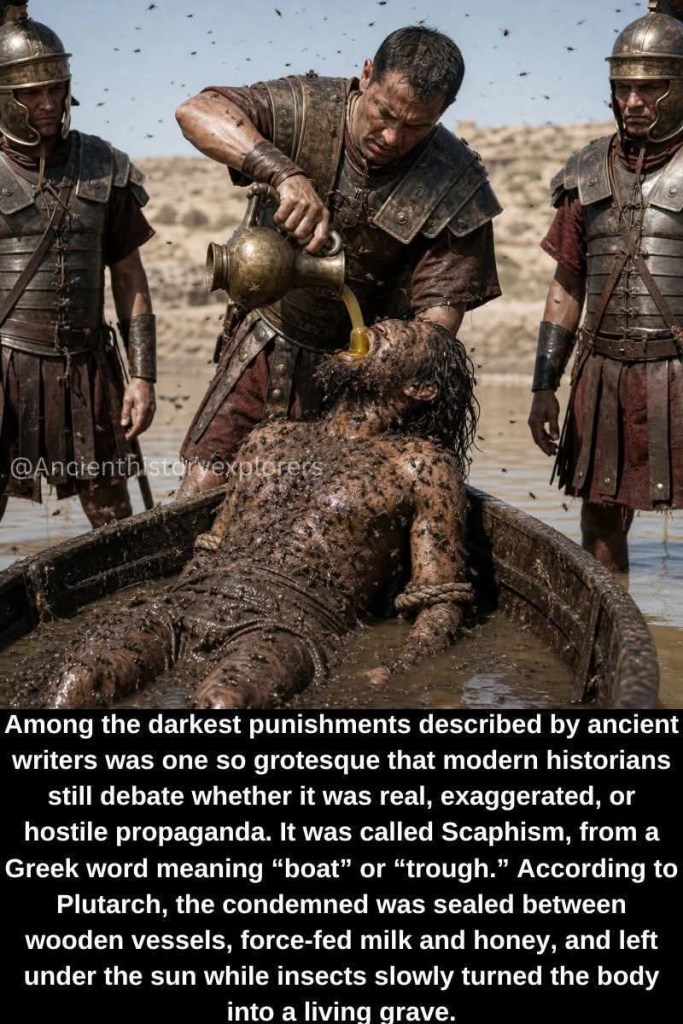
Ancient history is full of brutal punishments, but few are as horrifying as the one later known as Scaphism.
Ancient history is full of brutal punishments, but few are as horrifying as the one later known as Scaphism.
The name comes from the Greek word skaphe, meaning “boat” or “trough.” Most of what we know about the punishment comes from the Greek biographer Plutarch, who attributed it to the Achaemenid Persian Empire. That detail matters because Greek writers often described Persia through the lens of rivalry, fear, and moral contrast. Modern historians therefore treat the account with caution. It may preserve a real punishment, or it may be exaggerated propaganda meant to portray Persia as cruel and decadent.
But whether literal, embellished, or symbolic, the description became one of antiquity’s most infamous images of extreme cruelty.
According to the ancient account, the condemned prisoner was stripped and placed inside a narrow wooden boat or trough. In some versions, two hollowed vessels were fitted together around the body, leaving only the head, hands, and feet exposed. The victim could not stand, turn, flee, or defend himself. Movement was almost impossible.
Then the suffering was made deliberately slow.
The prisoner was force-fed large amounts of milk and honey. More honey was smeared across the exposed skin. The mixture was not chosen for mercy. It was meant to make the body attractive to insects and to cause sickness, diarrhea, and physical breakdown. Trapped in the wooden enclosure, the prisoner would become surrounded by filth while still alive.
The victim was then left in a stagnant pond, marsh, or open place beneath the heat of the sun.
The exposed body drew flies.
Then mosquitoes.
Then other insects.
Ancient descriptions claim that eggs were laid in the flesh and that infestation followed while the prisoner remained conscious, helpless, and unable to escape. Each day, guards supposedly returned—not to end the punishment, but to continue feeding the victim, prolonging life so the torment could continue.
That is what made Scaphism so terrifying in the imagination of the ancient world.
It was not a swift execution.
It was death by exposure, infection, dehydration, filth, insects, and time.
Plutarch’s account even claims that some victims survived for many days before dying. Whether that detail is accurate is impossible to prove. The story survives through hostile literary tradition, not through neutral forensic evidence. But its endurance tells us something important about ancient political storytelling.
Punishments were not only legal acts.
They were moral images.
To Greek audiences, Scaphism represented the nightmare of absolute power: a ruler able to turn the human body into a spectacle of degradation. It made the condemned person disappear slowly, not through a sword or rope, but through nature itself weaponized by human cruelty.
That is why the story still disturbs people today.
Even if some details were exaggerated, the idea behind the punishment is chilling. It imagines a death designed to strip away dignity hour by hour, making the victim suffer while the world around him—sun, water, insects, decay—became part of the sentence.
Scaphism may never have been practiced exactly as Plutarch described it.
But as a symbol, it became immortal.
It stands as one of the most grotesque warnings left by ancient literature: that human cruelty does not always seek quick death. Sometimes it seeks a slow one, staged so horribly that the story itself survives longer than the empire accused of creating it.