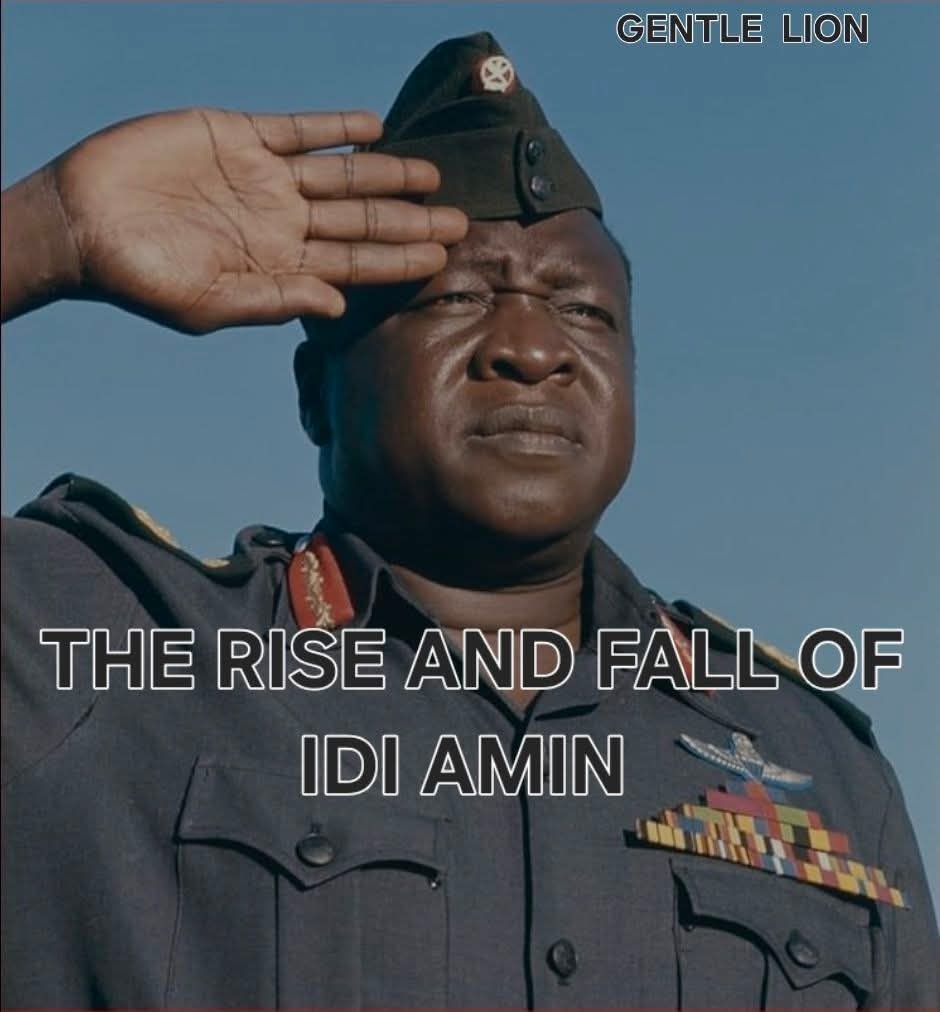
THE RISE AND FALL OF IDI AMIN. He is very mean indeed.
THE RISE AND FALL OF IDI AMIN. He is very mean indeed.
History Behind: The Rise and Fall of Idi Amin Dada
Idi Amin Dada, who ruled Uganda as its third president from 1971 to 1979, remains one of the most notorious and controversial figures in modern African history.
Often referred to by the grim moniker “The Butcher of Uganda”, his regime was defined by extreme authoritarianism, economic collapse, and massive human rights violations.
Background life and Military Beginnings
Historically, many details of Amin’s early life remain hazy. He was born around 1925 in Koboko, located in the northwestern West Nile region of Uganda, to a Kakwa father and a Lugbara mother. Abandoned by his father at a young age, he was raised by his mother in military barracks and received very little formal education.
In 1946, Amin enlisted in the King’s African Rifles (KAR), a regiment of the British colonial army, starting his career as an assistant cook.
His physical stature and athletic prowess—he was Uganda’s light heavyweight boxing champion from 1951 to 1960—quickly caught the attention of his British superiors.
He climbed the ranks and was deployed to f!ght against the Mau Mau uprising in Kenya during the 1950s. By the time Uganda gained independence from Great Britain in 1962, Amin was one of only a few African soldiers to have been commissioned as an officer.
The Alliance and Fallout with Milton Obote
Following independence, Amin aligned closely with Uganda’s first Prime Minister, Milton Obote.
Obote utilized Amin’s absolute loyalty and military muscle to consolidate his own power.
In 1966, after a severe political rift with the Kabaka (the traditional king of the Buganda kingdom who also served as president), Obote ordered Colonel Amin to lead an assàult on the Kabaka’s palace. The palace was overrun, forcing the King into exile and allowing Obote to declare himself executive president with Amin as the head of the Army and Air Force.
However, the alliance eventually shattered:
Power Struggles: Amin began recruiting heavily from his own West Nile tribesmen, creating a faction loyal only to him.
C0rruption and Disagreement: Relations deteriorated over military spending, and Obote suspected Amin of embezzling army funds.
The 1971 C0up: In January 1971, while Obote was attending a Commonwealth Summit in Singapore, he ordered Amin’s arrest.
Anticipating this, Amin staged a pre-emptive military c0up on January 25, 1971, seizing control of the state.
Initially, the c0up was met with celebration, especially in the Buganda region, as Amin promised to return the country to civilian rule and release political prisoners.
The Reign of Terr0r (1971–1979)
Amin’s promises of democracy quickly evaporated, and his eight-year rule turned into a brutàl dictatorship.
Human Rights Abusès
To maintain control, Amin established brutàl security agencies, including the State Research Bureau (SRB) and the Public Safety Unit. He targeted anyone suspected of opposing his regime.
Ethnic Purges: He ordered systematic executions of soldiers and civilians from the Acholi and Lango ethnic groups, which were historically loyal to Obote.
Scale of Vi0lence.
International human rights organizations estimate that between 100,000 and 500,000 people were murdèred or disappeared during his rule. Prominent figures, including the Chief Justice, the Anglican Archbishop, and various cabinet ministers, were openly assassinated.
Economic Collapse and the Asian Expulsion
In August 1972, claiming that God had spoken to him in a dream, Amin announced the expulsion of all Asian citizens and residents within 90 days.
Around 50,000 Asians (predominantly of Indian descent), who formed the backbone of Uganda’s commercial sector, were forced to leave, leaving behind their businesses and properties.
Amin redistributed these assets to his military officers and political cronies, who had no experience running them.
This triggered a catastrophic economic collapse, marked by hyperinflation and acute shortages of basic goods.
Erratic Foreign Policy
Amin shifted his international alliances rapidly. He broke off ties with Israel and Great Britain, instead seeking and securing financial and military backing from Libya’s Muammar Gaddafi and the Soviet Union.
His regime gained global infamy in 1976 during the Entebbe Hostage Cr!sis, when pro-Palestinian hijackers forced an Air France flight to land at Uganda’s Entebbe Airport.
Amin openly supported the hijackers, but the cr!sis ended when Israeli commandos launched a daring raid, rescuing the hostages and destroying a large portion of Uganda’s f!ghter jets.
The Fall and Exile of Idi Amin
By the late 1970s, domestic unrest and economic ruin had weakened Amin’s grip on power.
In a desperate bid to divert attention from internal instability and mutiny within his army, Amin ordered the invasion and attempted annexation of the Kagera region in neighboring Tanzania in late 1978.
This proved to be his ultimate undoing:
Tanzanian Counter-Offensive: Tanzanian President Julius Nyerere mobilized a massive force alongside the Uganda National Liberation Army (UNLA)—a coalition of Ugandan exiles.
The Fall of Kampala: The combined forces pushed deep into Uganda. On April 11, 1979, Kampala was captured, and Amin was forced to flee the capital.
Exile: Amin first fled to Libya and later settled in Jiddah, Saudi Arabia, where the Saudi government provided him with a sanctuary and a stipend on the condition that he remain completely out of politics.
Idi Amin never faced a trial for his crimes. He lived quietly in Saudi Arabia for over two decades until his death from kidney failure on August 16, 2003. His legacy remains a somber and heavily studied period of twentieth-century African histor.
Gentle Lion
reels #everyone #history #highlights #explore