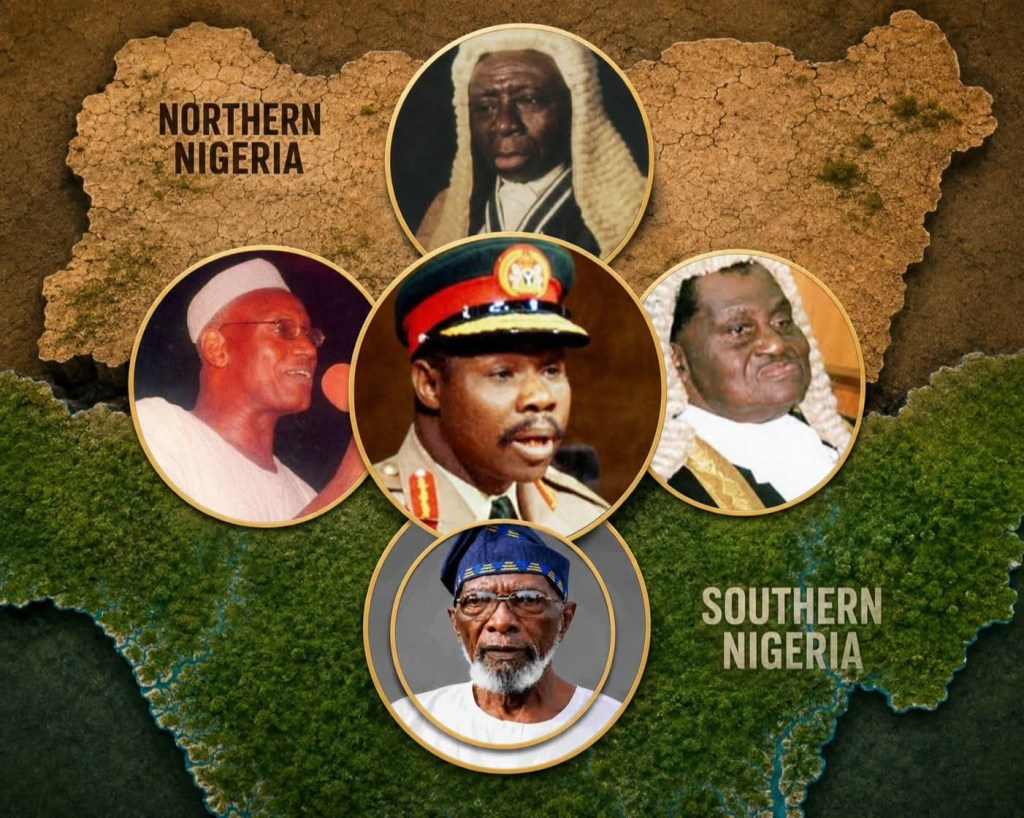
Nigeria’s Fraudulent Constitutional Foundation: Two Wise Men, 47 Unwise, and the Voices of Dr. Samuel Olusẹgun Ọsọba and Dr. Yusufu Bala Usman Suppressed
Nigeria’s Fraudulent Constitutional Foundation: Two Wise Men, 47 Unwise, and the Voices of Dr. Samuel Olusẹgun Ọsọba and Dr. Yusufu Bala Usman Suppressed
Why has every Nigerian regime since 1979 felt compelled to tinker with the constitution, yet the same defects persist?
The answer lies not in amendments, but in the original fraud.
The 1979 Constitution was hailed as Nigeria’s democratic salvation, but it was already a fraudulent foundation.
Its own architects knew it.
Two of them – Dr. Samuel Olusẹgun Ọsọba, a Marxist historian from the University of Ife, and Dr. Yusufu Bala Usman, a renowned leftist intellectual from Ahmadu Bello University, Zaria – warned in their Minority Report that the document was “a deliberate effort at mystification for the selfish interests of the bourgeoisie.”
The military regime did not merely ignore them.
Their voices were suppressed.
The report was declared “non-existent” by General Olusẹgun Ọbasanjọ, who adopted the majority draft and decreed it into the 1979 Constitution.
The 47 other “wise men” overruled them.
Nigeria has been paying the price ever since.
The story begins with a conspicuous absence.
When General Murtala Mohammed appointed the Constitution Drafting Committee in October 1975, Chief Ọbafẹmi Awolọwọ was among the 50 distinguished Nigerians invited to serve.
Awolọwọ, who had authored “Thoughts on the Nigerian Constitution” (1966) while in prison, was Nigeria’s preeminent constitutional thinker.
His refusal to serve reduced the committee to 49 members.
Official accounts cite his claim that he was “not a constitutional lawyer,” but his extensive writings on federalism and governance suggest a deeper political calculation.
His absence was deliberate.
Awolọwọ’s federalist principles – that the constituent states must be organised on the dual basis of language and nationality, represented a vision of Nigeria that was never seriously debated during the drafting process.
The military government placed strict boundaries on the constitutional debate.
At the inaugural meeting on October 8, 1975, Murtala Mohammed gave general guidelines.
When Ọbasanjọ inaugurated the Constituent Assembly on October 6, 1977, he delivered an explicit warning:
“Valuable time will be saved by sticking to your ‘Term of Reference’ as closely as possible. All diversion from it of the consideration of extraneous matters which are not the subject for discussion by the Constituent Assembly should be avoided.”
The so-called “no-go areas” included fundamental questions that one might expect any constitution to resolve: the structure of the federation, revenue allocation, the role of religion, and citizenship.
The military argued these “fundamental questions have been resolved or settled by resolutions in the previous conferences and the logic of the civil war.”
These fundamental questions were prohibited from debate.
The CDC chairman, Chief Rotimi Alade Williams, went so far as to declare that the Constituent Assembly’s decision on the Draft Constitution “possesses legitimacy superior to any decree that may be enacted by any other authority.”
Yet this rhetorical commitment to popular sovereignty was undercut by the military’s firm restrictions on what could be debated.
Against this constrained backdrop, two historians submitted a minority report that fundamentally disagreed with the majority’s vision.
Dr. Yusufu Bala Usman was a committed leftist and Marxist scholar who saw the constitution not as a neutral legal document, but as a tool for entrenching the interests of the ruling class.
Dr. Samuel Olusẹgun Ọsọba shared this critical perspective, viewing the constitutional project through the lens of class struggle and elite domination.
The Minority Report addressed what its authors saw as fundamental flaws.
They specifically challenged the constitutional immunity for the President, Vice President, Governors, and their deputies.
According to them, the immunity provisions “contradict violently the fundamental principle of the equality of all citizens before the law” and constituted “an unwarranted attempt to shield these high officials of the state from the full rigours of the law as would apply to the other citizens of Nigeria in similar situations of misconduct or improper conduct.”
They proposed a straightforward citizenship clause: “The following persons are Nigerian citizens by birth:
(a) every person born in Nigeria before 1 October, 1960 either of whose natural parents or grandparents belong or belonged to a community indigenous to Nigeria.
(b) every person born in Nigeria after 1 October, 1960 either of whose natural or legal parents or any of whose grandparents is or was a Nigerian citizen.
(c) every person born outside Nigeria either of whose natural parents is or was a Nigerian citizen.”
Dr. Samuel Olusẹgun Ọsọba lamented that if the issue of citizenship had been resolved 43 years ago, the country would have avoided so many of the tragedies which have followed in the wake of the confusion about this constitutional provision.
From their Marxist and leftist perspective, the authors concluded that the 1979 Constitution was “a deliberate effort at mystification for the selfish interests of the bourgeoisie” – verbose, laden with technical loopholes, and unwieldy with contradictory provisions.
Dr. Yusufu Bala Usman offered the most striking warning, one that has proven remarkably prescient: “Far from providing a basis and framework for the development of national cohesion and democracy, there will be an intensification of the present grossly uneven pattern of underdevelopment, greater capitalist and bureaucratic greed, individualism and chaos. When that happens the Nigerian people will be accused of being too immature and irresponsible for democracy and preparations will be made for consolidating the status quo and ensuring ‘law and order’ through repression and terror.”
As the philosopher George Santayana once wrote, “Those who cannot remember the past are condemned to repeat it.”
Nigeria has repeated its constitutional errors because it suppressed the very voices that could have corrected them.
The military regime of General Olusẹgun Ọbasanjọ rejected the Minority Report and enacted the majority draft as the 1979 Constitution after inserting into it the Land Use Decree of 1978, despite the Constituent Assembly’s objection to it as inappropriate in a constitution. The minority report was effectively declared “non-existent.”
Fẹmi Falana, SAN, later observed that “the lacuna in the 1979 and 1999 constitutions would have been removed long ago, if Chief Olusẹgun Ọbasanjọ in 1976 had accepted and implemented the Minority Report.”
The rejection of this alternative vision is not merely a historical curiosity.
It represents the moment Nigeria chose a fraudulent constitutional foundation over a more just and accountable one.
As Dr. Abubakar Siddique Mohammed, director of the Centre for Democratic Development, Research and Training (CEDDERT), observed, the minority report “has become a sort of ‘ghost’ publication, never formally published but widely circulated in mimeographed form”, a document that, if it had been followed, “might have solved, or avoided, many of the serious problems which Nigeria is facing today.”
Today, the 1999 Constitution is largely a re-enactment of the 1979 Constitution.
It retains the same fundamental flaws.
Every administration since 1979 has attempted to tinker with the document through amendments, yet the same defects persist.
The immunity clause that Ọsọba and Usman opposed continues to shield governors and presidents from prosecution.
The citizenship ambiguities they sought to resolve continue to fuel exclusion and political instability.
The non-justiciable Chapter II they identified as a contradiction still denies Nigerians legal recourse for socio-economic rights.
We are still living in the house built by the 47 unwise men, while the two wise men’s warnings echo from the margins of history.
The constant constitutional tinkering, five amendments to the 1999 Constitution alone, billions of naira spent on seasonal jamborees, is not a sign of a dynamic constitutional order.
It is evidence of a fundamental fraud that cannot be repaired by piecemeal changes.
The greatest tragedy of the 47 unwise men was not their failure to foresee the chaos, it was their refusal to listen to those who did.
They built a house of cards and called it a constitution.
They wrote rights with one hand and withdrew them with the other.
They gave immunity to the powerful and silence to the powerless.
In their arrogance, they mistook the suppression of dissent for the preservation of order.
But as Edmund Burke warned, “The only thing necessary for the triumph of evil is for good men to do nothing.”
These 47 men did not do nothing – they did worse.
They actively suppressed the good counsel of the two wise men among them, and in doing so, they condemned a nation to decades of constitutional crisis.
The 47 unwise men did not merely suppress two wise men, they suppressed solutions.
The immunity clause they rejected now shields corrupt officials.
The citizenship clarity they proposed could have prevented the “indigene vs. settler” bloodshed that continues to claim lives across Nigeria.
The justiciable socio-economic rights they championed could have reduced the poverty and inequality that now ravage the land.
The accountability mechanisms they proposed could have prevented the looting of public treasuries.
Every loophole that bedevils Nigeria today was foreseen and opposed by Dr. Samuel Olusẹgun Ọsọba and Dr. Yusufu Bala Usman.
Their suppressed report is not a historical curiosity, it is a mirror reflecting our present failures.
As Fẹmi Falana, SAN, observed, the “lacuna in the 1979 and 1999 constitutions would have been removed long ago” if the military regime had listened.
But the regime chose suppression over wisdom.
And Nigeria has been paying the price ever since.
The question is not whether Nigeria needs another constitutional amendment.
The question is whether Nigeria has the courage to finally listen to the wise men it suppressed in 1976.
Dr. Samuel Olusẹgun Ọsọba and Dr. Yusufu Bala Usman saw clearly what the 47 others refused to see: that a constitution built on elite interest, vague promises, and unenforceable rights would produce exactly the chaos Nigeria now endures.
As Usman warned, when the chaos arrives, “the Nigerian people will be accused of being too immature and irresponsible for democracy.”
That accusation has been made many times since 1979.
But the fault lies not with the people, it lies with the fraudulent foundation the 47 unwise men built, and the military regime that imposed it on an unsuspecting nation.
As the philosopher Reinhold Niebuhr once wrote, “Man’s capacity for justice makes democracy possible; but man’s inclination to injustice makes democracy necessary.”
Nigeria’s 47 unwise men placed their faith in the inclination to injustice, and suppressed the very voices that could have made justice possible.
· #FraudulentFoundation
· #SuppressedVoices
· #NigeriaPolitics
· #ConstitutionalCrisis
· #SecondRepublic
· #Awolowo
· #Obasanjo
· #NigerianHistory
· #JusticeForNigeria
· #Reclaim