
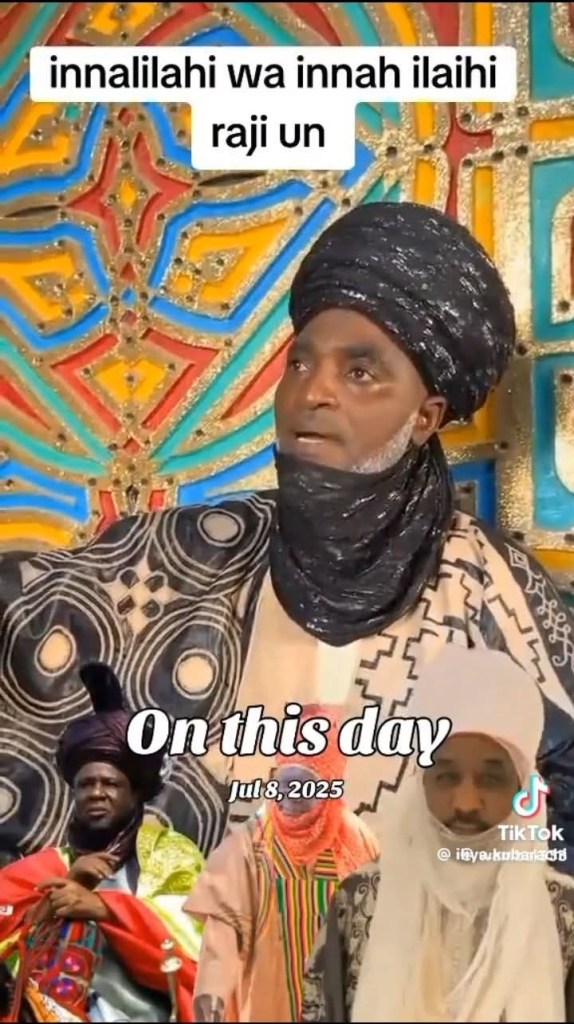
Meet an active Hausa slave, Usman Sallama Dako.
Meet an active Hausa slave, Usman Sallama Dako. His grandfather was among the Muslims captured by the Fulani and turned into a royal slave during the reign of Ibrahim Dabo. What is the Islamic ruling on enslaving Muslims?
His grandfather died in 1945 at the age of 100.
Today, Usman remains a loyal royal servant to Aminu Ado Bayero. According to this account, this was one of the reasons Emir Sanusi removed him from Gidan Rumfa.
I find it ironic that some people claim the Fulani strengthened Islam, yet they exempted Fulani from paying taxes while collecting them only from the Hausa people.
عَنْ أَبِي هُرَيْرَةَ رضي الله عنه، عَنِ النَّبِيِّ ﷺ قَالَ:
«قَالَ اللَّهُ تَعَالَى: ثَلَاثَةٌ أَنَا خَصْمُهُمْ يَوْمَ الْقِيَامَةِ: رَجُلٌ أَعْطَى بِي ثُمَّ غَدَرَ، وَرَجُلٌ بَاعَ حُرًّا فَأَكَلَ ثَمَنَهُ، وَرَجُلٌ اسْتَأْجَرَ أَجِيرًا فَاسْتَوْفَى مِنْهُ، وَلَمْ يُعْطِهِ أَجْرَهُ»
Abu Hurairah (may Allah be pleased with him) reported that the Prophet ﷺ said:
“Allah, the Most High, said: ‘There are three people whose opponent I will be on the Day of Resurrection: a man who makes a covenant in My Name and then breaks it; a man who sells a free person and consumes the price; and a man who hires a worker, receives the full benefit of his labor, but does not pay him his wages.'”
Source: Sahih al-Bukhari, Book of Sales (Kitab al-Buyu’), Hadith 2227 (numbering may vary by edition).
Relevance to the Question
The Prophet ﷺ specifically condemned:
«وَرَجُلٌ بَاعَ حُرًّا فَأَكَلَ ثَمَنَهُ»
“…and a man who sells a free person and consumes the price.”
Classical scholars understood that if selling a free person is prohibited, then capturing and enslaving that person unlawfully is also prohibited, because the sale itself is based on an illegitimate act of enslavement. In other words, the prohibition extends not only to the sale but also to the unlawful deprivation of a free person’s liberty.
The Qur’an likewise commands justice:
﴿إِنَّ اللَّهَ يَأْمُرُ بِالْعَدْلِ وَالإِحْسَانِ﴾
“Indeed, Allah commands justice and excellence.”
(Surah An-Nahl 16:90)
If a free person was a Christian or a pagan, the ruling is more nuanced and depends on the circumstances recognized by classical Islamic law.
The hadith in Sahih al-Bukhari (“…a man who sells a free person…”) is understood by many scholars as a general prohibition against unlawfully enslaving a free person, regardless of religion. However, classical Islamic jurisprudence also discussed situations in which captivity could occur during a lawful armed conflict under the rules that existed at that time.
In general:
It is forbidden to kidnap or seize a free Christian or pagan in peacetime and enslave them. This would be considered oppression and an unlawful violation of their freedom.
Classical Islamic law permitted the enslavement of certain captives taken in a lawful war under specific conditions that existed in that historical legal framework. It did not permit simply capturing free non-Muslims and making them slaves.
In the modern era, slavery has been abolished worldwide, and contemporary Muslim scholars generally hold that those historical rulings no longer apply because the legal and international framework governing war has fundamentally changed.
So, merely being a Christian or a pagan did not make a free person lawful to enslave. Religion alone was not a sufficient justification under classical Islamic law.
 Hi welcome to my website