THE CISSÉ (CEESAY/SESAY): FROM WAGADOU TO MANDEN — A SURNAME THAT SHAPED WEST AFRICAN HISTORY
THE CISSÉ (CEESAY/SESAY): FROM WAGADOU TO MANDEN — A SURNAME THAT SHAPED WEST AFRICAN HISTORY
Across West Africa, few surnames are as ancient, widespread, and respected as Cissé, also written Ceesay, Sesay, Ciise, Siise, or Sise, depending on local languages and colonial spelling systems.
From Mauritania to Senegal, The Gambia, Mali, Guinea, Guinea-Bissau, Sierra Leone, Liberia, Burkina Faso, and Côte d’Ivoire, the surname appears among Soninké, Mandinka, Maninka (Malinké), Bambara, Dyula, Diakhanké, Konianka, Djallonké (Yalunka), and other Mandé-speaking communities.
How did one surname become so widespread?
Its history begins long before the Mali Empire.
- The Origins in Ancient Wagadou
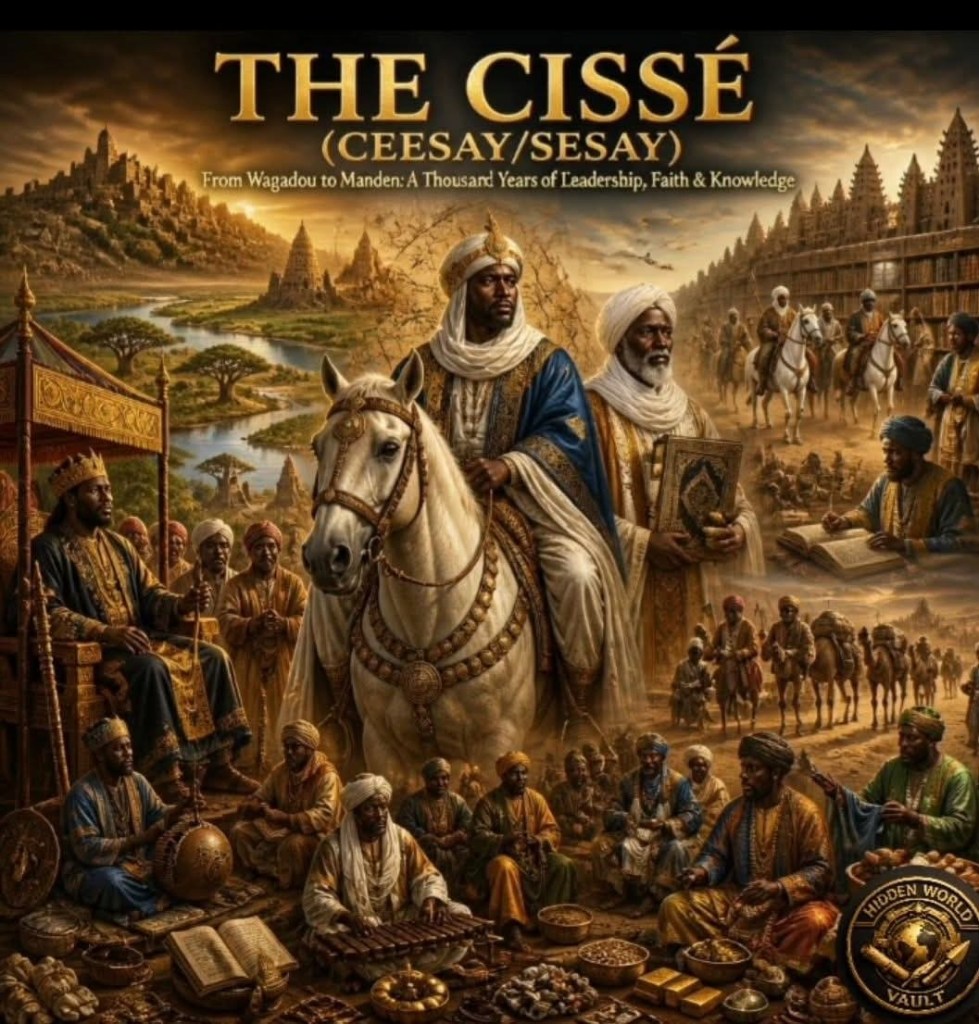
According to both medieval Arabic chronicles and Soninké oral traditions, the Cissé were among the founding dynasties of Wagadou (Ancient Ghana), one of Africa’s earliest imperial states.
Mainstream historians generally agree that the rulers of Ghana emerged from the Soninké-speaking world, though the exact genealogy of the earliest kings remains debated.
Within Soninké oral tradition, however, one name appears repeatedly:
Dinga Cissé (Dinga Siise).
He is remembered as the ancestral patriarch whose descendants established the royal dynasty of Wagadou.
His son, Diabé Cissé (Jaabe Siise), is traditionally celebrated as one of the earliest rulers and among the greatest horsemen of the kingdom.
Some traditions even maintain that the title Cissé (Siise) became associated with mastery of cavalry and horsemanship.
Although the precise linguistic origin remains debated among scholars, these traditions emphasize the central role of horses in the rise of Wagadou’s political and military power.
Medieval traditions associate the dynasty with figures such as Dinga Cisse and Kaya Magan Cissé, while later traditions connect the family with cavalry, political authority, and, eventually, Islamic scholarship.
- The Horsemen of Wagadou
Many Soninké traditions associate the Cissé with cavalry.
According to these traditions, they became famous as elite horsemen whose military organization strengthened the power of Wagadou.
Some oral traditions even interpret the surname as being associated with mounted warriors or horsemen, although the precise linguistic origin remains debated among scholars.
Whether literal or symbolic, the horse became an enduring emblem of Cissé prestige and authority.
- Before Wagadou: The Ancient Peoples of the Western Sahel
Manding oral traditions preserve another layer of history.
Long before Wagadou became the dominant political power, the western Sahel was inhabited by ancient populations remembered as the Kakolo (Kakoro).
These traditions describe the Kakolo as early hunters, metallurgists, farmers, ritual specialists, and founders of many of the clans that later shaped the Mandé world.
According to these traditions, Wagadou did not arise in an empty land.
It developed in a region already inhabited by earlier populations.
- The Meeting of the Soninké and the Kakolo
One of the most important teachings preserved in Manding oral history is that the Soninké and the Kakolo gradually lived together over many centuries.
They traded.
They intermarried.
They fought together.
They shared religious traditions.
They exchanged technologies.
They created political alliances.
Through this long process of interaction, many families, including the Cissé, became part of a broader historical community that would later contribute to the emergence of Manden.
This process is remembered in oral tradition as one of assimilation rather than replacement.
- The Fall of Wagadou
By the 11th century, Wagadou began to decline.
Historians attribute this to several factors, including political fragmentation, changing trade routes, environmental pressures, and Almoravid expansion, although the exact causes remain debated.
Its decline did not mean the disappearance of its people.
Many Soninké families migrated southward and eastward.
Among them were members of the Cissé lineage.
- From Wagadou to Manden
According to Manding traditions, many former Soninké families settled among the populations that were already living in Manden.
There they continued to intermarry with Kakolo-descended communities and other Mandé-speaking populations.
This long historical process helped shape the civilization that later produced the Mali Empire.
In this understanding, Manden was not created by one people alone.
It emerged through the interaction of older populations over many generations.
- The Rise of the Mali Empire
During the rise of Sundiata Keita in the 13th century, the Cissé remained influential.
Manding traditions remember Bougariba Cissé as one of the Muslim scholars who supported Sundiata during his struggle against Soumaoro Kanté.
After the victory at Kirina, tradition holds that Sundiata honored Bougariba Cissé with the title Manden Mori, often understood as “the marabout (Islamic scholar) of Manden.”
While the details belong primarily to oral tradition, they reflect the enduring association of the Cissé lineage with Islamic learning.
- Custodians of Islamic Scholarship
As Islam spread across the western Sudan, many Cissé families became renowned for:
● Qur’anic education
● Islamic jurisprudence
● Teaching
● Mediation
● Religious leadership
Their influence extended across the Manding world.
Entire villages became known for Cissé scholars.
Some later became associated with the Diakhanké scholarly tradition.
- Why the Cissé Are Found Among Many Manding Peoples, and Beyond
One of the most frequently asked questions is:
“If the Cissé were originally Soninké, why are they also found among the Mandinka, Maninka (Malinké), Bambara, Dyula, Konianka, Djallonké (Yalunka), and even among peoples who are not Manding or Mandé?”
The answer lies in more than a thousand years of West African history.
According to both mainstream scholarship and Manding oral traditions, the decline of Wagadou did not mark the disappearance of the Soninké people. Instead, it triggered centuries of migration, settlement, trade, Islamic scholarship, diplomacy, and intermarriage across the western Sudan.
Manding oral traditions add another important layer to this history. They teach that the Soninké did not move into an empty land. They gradually interacted with ancient populations remembered as the Kakolo (Kakoro), who are described as some of the earliest inhabitants of the western Sahel and among the ancestral foundations of the Mandé world.
Over many generations, Soninké and Kakolo communities:
● Intermarried
● Formed political alliances
● Shared technologies
● Exchanged religious traditions
● Developed common institutions
● Gradually assimilated into one another
From this long historical process emerged Manden, not as the creation of a single people, but as a civilization shaped by closely related populations living together over centuries.
As Manden expanded under the Mali Empire, families such as the Cissé spread throughout the Mandé world. Today, the surname is found among:
● Soninké
● Mandinka
● Maninka (Malinké)
● Bambara
● Dyula
● Konianka
● Djallonké (Yalunka)
● Diakhanké
● Khassonké
● Kagoro/Kakabé communities
and other Manding and Mandé populations.
The story did not stop within the Mandé world.
For centuries, Cissé scholars, merchants, clerics, diplomats, and travelers established themselves among neighboring peoples. Through trade, Islamic education, migration, political alliances, and marriage, the surname also became established among several non-Mandé communities, including:
● Wolof
● Limba
● Baga
● Temne
● Susu (Mixed with Atlantic/Mel peoples)
● Loko
● Landouma
and other neighboring peoples across West Africa.
In many cases, these communities adopted the surname through the settlement of respected Cissé families, the spread of Islam, commercial networks, or long-standing intermarriage. This does not necessarily mean that every Cissé family shares the exact same ancestral path. Rather, it reflects the highly interconnected nature of West African history, where families, ideas, and identities often crossed linguistic, political, and cultural boundaries.
The history of the Cissé teaches an important lesson:
West African surnames are often older than modern ethnic identities and far older than colonial borders. They preserve memories of migration, alliance, scholarship, commerce, and shared civilization.
The Cissé are therefore more than a Soninké surname. They are a living bridge linking Wagadou and Manden, and through centuries of movement and exchange, they became part of the shared historical heritage of both Mandé and numerous non-Mandé peoples across West Africa.
- A Bridge Between Two Great Civilizations
The story of the Cissé illustrates one of the great transitions in West African history.
From the royal courts of Wagadou…
to the scholarly centers of Manden…
from cavalry…
to Qur’anic schools…
from kingship…
to religious leadership…
…the Cissé remained influential across changing political landscapes.
According to Manding oral tradition, they represent one of the families that connected the Soninké heritage of Wagadou with the civilization of Manden.
- The Legacy Today
Today, the Cissé (Ceesay, Sesay, Ciise, Siise, Sise) surname is found throughout West Africa and the global African diaspora.
Its bearers include:
● scholars
● religious leaders
● educators
● politicians
● merchants
● community leaders
The surname continues to symbolize learning, leadership, faith, and historical continuity.
Conclusion
The history of the Cissé is not the history of one ethnic group alone.
It is the story of a family that crossed kingdoms, civilizations, and centuries.
It reminds us that West African history was shaped not only by empires but also by the movement of families, the blending of cultures, and the preservation of knowledge.
According to mainstream scholarship, the Cissé were among the leading lineages of ancient Wagadou and later played important roles in the Islamic and political history of the western Sudan.
According to Manding oral traditions, their story also reflects the deeper historical continuum linking the Soninké and the ancient Kakolo populations whose interaction contributed to the emergence of Manden.
Together, these traditions help explain why the Cissé surname remains one of the most enduring symbols of West Africa’s shared historical heritage.
REFERENCES
Mainstream Scholarship
● Nehemia Levtzion, Ancient Ghana and Mali
● D. T. Niane, Sundiata: An Epic of Old Mali
● Youssouf Tata Cissé, studies on Manding oral traditions
● Maurice Delafosse, Haut-Sénégal-Niger
● Tarikh al-Sudan
● Tarikh al-Fattash
Oral Traditions
● Soninké oral traditions of Wagadou.
● Manding jeli (griot) traditions preserved in Mali, Guinea, Senegal, The Gambia, Sierra Leone, Liberia, and Côte d’Ivoire.
● Oral traditions concerning the Kakolo (Kakoro), the formation of Manden, and the role of the Cissé lineage.
HiddenWorldVault #AfricanHistory #WestAfricanHistory #MandeHistory #Soninke #Cisse #Ceesay #Sesay #Kakolo #Wagadu #Manden #KnowYourRoots #OralTradition #AfricanCivilization