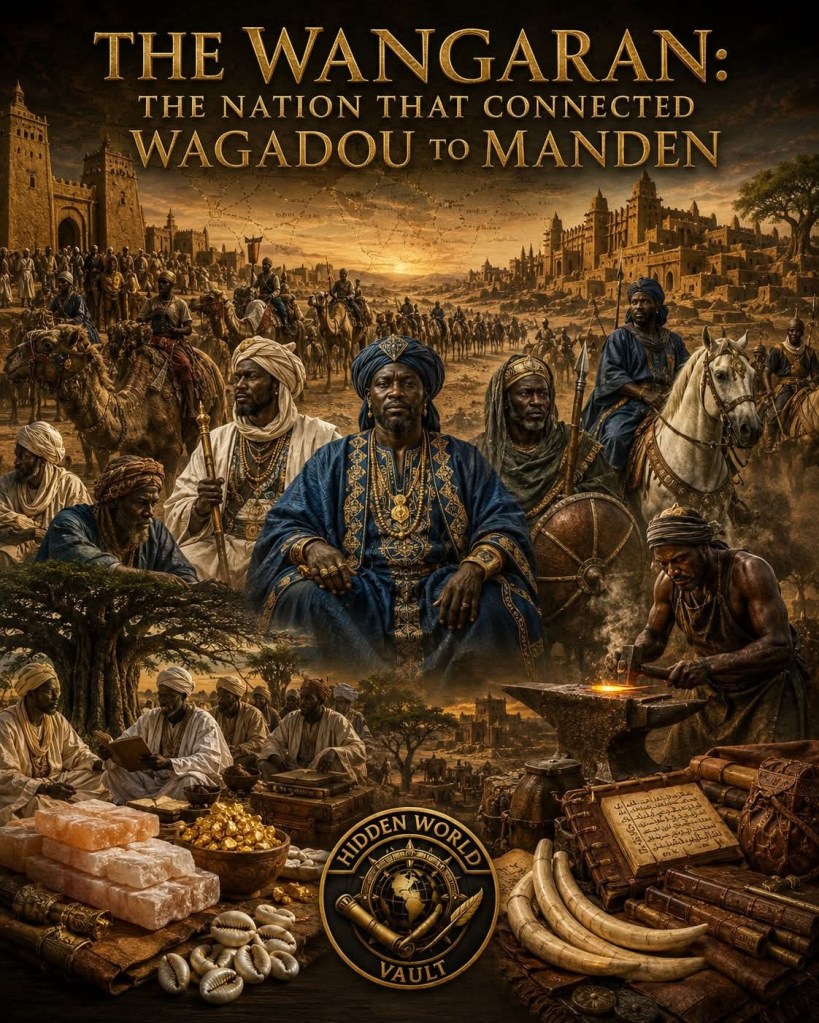
THE WANGARAN: THE NATION THAT CONNECTED WAGADOU TO MANDEN
THE WANGARAN: THE NATION THAT CONNECTED WAGADOU TO MANDEN
Who were the Wangaran?
Were they an ethnic group?
A merchant class?
A nation?
Or the architects of one of West Africa’s greatest civilizations?
The answer depends on whether we look through the lens of mainstream historical scholarship, oral tradition, or both. Together, these sources reveal a fascinating story that stretches across more than a thousand years of West African history.
- Before Empires, There Were Ancient Peoples
Long before the rise of the Ghana Empire (Wagadou), the western Sudan was already inhabited by diverse communities.
Mainstream archaeology confirms that human populations occupied the region for thousands of years before the emergence of organized states. Early hunter-gatherers, fishing communities, and farming societies gradually developed across the Sahel and the Upper Niger basin.
Manding oral traditions preserve another layer of this ancient past. They speak of early populations remembered as the Kakōrō (Kakolo), a people associated with hunting, ironworking, agriculture, ritual knowledge, and the founding of early settlements.
According to these traditions, the Kakōrō were among the earliest builders of society in parts of the western Sudan, long before the political dominance of the Soninké.
Although this reconstruction remains part of oral historical memory rather than established academic consensus, it continues to occupy an important place in the historical traditions of many Manding communities.
- The Rise of Wagadou
Between the first and early second millennium CE, the Kingdom of Wagadou, better known as the Ghana Empire, emerged as one of Africa’s earliest great states.
Located between present-day Mauritania and Mali, Wagadou controlled the famous trans-Saharan gold trade that linked West Africa with North Africa and the Mediterranean world.
The empire became renowned for:
- Gold production
- Salt trade
- Long-distance commerce
- Military organization
- Horse cavalry
- Diplomatic relations
Its ruling dynasty is remembered in Soninké traditions through figures such as Dinga Cissé, Diabé Cissé, and Kaya Magan Cissé.
- The Meeting of Two Historical Worlds
According to Manding and some Soninké oral traditions, the rise of Wagadou did not erase the older populations who already occupied the region.
Instead, something far more significant happened.
The Soninké and the Kakōrō gradually lived together over many generations.
They traded.
They married one another.
They shared hunting traditions.
They exchanged agricultural knowledge.
They forged political alliances.
They adopted one another’s customs.
Rather than one civilization replacing another, oral traditions describe a long process of assimilation that produced a broader historical community.
- The Birth of the Wangaran
This is where the Wangaran enter the story.
According to one strand of Manding oral tradition, backed up by some Soninké traditions, Wangaran was not originally the name of an ethnic group.
Instead, it referred to a larger political and cultural nation that emerged through the integration of Soninké and Kakōrō populations.
In this interpretation, “Wangaran” described a historical community united by commerce, political organization, and shared cultural traditions rather than by a single ethnicity.
Mainstream scholarship offers a different, though not entirely incompatible, perspective. Historians generally identify the Wangara as networks of Manding and Soninké-speaking Muslim merchants who carried gold, textiles, books, and Islamic learning across West Africa from the Ghana, Mali, and Songhai periods onward.
These two perspectives reflect different ways of remembering the past: one preserved in written historical sources and archaeology, the other in oral traditions transmitted by generations of griots.
- More Than Merchants
Whether viewed through oral tradition or historical scholarship, the Wangaran became associated with influence that reached far beyond trade.
They helped connect kingdoms.
They carried ideas as well as goods.
They spread Islamic scholarship.
They established settlements.
They built commercial partnerships that linked forests, savannas, and deserts across West Africa.
Their networks stretched across regions that are today:
- Mauritania
- Mali
- Senegal
- The Gambia
- Guinea
- Sierra Leone
- Liberia
- Côte d’Ivoire
- Burkina Faso
- Ghana
- Niger
In many places, Wangara communities became respected as merchants, scholars, judges, diplomats, and advisers to kings.
- The Road to Manden
Following the gradual decline of Wagadou, populations moved in many directions.
Mainstream historians attribute this movement to changing trade routes, political fragmentation, environmental pressures, and regional conflicts.
Manding oral traditions add that many Soninké families settled among the Manding communities already living in Manden, where centuries of interaction produced the civilization that later gave rise to the Mali Empire.
In this understanding, Manden was not the creation of a single people but the product of generations of cultural exchange and integration.
- Why So Many West Africans Share the Same Surnames
This long history helps explain one of West Africa’s most remarkable cultural features.
Across dozens of ethnic groups, one encounters the same ancient family names:
- Camara (Kamara)
- Cissé (Ceesay, Sesay)
- Fofana
- Kanté
- Konaté
- Kouyaté
- Traoré
- Touré
- Diabaté
- Koita
- Mariko
- Magassa
- Sakho
- Silla
- Koroma
- Condé and many others
These Manding-Soninké (Wangaran) surnames are found among Soninké, Mandinka, Malinké, Bambara, Dyula, Diakhanké, Konianka, Yalunka (Djallonké), Susu, Vai, Kuranko, Loko, Mende and many other communities.
Their widespread distribution reflects centuries of migration, intermarriage, trade, religious scholarship, political alliances, and cultural exchange rather than the history of a single ethnic group.
- A Shared West African Heritage
The story of the Wangaran reminds us that African history cannot always be understood through modern national borders or rigid ethnic categories.
Families moved.
Languages evolved.
Kingdoms rose and fell.
Communities merged.
Cultures transformed.
The Wangaran stand as a symbol of these deep historical connections that continue to shape West Africa today.
Whether remembered as a merchant network, a historical nation, or both, their legacy survives in the surnames people bear, the oral traditions families preserve, the trade routes that connected distant lands, and the shared heritage of millions across the region.
History is not only written in books.
It also lives in names, memories, songs, and the stories passed from one generation to the next.
REFERENCES
Mainstream Scholarship
● Nehemia Levtzion, Ancient Ghana and Mali
● D. T. Niane, Sundiata: An Epic of Old Mali
● Ivor Wilks, studies on the Wangara trading networks
● Maurice Delafosse, Haut-Sénégal-Niger
● Tarikh al-Sudan
● Tarikh al-Fattash
Oral Traditions
● Ansoumane Djala Sékou Camara
● Soninké oral traditions of Wagadou
● Manding jeli (griot) traditions
● Oral traditions concerning the Kakōrō (Kakolo)
● Oral traditions on the formation of Manden and the Wangaran historical community
HiddenWorldVault #AfricanHistory #WestAfricanHistory #Wangaran #Wagadu #AncientGhana #Manden #MaliEmpire #Soninke #Mande #Kakolo #OralTraditions #KnowYourRoots #AfricanCivilization #HistoryMatters