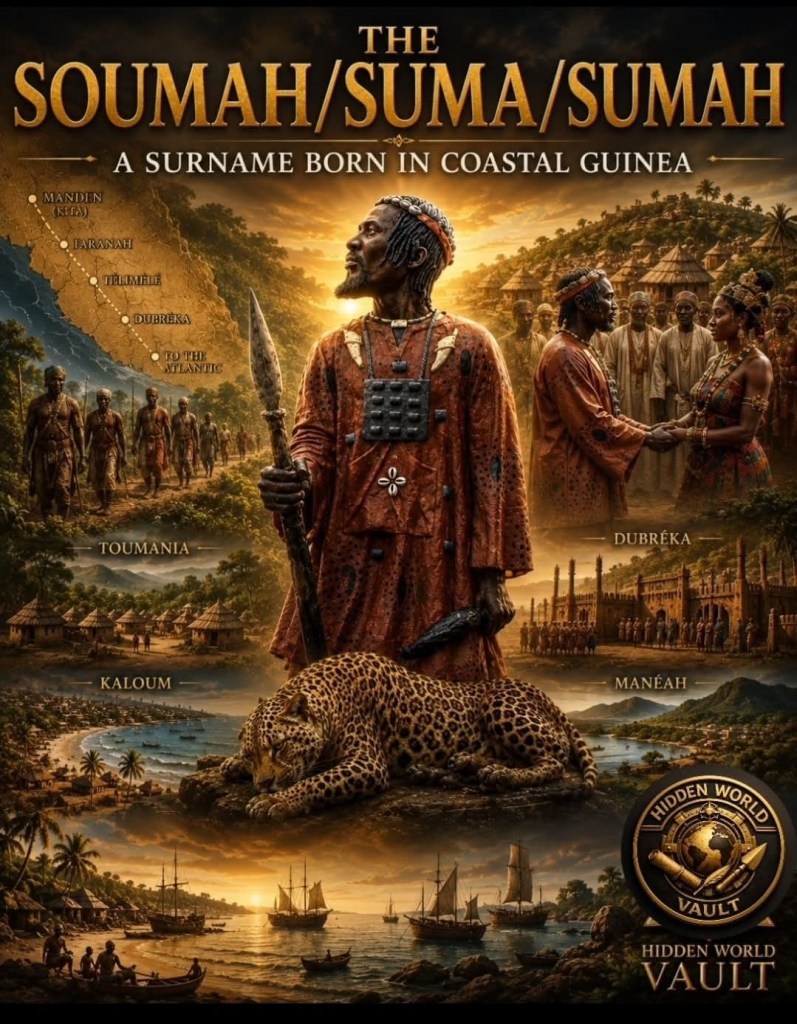
THE SOUMAH / SUMA / SUMAH: A SURNAME BORN IN COASTAL GUINEA
THE SOUMAH / SUMA / SUMAH: A SURNAME BORN IN COASTAL GUINEA
Across the Atlantic coast of West Africa, few surnames carry as much historical prestige as Soumah (also written Somah or Suma, Sumah). Today, the name is inseparable from the history of the Susu and Baga people of Guinea, but its story is far older than modern ethnic identities. It is the story of migration, courage, diplomacy, statecraft, and the remarkable fusion of civilizations.
The history of the Soumah clan is not simply about one family. It is the history of how the Manding interior and the indigenous Atlantic coast came together to create one of Guinea’s greatest royal dynasties.
- THE MANDING ROOTS
According to Susu, Djallonké (Yalunka), and Manding oral traditions, the ancestor of the Soumah clan originated in Kita, one of the oldest centers of the Manding world in present-day Mali.
Their founding ancestor is remembered as Soumba Toumani, born around 1571.
He was not an ordinary man.
He belonged to one of the famous Donso (hunter) brotherhoods of Manding society.
These hunters were far more than game trackers.
They were:
● military commanders
● guardians of the forests
● spiritual initiates
● diplomats
● frontier protectors
Among the Manding, hunters occupied one of the most respected positions in society because they combined courage, wisdom, medicine, and warfare.
Some oral traditions maintain that the word “Sômah” originally referred to a warrior-hunter, a title earned through bravery rather than inherited by birth.
- THE GREAT MIGRATION
Success often attracts rivals.
According to oral traditions, political tensions and conflicts eventually compelled Soumba Toumani and his followers to leave Kita.
Rather than moving directly to the coast, their migration unfolded over several generations and settlements.
They first established themselves around Faranah, where a locality known as Toumania still preserves the memory of their founder.
Many historians and oral traditions identify these communities with the ancestors of today’s Djallonké (Yalunka) populations.
The journey continued westward through present-day Télimélé, where Soumba Toumani settled at Soubékrou before descending toward the Atlantic coast.
This migration was not merely geographical.
It represented the gradual expansion of Manding civilization into the forests and coastal plains of Upper Guinea.
- THE ARRIVAL IN LOWER GUINEA
By the early seventeenth century, Soumba Toumani reached the fertile lands of present-day Dubréka.
These territories were already inhabited by indigenous peoples, particularly the Baga and Mandenyi.
Contrary to the simplistic idea of conquest, Susu and Baga traditions emphasize cooperation.
Soumba Toumani won the confidence of the Baga through his exceptional military skill.
He protected villages from raiders.
He defended trade routes.
He eliminated dangerous wildlife.
His reputation spread rapidly across the coast.
- A MARRIAGE THAT CHANGED HISTORY
One of the most significant moments in Guinea’s history came around 1610.
King Baya Tomboli, remembered in some traditions as Baya Tomboli, gave his daughter in marriage to Soumba Toumani.
This marriage permanently united two civilizations.
On one side stood the Manding-Djallonké warrior tradition.
On the other stood the indigenous Baga rulers of the Atlantic coast.
From this union emerged a new dynasty.
The descendants of Soumba Toumani became simultaneously:
● Manding/Djalonka through their father.
● Baga through their mother.
This explains why the history of the Soumah clan belongs not to one people alone but to several intertwined communities.
- THE BIRTH OF THE SOUMAH NAME
Many people assume Soumah was always an ancient surname.
Oral traditions suggest something more fascinating.
According to these traditions, “Soma” was originally an honorific title given to Soumba Toumani because of his extraordinary military achievements.
Different traditions interpret the title differently.
Some say it meant:
● war chief
● victorious warrior
● master hunter
● defender of peace
Following his death, his descendants proudly adopted the title as their hereditary surname.
French colonial administration later standardized the spelling as Soumah, while English-speaking territories preserved Sumah or Suma.
- THE KINGDOM OF DUBRÉKA
Following the death of his father-in-law around 1621, Soumba Toumani became king of Dubréka.
His reign transformed a regional alliance into one of the strongest kingdoms along the Upper Guinea coast.
He reorganized the state with remarkable political sophistication.
The kingdom was divided into three major provinces.
Kaloum Province
Governed by Manga Kanta.
Its capital was Kaporo.
This province controlled maritime trade and the territory that later became modern Conakry.
Tabounsou Province
Governed by Manga Demba.
Its capital was Dubréka.
It became the political and spiritual heart of the kingdom.
Manéah Province
Governed by Manga Sangaré.
Its capital was Manéah.
This province supervised agriculture and inland commerce.
Each province was administered by an Alkali, while the king was assisted by the Santigui (Prime Minister) and the Gali-Mangué, commander of the army.
For its time, Dubréka possessed one of the most organized political systems on the Upper Guinea coast.
- THE BIRTH OF THE BAGA-SUSU CIVILIZATION
Soumba Toumani’s greatest legacy was not simply military.
It was cultural.
His reign accelerated centuries of interaction between the Susu and the Baga.
Communities intermarried.
Trade expanded.
Political alliances multiplied.
Many Baga communities gradually adopted the Susu language, while the Susu absorbed numerous Baga customs and institutions.
Modern Maritime Guinea remains one of the finest examples of this cultural synthesis.
- THE FRENCH ARRIVE
By the nineteenth century, French colonial expansion reached the Guinean coast.
The Kingdom of Dubréka faced unprecedented challenges.
King Balé Demba Soumah, a descendant of Soumba Toumani, attempted to preserve his kingdom through diplomacy.
In 1885, he signed a treaty with France that eventually permitted French occupation of Tombo Island.
That decision laid the foundations for the city now known as Conakry.
Not everyone accepted colonial rule.
Many members of the Soumah lineage resisted French authority, while others pursued negotiation to safeguard their people’s future.
Ultimately, the kingdom became a French protectorate, and its political independence disappeared.
- THE LEGACY OF THE SOUMAH CLAN
Although the kingdom fell, its legacy never disappeared.
Today, the names Kaloum, Dubréka, Manéah, and Toumania remain living reminders of the kingdom established more than four centuries ago.
The tomb of Soumba Toumani continues to attract descendants and traditional custodians who honor one of Guinea’s greatest historical figures.
Across Guinea and Sierra Leone, the surnames Soumah, Sumah, and Suma continue to symbolize leadership, bravery, and historical continuity.
- MAINSTREAM SCHOLARSHIP AND ORAL TRADITIONS
Most historians agree that Soumba Toumani was a seventeenth-century hunter and military leader who migrated from the interior into Lower Guinea, married into the Baga royal family, and founded the ruling dynasty of Dubréka.
Oral traditions preserved by Susu, Baga, Djallonké, and Manding communities provide additional details about his birth in Kita, his migrations through Faranah and Télimélé, the origins of the title “Soma,” and the organization of the kingdom. While some of these traditions cannot yet be fully verified through written sources, they remain an essential part of the historical memory of the region and deserve careful study alongside archaeological and documentary evidence.
- CONCLUSION
The history of the Soumah clan is a reminder that African history cannot be understood through modern borders or narrow ethnic labels.
It is a story of migration without forgetting one’s roots.
A story of alliance instead of annihilation.
A story of a hunter who became a king.
A story of a marriage that united civilizations.
And above all, a story of a family whose legacy helped shape the political and cultural landscape of coastal Guinea for more than four hundred years.
The Soumah clan stands today not merely as a surname, but as a living bridge between the Manding heartland and the Atlantic coast; a testament to the resilience, diplomacy, and ingenuity that have long defined West African civilization.
REFERENCES
Mainstream Scholarship
● Muriel Devey, Guinée
● Regional histories of the Kingdom of Dubréka
● French colonial archives on Dubréka and Balé Demba
● Studies on the history of Maritime Guinea
Oral Traditions
● Mohamed Soumah
● Susu oral traditions
● Baga oral traditions
● Djallonké (Yalunka) traditions
● Manding hunter (Donso) traditions
● Traditions preserved by the descendants of Soumba Toumani in Toumania, Dubréka
HiddenWorldVault #AfricanHistory #GuineaHistory #Soumah #Somah #Suma #Susu #Baga #Djallonke #Manding #Dubreka #Conakry #WestAfricanHistory