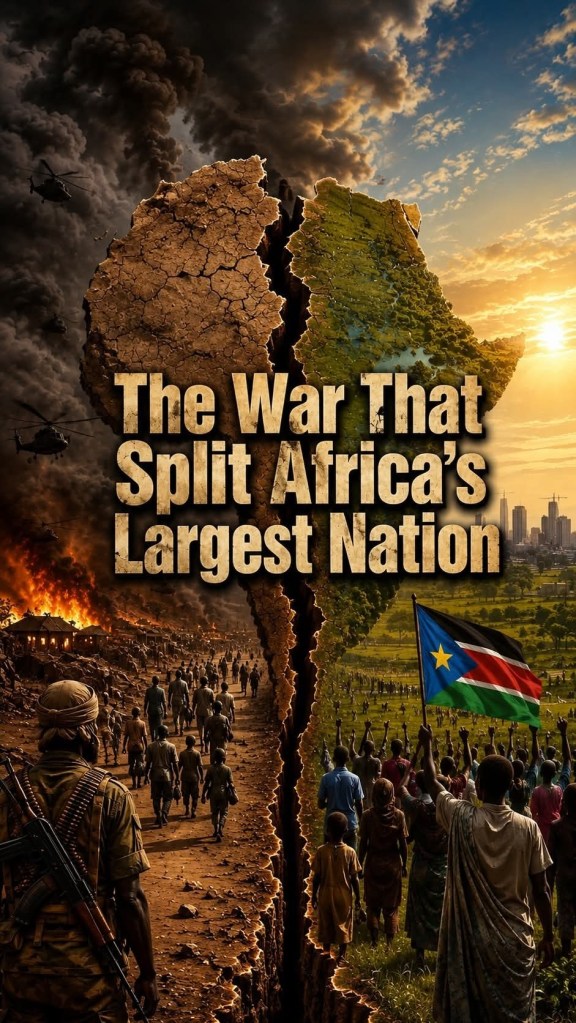
The Sudanese Civil Wars: The African Story Too Many People Never Learned
The Sudanese Civil Wars: The African Story Too Many People Never Learned
When people hear the word Sudan, many immediately think of war, famine, refugees, and suffering. But have you ever stopped to ask why Sudan became one of the most war-torn countries in modern history?
Was it simply because Africans couldn’t live together?
Or is the story far more complicated than most history books ever explain?
Let’s talk about it.
Sudan wasn’t always divided by war. For thousands of years, the land was home to powerful African kingdoms, diverse cultures, and hundreds of ethnic communities. The north developed strong ties with the Arab world and embraced Islam, while the south remained home to many African traditions and, later, Christianity through missionary influence.
Different? Yes.
Destined to fight? Not at all.
The real turning point came during colonial rule.
The British governed northern and southern Sudan almost as if they were two separate countries. The north received more roads, schools, investment, and political development. The south was left isolated, underdeveloped, and largely excluded from national administration.
Then, in 1956, Sudan gained independence.
But instead of building a government that represented everyone, political power became concentrated in Khartoum. Many people in the south felt ignored, marginalised, and shut out of decisions affecting their own future.
Before the country had even officially become independent, soldiers in the south had already begun to rebel.
That rebellion became the First Sudanese Civil War.
After seventeen years of bloodshed, peace finally arrived in 1972. Southern Sudan was granted limited self-rule.
Many believed the nightmare was over.
It wasn’t.
A decade later, oil was discovered beneath southern lands.
Suddenly, the struggle wasn’t only about identity or politics.
It was also about money.
Who would control the oil?
Who would benefit from its wealth?
Who would decide the future of those lands?
When the central government removed southern autonomy and imposed nationwide Islamic law in 1983, war erupted once again.
The Second Sudanese Civil War would become one of the deadliest conflicts since World War II.
Millions died.
Millions more fled their homes.
Entire villages disappeared.
Children grew up knowing nothing but conflict.
Yet despite all that suffering, the people of Southern Sudan continued pushing for the right to decide their own future.
Finally, in 2011, after decades of war, they voted overwhelmingly for independence.
South Sudan became the world’s newest nation.
Many believed peace had finally arrived.
But independence alone could not erase decades of destruction, political mistrust, poverty, weak institutions, and ethnic rivalries.
Conflict returned.
And today, both Sudan and South Sudan still face enormous challenges.
So the next time someone dismisses Sudan’s history as simply “Africans fighting each other,” ask them this:
How many countries could remain stable after decades of colonial division, unequal development, struggles over identity, competition for natural resources, political exclusion, and repeated wars?
History is rarely as simple as the headlines make it seem.
The Sudanese Civil Wars were not proof that Africans were incapable of peace.
They were a reminder that injustice, unequal governance, and competition for power can tear apart almost any nation.
Understanding that history isn’t about taking sides.
It’s about learning from the past so future generations don’t repeat it.
Now I want to hear your thoughts.
Do you believe Sudan’s conflicts were mainly caused by colonial borders, political leadership after independence, competition over oil, ethnic divisions—or a combination of all of them?
Let’s discuss it respectfully in the comments.