They Told You Africa Had No Writing… Then Explain Nsibidi
They Told You Africa Had No Writing… Then Explain Nsibidi
Before anybody jumps into the comment section to say Africa had no civilization before Europe arrived, let me ask you one simple question…
Have you ever heard of Nsibidi?
Not many people have. And that’s exactly the problem.
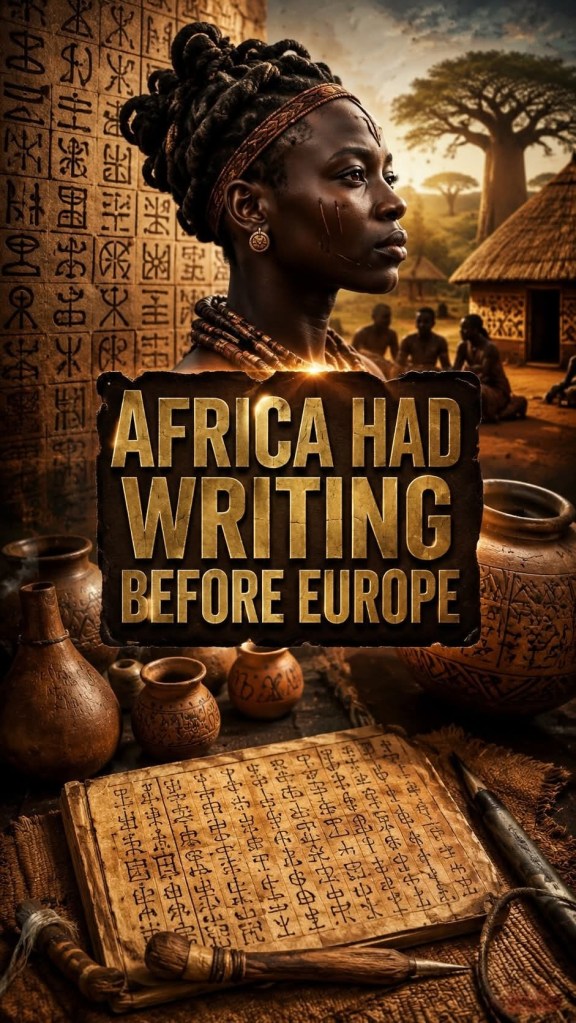
Long before colonial rule, long before English became the language of schools, and long before missionaries introduced the Roman alphabet to many communities in West Africa, there already existed an African system of graphic communication known as Nsibidi.
It wasn’t created in Europe.
It wasn’t borrowed from the Arabs.
It wasn’t copied from Asia.
It was born right here in Africa.
Originating among the Ejagham people in what is now southeastern Nigeria and parts of Cameroon, Nsibidi later spread among the Efik, Ibibio, Igbo, and neighboring communities. For generations, it was used to communicate ideas, preserve traditions, identify people, record important events, and even send secret messages.
Now here’s where many people get confused.
Nsibidi was not an alphabet like English.
It wasn’t based on A, B, C.
Instead, it used symbols to represent ideas, emotions, actions, relationships, objects, and events.
One symbol could mean love.
Another could mean peace.
Another represented marriage.
Others stood for friendship, conflict, authority, travel, family, or leadership.
Imagine being able to tell an entire story using symbols instead of spelling out every single word.
That’s exactly what made Nsibidi unique.
And it wasn’t just written on paper.
The symbols appeared on walls, wooden carvings, calabashes, pottery, ceremonial houses, clothing, body art, and sacred objects.
They were part of everyday life.
Even more fascinating, many Nsibidi symbols were used by the famous Ekpe Society, where certain signs carried meanings that only initiated members could understand.
Think about that for a moment.
Centuries before encrypted messages and passwords became part of modern technology, African societies already had symbolic systems that protected confidential information.
Yet many of us grew up believing our ancestors had no writing.
How?
Because colonial education focused almost entirely on European history while ignoring many African knowledge systems.
That doesn’t mean every African society used the same writing system.
It doesn’t mean Nsibidi was exactly like English or Arabic.
But it does prove something important.
Africa was never a continent without knowledge.
Africa was never a continent without intellectual traditions.
Africa was never waiting for civilization to arrive.
Our ancestors created systems that reflected their own cultures, languages, beliefs, and ways of thinking.
Today, historians continue studying Nsibidi because many symbols were intentionally kept secret, and some meanings have been lost over time.
That means there’s still more to discover.
So the next time someone confidently says, “Africa had no writing before Europeans came,” ask them one question…
If Africa had no writing, then what exactly was Nsibidi?
I’m not asking anyone to accept myths.
I’m asking people to study history with an open mind.
Knowledge grows when we ask questions—not when we repeat old assumptions.
Now I want to hear from you.
Had you ever heard of Nsibidi before today?
Do you think African history receives the attention it deserves in our schools?
Let’s discuss it respectfully in the comments.