HISTORY BEHIND AUGUST 1, 1966 you should know.
HISTORY BEHIND AUGUST 1, 1966 you should know.
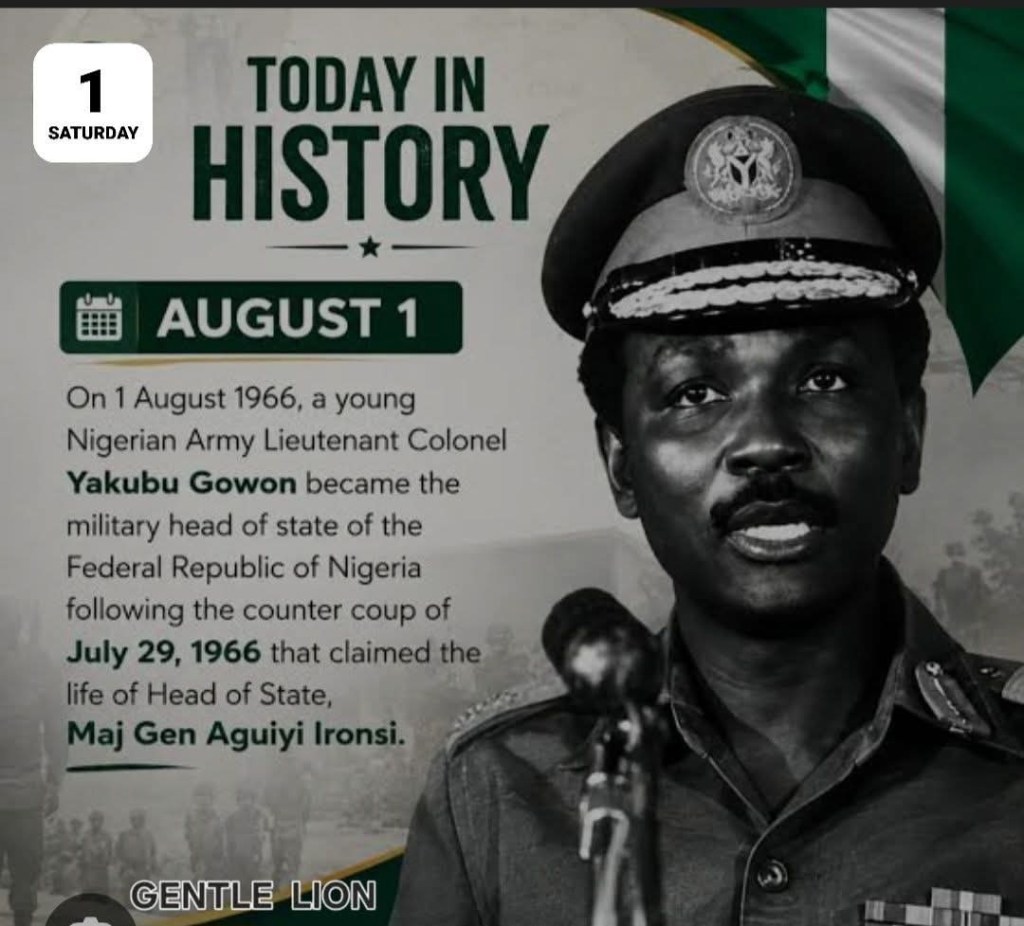
August 1, 1966: The Day Nigeria’s Leadership Changed
On August 1, 1966, Nigeria entered a new chapter.
Lieutenant Colonel Yakubu Gowon officially became Nigeria’s second military Head of State.
This came after a period of deep political crisis in July 1966 that changed the direction of the country.
1.The Context: July 1966
In late July 1966, a military mutiny took place.
This followed the events of January 15, 1966, when the First Republic was overthrown and several political and military leaders lost their lives.
During the July events, General Johnson Aguiyi-Ironsi, Nigeria’s first military Head of State, and Lt. Col. Adekunle Fajuyi also died.
The country was left without clear central leadership, and tensions rose across different regions.
2.How Gowon Emerged
With the chain of command broken, senior officers and members of the Supreme Military Council held consultations.
Lt. Col. Yakubu Gowon, then Army Chief of Staff, was chosen to lead.
He was 32 years old and from the Middle Belt.
Because he was not linked to either side of the earlier crises, many saw him as a compromise leader who could help stabilize the country.
He became one of Africa’s youngest heads of state at the time.
3.Key Points from the August 1 Broadcast
Later that day, Gowon addressed the nation on radio. His main messages were:
1.Assumed Leadership: He said he had been asked to take responsibility by the Supreme Military Council.
2.On National Unity: He made a frank statement: “The basis for unity is not there.”_ He acknowledged the deep mistrust between regions.
3.Return to Federalism: He rejected the unitary system introduced earlier and promised to restore a federal structure to address regional concerns.
4.Promise of Stability: He pledged to protect all citizens, honor treaties, and restore order.
4.The Long-Term Impact
Despite calls for calm, the events of mid-1966 left lasting effects.
There was large-scale movement of people across regions back to their home areas.
Trust between the Federal Government and the Eastern Region under Lt. Col. Odumegwu Ojukwu broke down.
Efforts to reconcile, like the Aburi Accord in 1967, did not hold.
The divisions from this period eventually led to major national conflict between 1967 and 1970.
Why It Still Matters
August 1, 1966 remains a turning point in Nigerian history.
It showed how important dialogue, federalism, and trust are in a diverse country.
 Hi welcome to my website
One thought on “HISTORY BEHIND AUGUST 1, 1966 you should know.”