THE UNTOLD STORY OF THE DIAKHANKÉS: SONINKÉ ROOTS, MANDING SOUL
THE UNTOLD STORY OF THE DIAKHANKÉS: SONINKÉ ROOTS, MANDING SOUL
History often resists simple labels.
When people ask whether the Diakhanké (Jakhanke) are Soninké or Manding, they assume the answer must be one or the other.
History tells a more fascinating story.
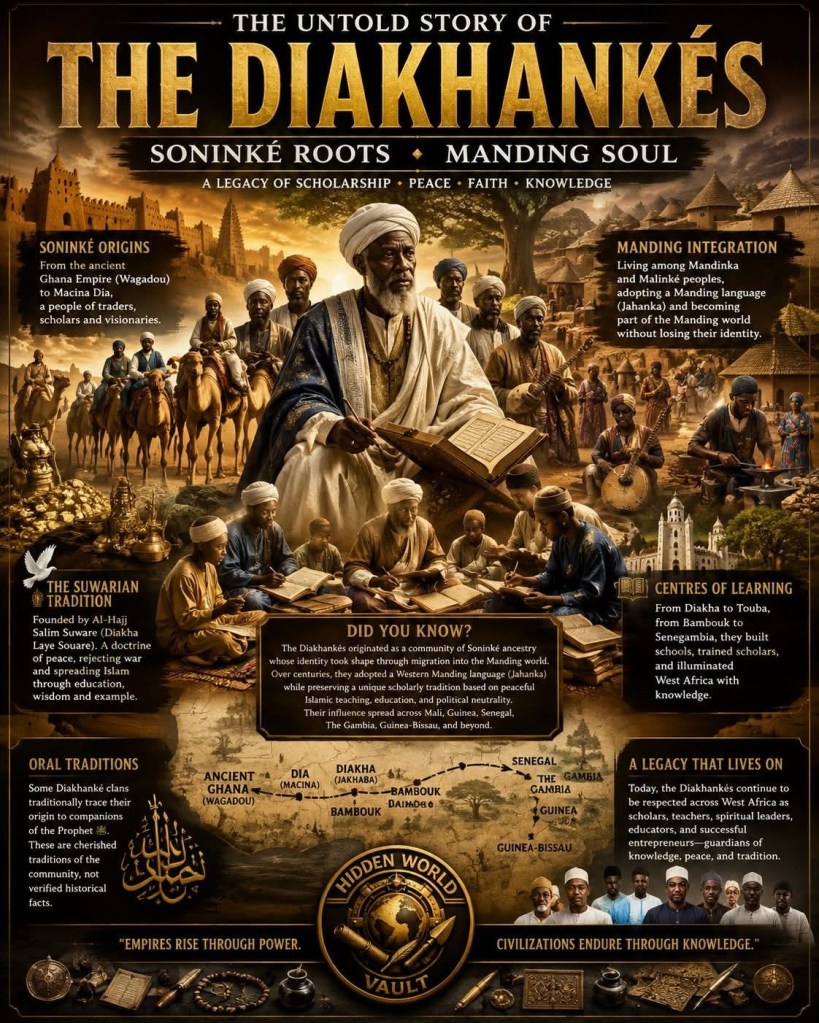
The Diakhanké emerged from Soninké (Sarakolé) roots, but over centuries became deeply integrated into the Manding world through migration, language, scholarship, trade, and intermarriage. Their identity reflects one of the greatest examples of cultural continuity and adaptation in West African history.
- The Soninké Foundation
The earliest ancestors of the Diakhanké belonged to the Soninké, founders of the ancient Ghana Empire (Wagadou), one of Africa’s earliest imperial civilizations.
Between the eleventh and thirteenth centuries, political instability, regional conflicts, and the gradual decline of Ghana encouraged many Soninké families to migrate southward and westward.
Among these migrants were merchants, jurists, Qur’anic scholars, and respected religious leaders whose descendants would eventually become known as the Diakhanké.
Their earliest identity was therefore firmly rooted within the Soninké world.
- Al-Hajj Salim Suware and the Rise of the Diakhanké
The Diakhanké tradition is closely associated with Al-Hajj Salim Suware, also remembered as Diakha Laye Souare or Mbemba Laye Souare.
According to historical tradition, he was born in Dia (Diaka) in the Macina region of present-day Mali.
After years of travel through Diafounou, Saloum, Bambouk, and neighbouring regions, he established an important religious settlement called Diakha (Jakhaba) on the Bafing River.
This settlement soon became one of the greatest centres of Islamic learning in medieval West Africa.
His teachings would profoundly influence Islam throughout the western Sudan.
- The Four Founding Families
Diakhanké tradition remembers four principal Soninké families as the original pillars of the community.
These are collectively known as the “Four Hearths” (Boloun Naano):
● Souaré
● Dramé
● Fofana-Guirassy
● Fadiga
As the community expanded across West Africa, many additional lineages became incorporated into the Diakhanké scholarly tradition, including:
● Sylla
● Diaby-Gassama
● Sakho
● Dansokho
● Diakhité
● Kaba
● Badio
● Touré
● Cissé
● Minté
● Diaouné
● Simakha
● Kadiakhé
Together they helped build one of the continent’s most respected scholarly networks.
- Becoming Part of the Manding World
Although their ancestry remained predominantly Soninké, the Diakhanké settled for centuries within territories governed by the Mali Empire.
Living among the:
● Mandinka
● Malinké
● Bambara
● Kassonké
● Dyula
they gradually adopted a Western Manding language now known as Jahanka (Diakhanké).
Their daily customs, social organisation, and cultural life increasingly reflected Manding civilisation.
This transformation did not erase their Soninké heritage.
Rather, it created a unique community that combined Soninké ancestry with Manding language and culture.
- The Suwarian Tradition
Perhaps the Diakhanké’s greatest historical contribution was the development of the Suwarian Tradition, named after Al-Hajj Salim Suware.
Unlike many contemporary Islamic movements, the Suwarian tradition rejected religious warfare as a method of spreading Islam.
Instead, it taught that:
● Islam should spread through education.
● Faith cannot be forced.
● Muslims should coexist peacefully with followers of other religions.
● Scholars should remain independent of political power whenever possible.
This philosophy distinguished the Diakhanké throughout West Africa.
They became known not as conquerors, but as teachers.
- Builders of Knowledge
For centuries, Diakhanké settlements functioned as autonomous centres of scholarship.
Students travelled from across West Africa to study:
● Qur’anic memorisation
● Arabic grammar
● Maliki jurisprudence
● Theology
● Logic
● Mathematics
● Astronomy
● Calligraphy
These schools trained generations of imams, judges, scholars, and teachers who spread Islamic learning throughout Senegambia and the western Sudan.
- A Scholarly Network Across West Africa
As their influence expanded, Diakhanké communities established settlements throughout:
● Mali
● Guinea
● Senegal
● The Gambia
● Guinea-Bissau
● Côte d’Ivoire
● Mauritania
In different regions they became known by different names, including:
● Diakhanké
● Jakhanke
● Jahanka
● Wangara
● Toubaka
● Suwarians
Despite these regional names, they remained united through shared scholarship, family ties, and religious tradition.
- Agriculture, Trade, and Learning
The Diakhanké sustained their educational institutions through agriculture and commerce.
Their communities cultivated farms, participated in regional trade networks, and maintained economic independence from political rulers.
This independence enabled generations of scholars to dedicate themselves almost entirely to education and religious instruction.
- Touba: A New Centre of Learning
During the nineteenth century, Karamokho Ba (Karamokhoba Diaby Gassama) founded the town of Touba in Guinea around 1815.
Touba rapidly became one of West Africa’s most respected centres of Islamic scholarship.
Students from across the region travelled there to pursue advanced religious education.
For many decades, Touba stood among the intellectual capitals of Muslim West Africa.
- Colonial Rule and Dispersion
French colonial expansion profoundly transformed Diakhanké society.
Colonial conquest, administrative reforms, and the abolition of slavery weakened the economic foundations that had supported many scholarly communities.
As a result, Diakhanké families dispersed throughout West Africa.
Although many famous educational centres declined, the scholarly tradition survived through village schools, family networks, and generations of respected teachers.
- Oral Traditions and Genealogical Memory
Alongside documentary history, the Diakhanké preserve rich oral traditions concerning their ancestry and founding lineages.
According to these traditions, certain Diakhanké clans trace their ancestry to companions of the Prophet Muhammad.
For example:
● The Dramé are traditionally linked to Salman al-Farisi.
● The Fofana-Guirassy are linked to Abu Bakr al-Siddiq.
● The Diaby are associated with Umar ibn al-Khattab.
● The Sylla are connected to Al-Abbas, the Prophet’s uncle.
These genealogies form an important part of Diakhanké historical memory and spiritual identity.
However, modern historians generally regard these claims as oral traditions rather than established historical fact. While historical interaction between North Africa, the Islamic world, and West Africa is well documented, there is currently no conclusive documentary evidence demonstrating direct descent of these clans from the Prophet’s companions.
Rather than dismissing these traditions, historians recognise them as an important component of the community’s cultural heritage that reflects how the Diakhanké have understood and preserved their own past across generations.
- A Lasting Legacy
Today the Diakhanké continue to be respected throughout West Africa as scholars, religious leaders, educators, businesspeople, and guardians of Islamic learning.
Their history demonstrates that civilizations are not built only by kings and armies.
Sometimes they are built by classrooms, libraries, teachers, and generations of students.
The Diakhanké remind us that scholarship can transform societies just as profoundly as political power.
Their story belongs not only to the Soninké.
Nor only to the Manding.
It belongs to the shared history of West Africa itself.
REFERENCES
● Lamin O. Sanneh, The Jakhanke: The History of an Islamic Clerical People of the Senegambia (1979).
● Nehemia Levtzion, Ancient Ghana and Mali (1973).
● Nehemia Levtzion & Randall L. Pouwels (eds.), The History of Islam in Africa (2000).
● David C. Conrad, Empires of Medieval West Africa (2005).
● John O. Hunwick, Timbuktu and the Songhay Empire (1999).
● J. Spencer Trimingham, A History of Islam in West Africa (1962).
● UNESCO, General History of Africa, Volumes IV and V.
● Ivor Wilks, “Wangara, Akan and Portuguese in the Fifteenth and Sixteenth Centuries,” Journal of African History.
● Bruce S. Hall, A History of Race in Muslim West Africa, 1600–1960 (2011).
 Hi welcome to my website
Very nice.
LikeLiked by 1 person