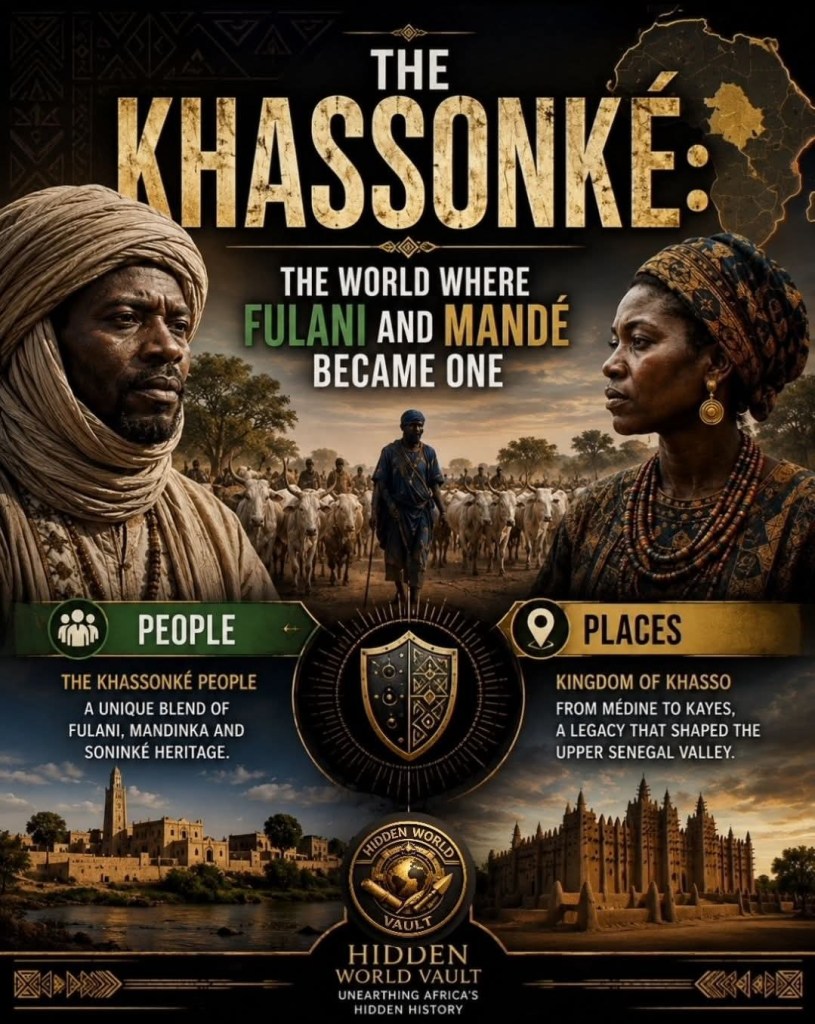
THE KHASSONKÉ: THE WORLD WHERE FULANI AND MANDING BECAME ONE
THE KHASSONKÉ: THE WORLD WHERE FULANI AND MANDING BECAME ONE
What happens when two great civilizations merge?
The answer is the Khassonké.
The Khassonké are not simply another Mandé-speaking people. They are one of West Africa’s most remarkable examples of a new nation emerging from centuries of migration, cultural exchange, and political transformation.
- According to mainstream historical research…
Historians generally agree that the Khassonké emerged between the 16th and 17th centuries through the integration of Fulani (Peul) migrants with Mandinka (Malinké) and Soninké communities in the upper Senegal River valley.
Rather than one people replacing another, a new society gradually formed.
The Fulani brought pastoral traditions.
The Mandinka and Soninké contributed the dominant political institutions, language, and commercial networks.
Together, they created a new identity.
Their name, Khassonké, is traditionally associated with the khasso, a woolen tunic worn by these early settlers.
- The Birth of the Kingdom of Khasso
According to historical records, Yamadou Hawa (Amadou Awa) Diallo led a successful uprising around 1681, establishing the Kingdom of Khasso.
His son,
Séga Doua Diallo
became the first king (Fankamala) and transformed Khasso into one of the strongest kingdoms in the Upper Senegal Valley.
The ruling dynasty, known as the Fulani Bambéra (Bamberaaɓe) Dynasty, remained in power for generations.
The known rulers include:
- Diadié Diallo
- Maré Mfa Diallo
- Makhandja Mbata Diallo
- Sandiki Khoy Diallo
- Amadou Awa Diallo
- Séga Doua Diallo
- Diadié Gagnesiri Diallo
- Guimba Kinti Diallo
- Demba Séga Diallo
- Wouri Diadié Diallo
- Saféré Diallo
- Dibba Sambala Diallo
- Moussa Khoy Diallo
- A Kingdom Divided
The death of Demba Séga Diallo in 1796 changed everything.
A succession struggle between his sons,
Dibba Sambala Diallo
and
Demba Maddy Diallo
plunged Khasso into civil war.
By around 1800, the once-unified kingdom had fragmented into five independent states:
- Dembaya
- Séro
- Almamya
- Diadiéya
- Guimbaya
Among them, Dembaya, ruled by Awa Demba Diallo, became the most powerful, with its capital at Médine.
- Regional Rivalries
Khasso maintained complex relationships with neighboring Mandinka kingdoms such as Bambouk, whose rulers bore the title Farin.
Some neighboring states, including Niatiaga, were at times vassals of Khasso.
The kingdom also faced repeated attacks from the Bambara Kingdom of Kaarta before confronting the expanding Toucouleur Empire under El Hadj Umar Tall.
- The Siege of Médine
In 1857, Khassonké leaders made one of the most consequential decisions in their history.
They allied with French forces during the famous Siege of Médine, helping repel El Hadj Umar Tall.
Although this alliance preserved Khasso from Toucouleur conquest, it also accelerated French colonial expansion.
By the end of the nineteenth century, Khasso had been absorbed into French Sudan, present-day Mali.
- The Language Revolution
Perhaps the most fascinating transformation happened not in politics, but in language.
Although the ruling dynasty was of Fulani origin, generations of interaction with Mandinka communities led to the gradual abandonment of Fulfulde.
The Khassonké adopted a variety of Western Manding, closely related to Maninka and Bambara.
Yet they never abandoned their ancestral memory.
Fulani surnames such as:
- Diallo
- Diakité
- Sidibé
- Sangaré
remain among the Khassonké today.
Their language preserves Manding grammar while still carrying traces of Fulani influence in pronunciation and specialized vocabulary.
- Oral Traditions and Hidden Histories
Beyond the mainstream historical narrative, oral traditions across the wider Mandé world often preserve memories that extend further back than surviving written records.
At Hidden World Vault, we study these traditions alongside comparative linguistics, migration patterns, and documented history.
Our goal is not to replace established scholarship, but to compare multiple sources of evidence, including oral history, to better understand Africa’s past.
History deserves investigation, not blind acceptance.
Every kingdom has a written history.
Every people have a remembered history.
Both deserve to be studied carefully.
Unearthing Africa’s forgotten past through research, oral traditions, comparative linguistics, and historical evidence.
REFERENCES
- James Stuart Olson (Ed.). The Peoples of Africa: An Ethnohistorical Dictionary. Greenwood Press, 1996.
- David C. Conrad & Barbara E. Frank (Eds.). Status and Identity in West Africa: Nyamakalaw of Mande. Indiana University Press, 1995.
- Nehemia Levtzion. Ancient Ghana and Mali. Methuen, 1973.
- Nehemia Levtzion & John F. P. Hopkins (Eds.). Corpus of Early Arabic Sources for West African History. Markus Wiener Publishers, 2000.
- Yves Person. Samori: Une révolution dyula. IFAN, Dakar, 1968–1975.
- Valentin Vydrin. Manding-English Dictionary and publications on Manding linguistics.
- Denis Creissels. Studies in Manding Languages and Linguistics.
- Charles Monteil. Les Bambara du Ségou et du Kaarta. Paris, 1924.
- Maurice Delafosse. Haut-Sénégal-Niger. Paris, 1912.
- Oral traditions collected among Khassonké, Maninka, Soninké, and Fulani communities in Mali, Senegal, and Guinea, compared with historical and linguistic evidence.
Research Note:
This presentation combines mainstream historical scholarship with comparative linguistics and oral traditions. Where oral traditions differ from published academic interpretations, both perspectives are acknowledged to encourage continued research and informed discussion. Hidden World Vault supports evidence-based historical inquiry rather than uncritical acceptance of any single narrative.