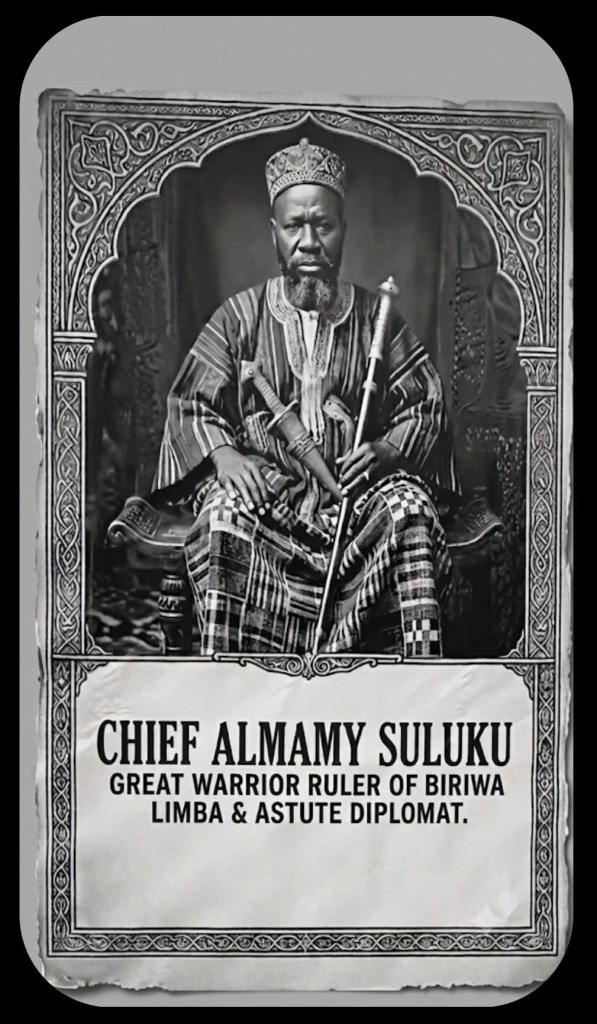
The Chief Who Outsmarted Empires: The Remarkable Story of Almamy Suluku
The Chief Who Outsmarted Empires: The Remarkable Story of Almamy Suluku
Long before Sierra Leone became a British Protectorate, when powerful kingdoms ruled the interior and foreign powers were competing for influence in West Africa, one leader understood a truth that many rulers ignored: a kingdom was not defended by weapons alone.
It was defended by wisdom, patience and the ability to understand the intentions of those around you.
His name was Chief Almamy Suluku, one of the most remarkable rulers in the history of the Limba people and one of the greatest political strategists Sierra Leone has ever produced.
Born around 1820, Suluku was the second son of Sankailay, the ruler of the Biriwa Limba kingdom in northern Sierra Leone. From an early age, he showed exceptional courage and leadership qualities. He became known as a skilled warrior and was eventually appointed Kurugba, the kingdom’s war captain.
But Suluku was not just a fighter. He was a strategist.
Under his leadership, Biriwa Limba expanded its influence, bringing neighbouring territories, including Safroko Limba, under its control. Through military strength and political organisation, the kingdom grew into one of the most powerful states in the Sierra Leone hinterland.
When his father died in 1873, Suluku became Gbaku, the supreme ruler of Biriwa Limba.
His kingdom stretched across a large territory between the Rokel and Mabole rivers, with Bumban serving as its political centre. At a time when many rulers focused only on conquest, Suluku understood that a strong economy was the foundation of a strong state.
He turned Biriwa into an important centre of trade.
Under his rule, traders moved safely through his territory carrying valuable goods such as gold, ivory, hides and agricultural products from the interior towards Freetown. He protected trade routes, punished criminals who threatened merchants and created an environment where commerce could flourish.
The wealth that came from trade strengthened his army, his administration and his influence.
But Suluku’s greatest challenge came not from a neighbouring chiefdom, but from one of the most powerful military leaders in West Africa.
During the 1880s, the armies of the Mandinka conqueror Samori Touré were expanding rapidly across the region. Many kingdoms that confronted Samori’s forces directly were destroyed or forced into submission.
Suluku chose another approach.
When Samori’s Sofa forces entered parts of Biriwa around 1884, Suluku avoided a reckless war that could have devastated his people. Instead, he used diplomacy and patience. While appearing to cooperate with the occupying forces, he continued to protect his kingdom’s interests and maintained communication with British officials in Freetown.
He understood that survival sometimes required intelligence more than bravery.
By carefully managing relationships with both sides, Suluku preserved his kingdom from complete destruction. His warnings to British officials that continued Sofa occupation would disrupt trade eventually contributed to British intervention. In 1888, Major Morton Festing, a British special service officer, negotiated the withdrawal of the Sofa forces from Biriwa.
Suluku’s victory was not achieved through a single battle, but through patience, political calculation and the ability to use diplomacy to protect his people when direct confrontation could have brought disaster.
His political skills became famous.
British officials often viewed him as a friendly and cooperative ruler because of the respect he showed towards them. But behind the diplomatic smiles was a leader determined to protect the independence of his kingdom.
Suluku knew how to negotiate without surrendering.
When Britain officially declared Sierra Leone a Protectorate in 1896, the political situation changed. Traditional rulers who had controlled their territories for generations were now facing a new colonial authority.
Then came the Hut Tax War of 1898, one of the most important resistance movements in Sierra Leone’s history.
During the Hut Tax War of 1898, Suluku carefully maintained a public position of caution while continuing to protect the interests of his people. Historical accounts suggest that he secretly supported the resistance led by chiefs such as Bai Bureh by providing warriors and weapons, even while maintaining communication with British officials.
It was a dangerous balance, but it reflected Suluku’s lifelong strategy: avoiding unnecessary destruction while defending his kingdom’s influence.
Even after colonial rule was established, Suluku remained one of the most influential chiefs in northern Sierra Leone. His reputation, wealth and political experience made him a figure the colonial administration had to consider carefully.
His authority survived because it was built over decades through military strength, economic power and the loyalty he earned from his people.
As Suluku grew older, a British district commissioner reportedly asked him who would succeed him after his death.
The old chief smiled and replied:
“Suluku will never die.”
Those words became a symbol of his enduring legacy.
Chief Almamy Suluku died in 1906, but his influence continued long after his passing. More than a century later, his name remains remembered as that of a leader who combined courage with wisdom, strength with diplomacy and power with vision.
He was not only a warrior who defended his land. He was a statesman who understood politics, protected trade and preserved the dignity of his people during one of the most difficult periods in Sierra Leone’s history.
The story of Almamy Suluku reminds us that sometimes the greatest victories are not won on the battlefield.
Sometimes they are won through patience, intelligence and the ability to outthink those who seek to control you.