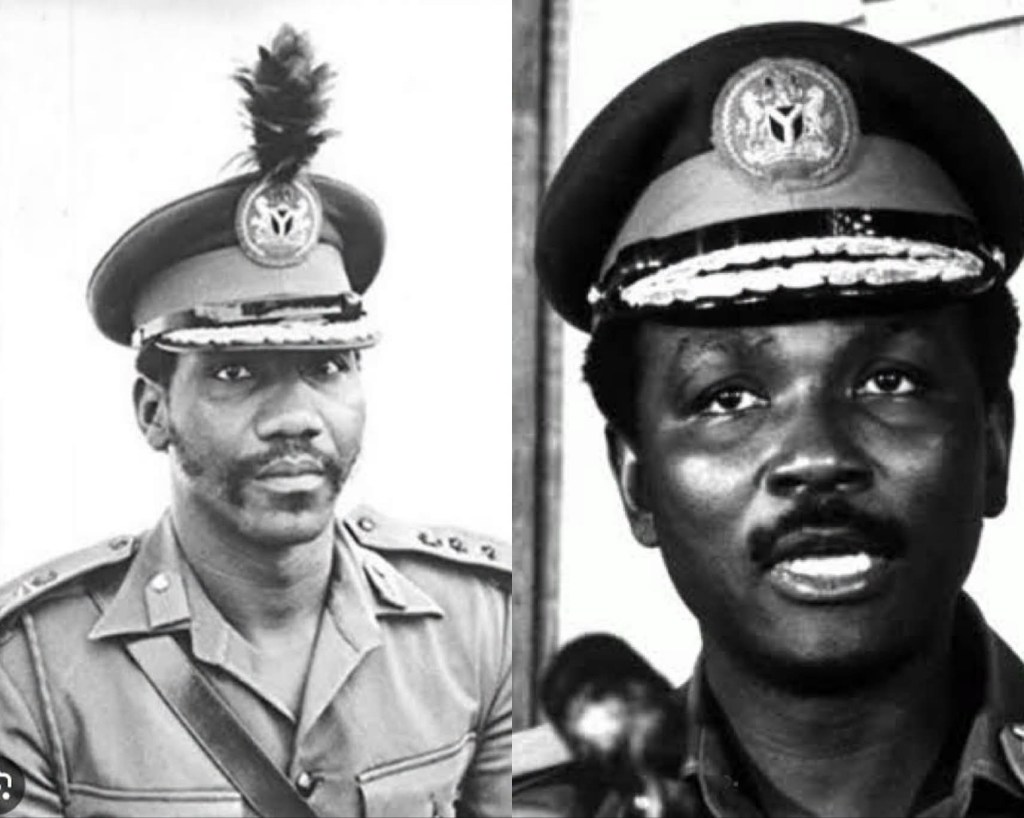
On 29 July 1975, Nigeria experienced another major military intervention that brought an end to the nine year rule of General Yakubu Gowon.
On 29 July 1975, Nigeria experienced another major military intervention that brought an end to the nine year rule of General Yakubu Gowon. Gowon was outside the country at the time, attending the 12th Summit of the Organisation of African Unity in Kampala, Uganda, when news reached him that his government had been overthrown.
The announcement that morning came from Colonel Joseph Nanven Garba, commander of the Brigade of Guards and one of Gowon’s trusted officers and close ally. Speaking over Lagos Radio, Garba announced that the Nigerian Armed Forces had decided to change the leadership of the Federal Military Government and declared that Gowon had ceased to be Head of State and Commander in Chief of the Armed Forces. Contemporary British parliamentary records confirmed that Garba’s broadcast was the first major public indication of the coup and that it was followed by measures including a curfew and the closure of Nigeria’s borders and airports.
The broadcast began with the words:
“Fellow countrymen and women, I, Colonel Joseph Nanven Garba, in consultation with my colleagues, do hereby declare that in view of what has been happening in our country in the past few months, the Nigerian Armed Forces decided to effect a change of the leadership of the Federal Military Government. As from now, General Yakubu Gowon ceases to be head of the Federal Military Government and Commander-in-Chief of the Armed Forces of Nigeria. The general public is advised to be calm and to go about their lawful duties.”
Garba then announced that General Gowon had ceased to be Head of the Federal Military Government and Commander in Chief of the Armed Forces of Nigeria. He appealed to Nigerians to remain calm and continue with their lawful activities.
Although Garba’s voice became the public face of the coup, the overthrow of Gowon was not simply a personal action by Garba. The military intervention was led by senior officers around Brigadier Murtala Ramat Mohammed, who subsequently emerged as the new Head of State. Scholars have linked the coup to growing dissatisfaction within the military over the direction of Gowon’s government, including concerns about corruption, administrative weaknesses and the indefinite postponement of the promised return to civilian rule.
The question of civilian rule was particularly important. In October 1970, Gowon had announced a programme that was expected to prepare Nigeria for a return to democratic government. However, the timetable was later postponed indefinitely. By 1975, the prolonged military government had generated increasing frustration among sections of the armed forces and the wider political establishment. Historian Claude S. Phillips notes that Gowon’s removal came nine years after he had first assumed power and that the new military leadership presented the need to restore confidence in the military government as one of its justifications.
Another factor was the enormous political and economic importance of Nigeria’s oil wealth. By the early 1970s, rising petroleum revenues had transformed the country’s economy and greatly increased the resources controlled by the federal government. Recent scholarship has argued that the concentration of oil wealth within the Gowon administration contributed to tensions within the military and formed part of the broader political circumstances surrounding the 1975 coup.
The coup itself was remarkably peaceful compared with the violence associated with some earlier military interventions in Nigeria. Garba’s announcement explicitly described the operation as bloodless and warned Nigerians against disrupting public order. The coup plotters were able to take control of key institutions with limited fighting, allowing Murtala Mohammed to assume power without a prolonged armed confrontation. Contemporary diplomatic reporting likewise described Garba and other senior officers as central figures in what was regarded as a bloodless overthrow of Gowon’s government.
Garba’s involvement was particularly striking because of his relationship with Gowon. He had been trusted with responsibility for the security of the Head of State and had risen through the military establishment under Gowon’s patronage. His participation therefore gave the coup a deeply personal dimension. Later accounts, including Gowon’s own memoir published in 2026, have described Garba’s involvement as a profound personal betrayal because of the trust Gowon had placed in him.
Following the coup, General Murtala Mohammed became Head of State and began a major reorganisation of the Nigerian government and military. His administration also initiated a new programme for political transition. In October 1975, Murtala addressed the Constitution Drafting Committee and stressed the need to prevent the regional divisions that had contributed to Nigeria’s earlier political crises.
Gowon remained outside Nigeria after his removal and eventually settled in Britain. Garba continued his own public career and later became one of Nigeria’s most prominent diplomats, eventually serving as President of the United Nations General Assembly.
Despite the dramatic circumstances of Gowon’s removal, the relationship between the two men did not remain permanently hostile. Their later reconciliation became an important part of the story of the 1975 coup. Garba died in June 2002, and accounts of his death noted his earlier role in the overthrow of Gowon.
The 29 July 1975 coup therefore represents much more than the removal of one military ruler by another. It marked a turning point in Nigeria’s post Civil War political history. It ended Gowon’s long tenure, brought Murtala Mohammed to power and opened a new phase of military rule that would eventually lead to another attempt at returning Nigeria to civilian government.
The episode also reveals the complicated nature of personal relationships within Nigeria’s military elite. Colonel Joseph Garba was both a trusted officer of Gowon and one of the men who announced his removal from power. His role in the coup remains one of the most remarkable examples of how personal loyalty, institutional dissatisfaction and political ambition intersected in Nigeria’s turbulent military history.