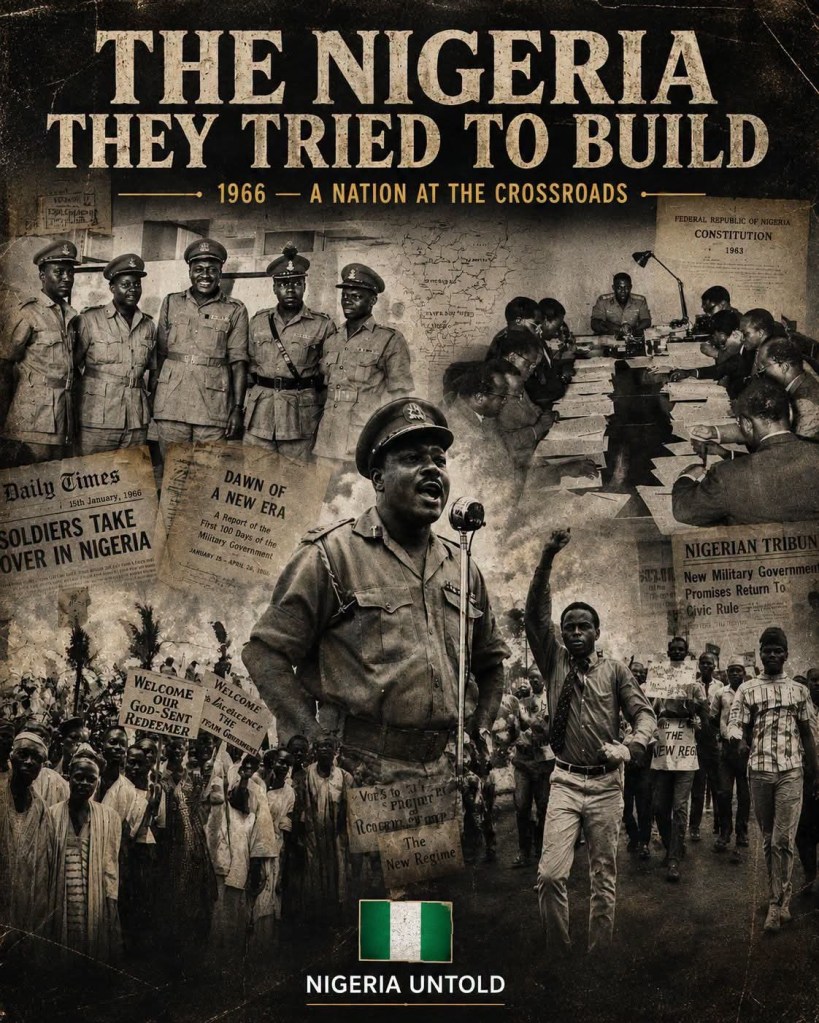
𝗧𝗛𝗘 𝗡𝗜𝗚𝗘𝗥𝗜𝗔 𝗧𝗛𝗘𝗬 𝗧𝗥𝗜𝗘𝗗 𝗧𝗢 𝗕𝗨𝗜𝗟𝗗
𝗧𝗛𝗘 𝗡𝗜𝗚𝗘𝗥𝗜𝗔 𝗧𝗛𝗘𝗬 𝗧𝗥𝗜𝗘𝗗 𝗧𝗢 𝗕𝗨𝗜𝗟𝗗
𝗙𝗜𝗩𝗘 𝗬𝗘𝗔𝗥𝗦 𝗔𝗙𝗧𝗘𝗥 𝗜𝗡𝗗𝗘𝗣𝗘𝗡𝗗𝗘𝗡𝗖𝗘: 𝗪𝗛𝗔𝗧 𝗛𝗔𝗗 𝗚𝗢𝗡𝗘 𝗪𝗥𝗢𝗡𝗚?
Nigeria was five years old.
Five years after independence, the country that had entered the world on 1 October 1960 with enormous expectations was facing a political crisis that was becoming increasingly difficult to contain.
The flag had changed.
The government was Nigerian.
The country had become a republic.
But independence had not solved every problem.
By 1965, political competition had become increasingly bitter. Regional loyalties remained powerful. Elections were fiercely contested. Allegations of corruption, intimidation and political manipulation were widespread.
And confidence in the political system was beginning to collapse.
𝗧𝗛𝗘 𝗣𝗥𝗢𝗠𝗜𝗦𝗘 𝗢𝗙 𝗜𝗡𝗗𝗘𝗣𝗘𝗡𝗗𝗘𝗡𝗖𝗘
At independence, Nigeria had inherited a parliamentary system in which political parties were closely associated with particular regions and political constituencies.
The system could work only if its competing political forces were prepared to accept limits, compromise and the rules of the democratic process.
By the middle of the 1960s, those relationships were under enormous strain.
The 1964 Federal election became one of the clearest signs.
The election was followed by a sixteen-day constitutional crisis. Both major political sides claimed victory, leaving the country uncertain about who would ultimately govern.
Eventually, a compromise was reached and the competing sides joined together to form what President Nnamdi Azikiwe described as a “broadly-based” Federal Government.
The crisis had been temporarily contained.
But it had not disappeared.
𝗪𝗛𝗘𝗡 𝗣𝗢𝗟𝗜𝗧𝗜𝗖𝗦 𝗕𝗘𝗖𝗔𝗠𝗘 𝗔 𝗕𝗔𝗧𝗧𝗟𝗘 𝗙𝗢𝗥 𝗣𝗢𝗪𝗘𝗥
The contemporary military government later presented the political class of the First Republic in extremely harsh terms.
In Dawn of a New Era, the National Ministry of Information argued that after five years of independence, political leaders had become increasingly preoccupied with prestige, power, wealth and personal advancement.
It accused some government officials of acquiring wealth through corrupt and improper means and argued that the pursuit of personal ambition had displaced the responsibility to serve the public.
The publication also argued that political patronage had become a major problem.
According to its account, appointments were sometimes made for political expediency rather than competence, creating opportunities for individuals whose qualifications were allegedly based more on political connections than public service.
This was the military government’s interpretation of what had gone wrong.
It is important to say that clearly.
The publication was produced by the government that had just taken power. It was therefore not an independent investigation into the First Republic.
But it is an extraordinarily valuable contemporary source because it tells us how the new government itself explained its intervention to Nigerians in 1966.
𝗧𝗛𝗘 𝗣𝗥𝗘𝗦𝗦 𝗔𝗡𝗗 𝗧𝗛𝗘 𝗣𝗢𝗟𝗜𝗧𝗜𝗖𝗔𝗟 𝗕𝗔𝗧𝗧𝗟𝗘
The crisis was not confined to politicians.
The military government’s publication also accused sections of the Nigerian press of becoming increasingly partisan.
It argued that newspapers that should have judged public issues on their merits had instead become instruments of political rivalry, tribal sentiment and partisan propaganda.
Again, this is the language of the government that took power.
But it reveals something important about the political atmosphere of the time.
The struggle for influence was no longer taking place only inside Parliament.
It was being fought through political organizations, newspapers, regional governments and public opinion.
Nigeria was becoming increasingly polarized.
𝗧𝗛𝗘 𝗪𝗢𝗥𝗗𝗦 𝗔𝗧𝗧𝗥𝗜𝗕𝗨𝗧𝗘𝗗 𝗧𝗢 𝗔𝗭𝗜𝗞𝗜𝗪𝗘
The publication also quoted former President Dr. Nnamdi Azikiwe as condemning aspects of the political system that had developed after independence.
The statement attributed to him described Nigeria as suffering from corruption, nepotism, clannishness and tribalism.
It alleged that relatives were appointed to positions of authority and that corruption had taken forms including bribery, favouritism and party patronage.
That quotation deserves careful treatment.
It is tempting to reproduce it simply as proof that Azikiwe himself had condemned the First Republic.
But historical journalism requires another step.
Where did Azikiwe originally make this statement?
Was it a speech?
An interview?
A broadcast?
A written statement?
And what was the context?
Nigeria Untold will verify such claims against the original or independent contemporary records wherever possible.
Because history is not simply about finding a powerful quotation.
It is about establishing what was actually said, by whom, when and why.
𝗧𝗛𝗘 𝗪𝗘𝗦𝗧𝗘𝗥𝗡 𝗥𝗘𝗚𝗜𝗢𝗡
Then came the Western Region.
In October 1965, the people of Western Nigeria went to the polls to elect a new regional government.
The election took place in an atmosphere already dominated by allegations of corruption, intimidation and electoral malpractice.
The authorities declared one side the winner.
The opposing side refused to accept the result.
The political disagreement quickly became something much more dangerous.
The military government’s account describes widespread riots, arson, murder, looting and intimidation.
It reported that ordinary citizens became victims of political violence and that property and vehicles were destroyed.
Whatever perspective one takes on the political causes of the crisis, one fact is difficult to ignore:
Nigeria’s democratic institutions were under extraordinary pressure.
The Western Region crisis was no longer simply an argument over who had won an election.
It had become a crisis of political legitimacy.
𝗔 𝗖𝗢𝗨𝗡𝗧𝗥𝗬 𝗟𝗢𝗦𝗜𝗡𝗚 𝗖𝗢𝗡𝗙𝗜𝗗𝗘𝗡𝗖𝗘
The publication used the phrase “crisis of confidence” to describe the situation.
According to the account presented by the military government, the combination of political rivalry, electoral disputes, violence, economic pressures and growing public frustration had pushed the country towards a breaking point.
Food prices were rising.
Unemployment was increasing.
Political wealth appeared increasingly concentrated in fewer hands.
And the gap between the ideals of independence and the realities experienced by many Nigerians was becoming more difficult to ignore.
The question was no longer simply:
Who should govern Nigeria?
It was becoming:
Could the existing political system continue to govern Nigeria at all?
𝗧𝗛𝗘 𝗥𝗢𝗔𝗗 𝗧𝗢 𝗝𝗔𝗡𝗨𝗔𝗥𝗬
By the beginning of 1966, Nigeria had survived one constitutional crisis and was struggling through another political crisis in the Western Region.
Compromise had repeatedly prevented the political system from completely breaking apart.
But compromise could only work when political opponents were willing to compromise.
The January 1966 publication later described the situation as having reached a “point of no return.”
Then, before dawn on 15 January 1966, a group of military officers attempted to seize power.
The Prime Minister, Sir Abubakar Tafawa Balewa, and Finance Minister Chief Festus Okotie-Eboh were taken away.
The political crisis had entered a new phase.
Nigeria was no longer dealing with a crisis inside a democratic system.
The Army had entered the story.
And within hours, the country would begin the most dramatic political transformation it had experienced since independence.
But before we examine what happened on that night, there is one question we must first confront:
Was the First Republic really as corrupt, dysfunctional and divided as the new military government claimed?
Or was the story more complicated?
The answer requires us to go beyond the narrative of the victors and examine the elections, the political parties, the regional rivalries, the economic conditions and the people who lived through those final months of civilian rule.
Because to understand the Nigeria they tried to build, we must first understand the Nigeria they believed they had inherited.
Nigeria Untold