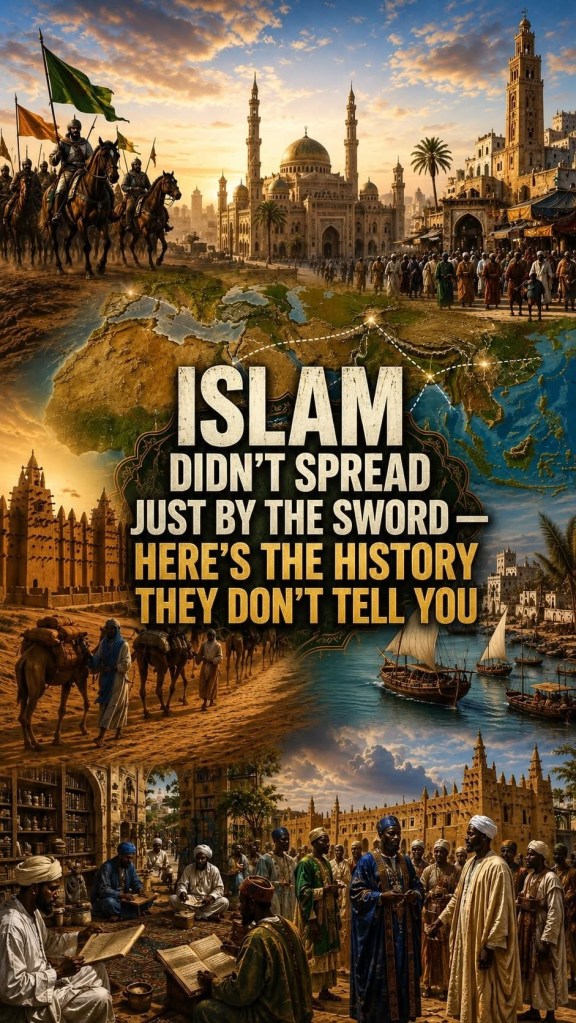
THE SPREAD OF ISLAM: THE HISTORY IS MORE COMPLICATED THAN YOU WERE TOLD
THE SPREAD OF ISLAM: THE HISTORY IS MORE COMPLICATED THAN YOU WERE TOLD
Let’s have an honest historical conversation.
When people talk about the spread of Islam, they often give you one of two extreme stories.
One side says, “Islam spread entirely by the sword.”
The other says, “Islam spread entirely peacefully.”
But history doesn’t fit neatly into either story.
Islam began in Arabia in the 7th century with the preaching of Prophet Muhammad. By the time of his death in 632 CE, Islam had already transformed Arabian society.
Then came a period of extraordinary political expansion.
Muslim armies conquered territories across the Middle East, North Africa and eventually parts of Europe and Central Asia.
But here is the part people often leave out:
Conquering a territory and converting its population are NOT the same thing.
A population could come under Muslim political rule while remaining Christian, Jewish, Zoroastrian, or followers of other traditions for generations.
So how did Islam actually become a global religion?
Through multiple channels.
Trade.
Migration.
Scholarship.
Marriage.
Political alliances.
Royal conversion.
Sufi teachers.
And yes—military conquest in certain regions.
Now let’s talk about Africa, because this is where the history gets particularly interesting.
Africa encountered Islam almost immediately.
When the early Muslims faced persecution in Mecca, some sought refuge across the Red Sea in the Christian kingdom of Aksum.
Think about that.
Africa was connected to the story of Islam from its earliest decades.
Later, Islam spread across North Africa and into the Sahara.
And the Sahara wasn’t simply a wall separating North Africa from sub-Saharan Africa.
It became a highway.
Camel caravans carried salt, textiles, metals and other goods southward—and gold and other commodities northward.
But merchants carried something else too:
ideas.
Muslim merchants established communities along major trade routes.
Scholars followed.
Mosques appeared.
Schools developed.
African rulers began establishing relationships with the wider Islamic world.
And eventually, some rulers converted.
But conversion was usually not instantaneous.
A king could become Muslim while many of his subjects continued following older African religious traditions.
Over generations, however, Islamic institutions became increasingly influential.
Then came some of the greatest African empires in history.
Mali.
Songhai.
Kanem-Bornu.
Cities such as Timbuktu and Jenne became major centers of commerce and Islamic scholarship.
And here’s something that needs to be understood:
Islam did not turn Africans into Arabs.
West African Muslims remained African.
Swahili Muslims remained African.
Hausa Muslims remained African.
Islam was adopted and reshaped within African societies.
Look at the Swahili Coast.
Islam spread through Indian Ocean trade connecting East Africa with Arabia, Persia, India and Southeast Asia.
The result wasn’t simply an Arab colony.
It was a distinctly Swahili civilization, built largely by African coastal societies while incorporating influences from across the Indian Ocean.
And then look at Southeast Asia.
Islam reached places like Indonesia largely through commercial and cultural networks rather than massive Arab armies invading the region.
Muslim merchants arrived.
Local communities interacted with them.
Some rulers converted.
Scholars and religious teachers followed.
And over centuries, Islam became deeply rooted.
The same pattern occurred differently in South Asia, Central Asia and elsewhere.
So here’s the real lesson:
Islam didn’t spread by one method.
It spread through a complicated combination of conquest, commerce, migration, scholarship, political power, spiritual movements and voluntary conversion.
And once Islam entered new societies, those societies didn’t simply disappear.
Persians contributed enormously to Islamic civilization.
Turks built powerful Muslim empires.
Africans created powerful Muslim states and intellectual centers.
South Asians produced major schools of Islamic scholarship.
Southeast Asians developed their own Islamic traditions.
Islam became global without making everyone Arab.
And THAT is the part people often misunderstand.
Arab is not the same thing as Muslim.
Arabic is not the same thing as Islam.
And African Muslims did not stop being African because they became Muslim.
So if someone tells you:
“Islam spread only by the sword,”
ask them to explain Indonesia, the Swahili Coast, West African trade networks and the role of merchants and scholars.
But if someone tells you:
“Islam spread entirely peacefully,”
ask them to explain the early Arab conquests, the expansion into North Africa, Persia and other regions.
The truth is more complicated.
And real history isn’t afraid of complexity.
Islam began in Arabia—but its history was ultimately written across Africa, Asia and Europe by millions of different peoples.
Now let’s debate.
Do you think trade and cultural exchange were more important to the long-term spread of Islam than military conquest? Or do you think political expansion was the decisive factor?
Drop your argument in the comments.
Just bring history with you. 🔥