On Christmas 1831, Samuel Sharpe helped organize one of the largest uprisings of enslaved people in the British Caribbean, changing Jamaica and accelerating Britain’s slavery crisis.
On Christmas 1831, Samuel Sharpe helped organize one of the largest uprisings of enslaved people in the British Caribbean, changing Jamaica and accelerating Britain’s slavery crisis.
What made that Christmas so dangerous to Jamaica’s slaveholding order was not simply the possibility of rebellion. It was the realization that tens of thousands of enslaved Black people were beginning to understand how much power rested in the labor they were being forced to give away.
Samuel Sharpe’s original plan was not to set Jamaica on fire.
He wanted enslaved workers to refuse to return to plantation labor after the Christmas holiday unless their demands were taken seriously, including greater freedom and payment for their work. In a colony built almost entirely around forced Black labor, simply refusing to work together could strike directly at the source of plantation wealth.
That was the brilliance, and the danger, of what Sharpe was attempting.
A plantation owner might control the land, the sugar mills, the warehouses, the courts, and the local political system, but sugar could not cut itself. Cane could not carry itself from the fields, mills could not run themselves, and ships could not be filled with the wealth Jamaica produced without the labor of the people the colony had enslaved.
Sharpe understood that contradiction.
He was himself enslaved in St. James Parish, yet he had become a Baptist deacon and an influential leader among the Native Baptists around Montego Bay. He was literate, politically aware, and closely interested in the growing abolition debate taking place across the Atlantic in Britain.
Those qualities mattered enormously in Jamaica.
Enslaved people lived inside a system that tried to control not only where they went and what work they performed, but also how freely they could gather, communicate, and organize. Baptist religious meetings created one of the few spaces where large numbers of Black Jamaicans could meet with some degree of legitimacy.
Sharpe saw what those gatherings could become.
A church meeting could be a place of worship, but it could also become a place where information traveled from one plantation to another. News could move, arguments could be discussed, political developments could be understood, and people who were deliberately kept powerless could discover that their frustration was shared by thousands of others.
There was another contradiction Sharpe could hardly have missed.
The same society that allowed Christianity to be preached to enslaved people maintained laws treating those people as property. Black worshippers could hear teachings about spiritual equality, deliverance, justice, and human worth, then leave the service and return to estates where another person claimed ownership of their time, labor, movement, and future.
For Sharpe, faith did not require accepting that contradiction quietly.
By late 1831, he was helping transform religious and personal conviction into coordinated action. His strategy was remarkable precisely because he understood that collective discipline might accomplish what isolated resistance could not.
Timing mattered.
Christmas came during a crucial period for Jamaica’s plantation economy, when sugar production depended heavily on the availability of labor. A mass refusal to work could threaten not merely the authority of individual overseers, but the income of some of the most powerful people in the colony.
One enslaved worker refusing could be punished.
Thousands refusing together created an entirely different problem.
Sharpe’s message moved across western Jamaica through networks connecting plantations, workers, and Baptist congregations. Historical estimates vary, but as many as 60,000 enslaved Jamaicans became involved in the movement that followed, out of an enslaved population of roughly 300,000.
That number deserves to be absorbed slowly.
This was not a small circle of conspirators hidden somewhere in Montego Bay. Tens of thousands of Black men and women were being drawn into a confrontation with one of the most profitable and heavily defended slave societies in the British Empire.
They knew what stood against them.
The colonial government had soldiers, militia, courts, prisons, weapons, and laws written largely to protect property and plantation power. Enslaved Jamaicans knew that rebellion could mean imprisonment, physical punishment, separation from family, transportation, or death.
Yet thousands still chose resistance.
That choice reveals something that can disappear when slavery is remembered only through the cruelty imposed upon Black people. Enslaved people were not simply enduring history while waiting for outsiders to rescue them.
They were studying the world around them.
They were listening to political developments, building communities, creating religious networks, resisting forced labor, escaping when opportunities appeared, protecting one another where they could, and imagining forms of freedom long before governments were willing to recognize them.
Sharpe was one man inside that much larger history.
By Christmas 1831, however, the secret could no longer remain contained. Plantation interests had learned that some form of widespread resistance was being organized, and colonial authorities began preparing for trouble.
Troops were positioned.
Warships were present around important Jamaican ports, including Montego Bay and Black River, and the possibility of a peaceful confrontation was narrowing before the strike had fully unfolded.
Imagine the weight of that moment without inventing a single word Sharpe might have spoken.
People who had spent their lives being commanded to work were being asked to do something frighteningly simple: when the holiday ended, do not return obediently to the fields.
The power of the idea came from its simplicity.
The danger came from what refusal meant in a slave society.
Christmas passed, and the situation moved rapidly beyond the disciplined protest Sharpe had envisioned.
On December 27, Kensington Estate in the hills above Montego Bay was set on fire, an event widely identified as the moment the crisis broke into open rebellion. Once the flames appeared, the movement entered a new and far more dangerous stage.
The uprising spread through western Jamaica.
Estates were attacked, plantation property was seized or destroyed, and thousands of enslaved people entered resistance in a way colonial authorities could no longer dismiss as a labor dispute or isolated act of disobedience.
The planned strike had become the Baptist War, also remembered as the Christmas Rebellion or the Sam Sharpe Rebellion.
What had begun with a question about labor had exposed a much larger question about power.
Could a society continue indefinitely when the overwhelming majority of the people doing its hardest work rejected the system governing them?
The colonial answer came through force.
British troops, Jamaican militia, and Maroon forces were used in suppressing the rebellion, and organized resistance was overwhelmed by early January 1832. The military superiority of the colonial government meant the uprising itself lasted only a short time.
The punishment lasted much longer.
Hundreds of enslaved Jamaicans were killed during the suppression and the judicial reprisals that followed, with records and historical estimates varying on the exact totals. More than 300 people were executed after trials according to commonly cited estimates, while many others were subjected to additional punishments.
Those executions were meant to do more than eliminate participants.
They were intended to rebuild fear.
Plantation authority depended upon making the consequences of collective Black resistance visible. The government wanted every surviving worker, every family, and every congregation to understand what might happen if another movement challenged the colonial order.
Baptist churches also came under attack.
Planters had seen how religious networks could provide something slavery feared deeply: places where enslaved people could meet, exchange information, develop trust, and begin seeing themselves not as isolated individuals on separate estates, but as a community capable of collective action.
Then the authorities captured Samuel Sharpe.
He was tried, convicted, and sentenced to death for his role in the uprising. On May 23, 1832, he was hanged in Montego Bay.
He was about 31 years old.
That detail changes the scale of the story.
A man barely into his thirties had helped organize a movement involving tens of thousands of people, challenged the economic foundation of British Jamaica, and forced one of the most powerful empires in the world to confront the instability of a system it had spent generations defending.
The colonial government could end Sharpe’s life.
What it could not do was make Christmas 1831 disappear.
News of the uprising crossed the Atlantic at a moment when Britain was already locked in a fierce political struggle over slavery. The rebellion, followed by reports of the brutal suppression, gave abolitionists further evidence that slavery in the Caribbean was neither peaceful nor sustainable.
Sharpe’s uprising did not single-handedly abolish British slavery.
That victory had been shaped by generations of resistance from enslaved Africans and their descendants, earlier Caribbean rebellions, Black testimony, religious activism, abolitionist organizing, political pressure, and countless acts of resistance whose participants never entered famous history books.
But the Baptist War accelerated the crisis.
In 1833, the British Parliament passed the Slavery Abolition Act, and emancipation began across most British colonies in 1834. Samuel Sharpe had already been dead for more than a year.
Even then, freedom came compromised.
Many formerly enslaved people were forced into an apprenticeship system that continued compulsory labor under new rules until full emancipation arrived in Jamaica in 1838. The legal name of their condition had changed before complete control over their own labor had truly arrived.
And Britain made another choice that revealed whose losses the empire valued.
Slaveholders received enormous financial compensation for the loss of people the law had previously treated as their property. The formerly enslaved received no comparable payment for generations of stolen labor, family disruption, confinement, and wealth produced under bondage.
That makes Sharpe’s original strategy even more striking.
Before Parliament settled the question of compensation, before emancipation became imperial law, before monuments carried his name, an enslaved Black Jamaican had already identified the connection between freedom and control over one’s own labor.
He understood that work had value because the plantation economy proved it every day.
He simply refused to accept the idea that everyone should benefit from Black labor except the Black people providing it.
The place where Sharpe was executed would not remain forever defined by the authority that condemned him.
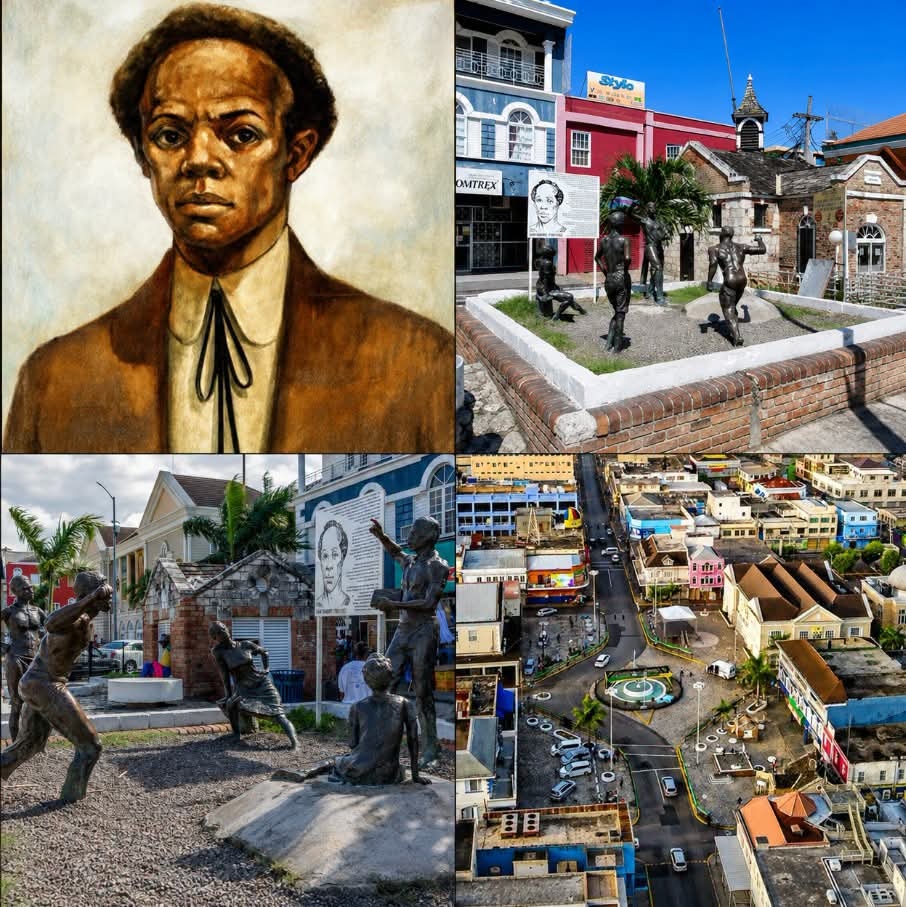
Montego Bay eventually named the location Sam Sharpe Square, and independent Jamaica recognized him as one of its National Heroes in 1975. His face later appeared on Jamaican currency, turning the image of a man once executed as a threat to colonial order into an official symbol of the nation.
There is something deeply fitting about that reversal.
The government that sentenced Samuel Sharpe controlled the courtroom, the soldiers, the gallows, and the written verdict. But colonial power could decide how he died without deciding how future generations would remember why he lived.
And Sharpe should never stand alone in that memory.
Behind the famous name were thousands of enslaved Jamaicans whose names may never appear on monuments, people who understood the risks and still chose to participate. Mothers, fathers, workers, worshippers, craftsmen, field laborers, and families entered a movement whose defeat could cost them everything.
Their courage did not depend on knowing they would win.
That may be the most human part of this history.
They could not see 1834 from Christmas 1831. They could not know that apprenticeship would end in 1838, that Jamaica would one day become independent, or that a square in Montego Bay would carry the name of the man colonial authorities intended to silence.
All they knew was the world in front of them.
And in that world, slavery still had the law, the military, the plantations, and the empire behind it.
Yet for a few extraordinary days beginning at Christmas 1831, tens of thousands of Black Jamaicans forced that empire to confront a truth it had spent generations trying to bury: the people working its plantations had never surrendered their humanity simply because someone had written ownership over them.
Samuel Sharpe walked to his death before he could see emancipation.
But the system that hanged him did not survive him for long, and that is the haunting legacy of his story: an empire had enough power to take his life, yet not enough power to stop the freedom he helped make imaginable.
I invest a lot of time researching and sharing these important stories. If you’d like to support the work behind them, here’s the link: