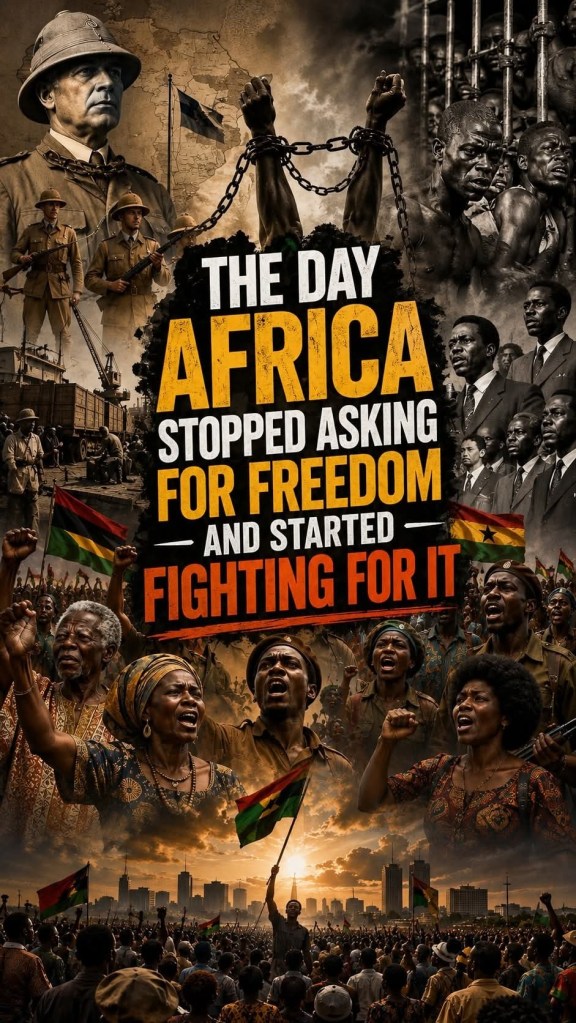
AFRICA DIDN’T “GET” INDEPENDENCE — AFRICANS FOUGHT FOR IT. SO WHO REALLY LOST POWER?
AFRICA DIDN’T “GET” INDEPENDENCE — AFRICANS FOUGHT FOR IT. SO WHO REALLY LOST POWER?
Let’s stop romanticizing colonial history for a minute.
Every time somebody says, “Europe gave Africa independence,” I have one question:
Since when does the person occupying your house deserve applause for eventually leaving it?
Africa’s independence was not a European gift.
It was the result of resistance, political movements, strikes, protests, negotiations, armed struggles, imprisonment, sacrifice and, in many places, bloodshed.
And here’s what makes the story uncomfortable:
Africans were resisting European conquest from the beginning.
Samori Touré fought French expansion.
Yaa Asantewaa led resistance against British colonial rule.
Menelik II’s forces defeated Italy at Adwa.
Zulu forces famously defeated a British army at Isandlwana.
So no, African resistance did not begin when Europeans decided Africans were finally “ready” for freedom.
Then World War II happened.
Africans fought in European wars.
They were told they were fighting for freedom.
They returned home and asked a very inconvenient question:
“Freedom for whom?”
Because apparently democracy was a beautiful principle in Europe—but somehow became complicated when Africans demanded it in Africa.
Then the nationalist movements exploded.
Kwame Nkrumah.
Nnamdi Azikiwe.
Jomo Kenyatta.
Julius Nyerere.
Patrice Lumumba.
Ahmed Ben Bella.
Amílcar Cabral.
Kenneth Kaunda.
Nelson Mandela.
These weren’t people sitting around waiting for Europe to become generous.
They were challenging a system that had been built to keep Africans politically subordinate.
And then Ghana shocked the colonial world.
- Ghana became independent.
Nkrumah didn’t say:
“Thank you, Britain, for giving us our freedom.”
He looked beyond Ghana.
He understood that Ghana’s freedom meant very little if the rest of Africa remained under colonial domination.
Then came 1960.
The Year of Africa.
African countries began breaking away from European rule at astonishing speed.
But here’s where the fairy tale falls apart.
Some colonial powers negotiated.
Others fought.
Algeria fought France.
Kenya experienced the Mau Mau uprising.
Angola and Mozambique fought Portugal.
Guinea-Bissau fought Portugal.
And Congo?
Congo became independent—and almost immediately became a battlefield for political, economic and Cold War interests.
Patrice Lumumba, one of Africa’s most powerful nationalist voices, was assassinated in 1961.
So here’s the uncomfortable question:
If colonialism was simply about bringing civilization and development, why was African self-determination so violently resisted?
And here’s an even bigger question:
Did colonialism really disappear when the colonial flags came down?
Because political independence is not the same thing as economic independence.
You can change the flag.
Change the president.
Change the national anthem.
But if your economy still depends heavily on exporting raw materials while foreign corporations capture much of the value…
If your industries remain dependent on foreign capital…
If your borders were drawn by colonial powers…
If your political institutions were inherited from colonial systems…
Then we need to have a serious conversation about what “independence” actually means.
And don’t misunderstand me.
I’m not saying African leaders were powerless or that everything after independence was caused by Europe.
African governments made mistakes.
Leaders became corrupt.
Military coups happened.
Civil wars erupted.
Political rivalries destroyed nations.
African elites sometimes exploited their own people.
Africans must own their mistakes too.
But pretending colonialism had no long-term consequences is just as intellectually dishonest as blaming every modern African problem on colonialism.
History is more complicated than that.
The real question is this:
When the colonial governor left, who inherited the economic system?
And who benefited from it?
Because Africa didn’t just inherit countries.
Africa inherited colonial borders, colonial economic structures, political institutions, foreign interests and enormous challenges.
And that’s why the independence struggle didn’t end when the European flags came down.
It changed form.
From political liberation…
to economic liberation…
to cultural liberation…
to the struggle over who controls Africa’s resources and future.
So here’s my controversial question for you:
🔥 Was African independence the end of colonialism—or did colonialism simply change its clothes?
And before you start typing “Africa should stop blaming colonialism”…
Relax.
Nobody said Africans are helpless.
The question is whether we are willing to examine the entire history instead of repeating comfortable slogans.
Agree? Disagree?
Tell me exactly where you think I’m wrong.
But bring historical evidence.
Let’s debate.
 Hi welcome to my website