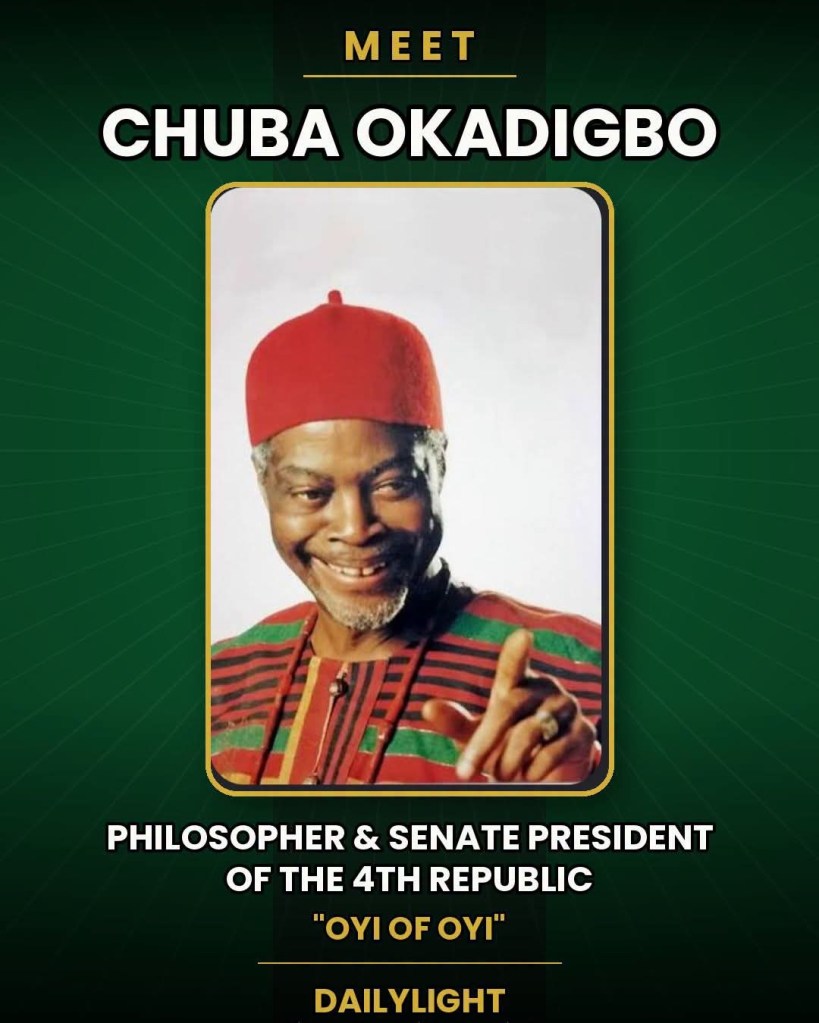
MEET CHUBA OKADIGBO, THE OYI OF OYI. PHILOSOPHER AND SENATE PRESIDENT IN THE 4TH REPUBLIC.
MEET CHUBA OKADIGBO, THE OYI OF OYI. PHILOSOPHER AND SENATE PRESIDENT IN THE 4TH REPUBLIC.
This is a man Nigeria did not deserve, and Nigeria did not know what to do with him while he was alive.
He was born on the 17th of December, 1941, in Asaba (according to most historical records, though some archives place his birth in the nearby town of Ogwashi-Uku, both in present-day Delta State). His father was Chief Ozota Okadigbo, a District Officer, a stern man who forced young Chuba to read newspapers and summarize the news to him every single day, Daily Times, West African Pilot, whatever was available. His mother was Chief (Mrs.) Catherine Anyanwu Okadigbo, a baker and women’s mobilizer from Ogbunike in Anambra State, a woman so respected in her community that she was given the traditional title “Nne Nmanwu” Queen Mother of Masquerade. Chuba said it himself: his gift of oratory, his wit, his sharp tongue, all of it came from his mother.
He was the dark-skinned one among three brothers, Edmund and George were fair like their mother, Chuba was dark like his father. He said people used to caress his brothers’ heads and give them money while they ignored him. That small pain, according to him, is part of what pushed him to want to conquer through excellence. A boy who felt overlooked in his own compound grew up to become one of the most feared minds in Nigerian politics. Remember that the next time somebody tells you your background determines your ceiling.
His education alone should humble anybody claiming “school is not important.” St. Patrick’s College, Asaba. Annunciation College, Irrua. Our Lady’s High School, Onitsha. Then he crossed all the way to East Germany, Blankenburg College of Technology, then Karl Marx University in Leipzig. But here’s the part most people writing about him leave out: when the Biafran war broke out and East Germany took a pro-Lagos stance against his people, Okadigbo, according to accounts of his life, left in protest and moved to the Catholic University of America in Washington D.C. That is not a small decision for a young man in the 1960s. He picked his people over a scholarship in a communist superpower. He finished with a Master’s in Political Science, then went further and earned two doctorate degrees, one in Philosophy, one in Political Science. By age 34, this man had already lectured at the University of the District of Columbia, Catholic University of America, and Howard University in the United States.
He came back home. Nsukka. Bigard Memorial Seminary in Enugu. Then politics swallowed him. He served on the Constituent Assembly that birthed the Second Republic in 1977-78, and in 1979, at just 37 years old, President Shehu Shagari made him Special Adviser on Political Affairs, a position he held until the military struck in 1983. During this period, he nearly became Governor of the old Anambra State, but split votes with Alex Ekwueme in the primaries and lost the ticket to C.C. Onoh.
When the military eventually stepped back and the Third Republic came in 1992, Okadigbo joined the Social Democratic Party and won a Senate seat representing Anambra North. He lost the race to become Senate President twice in that republic. But by 1999, at the dawn of the Fourth Republic, his moment finally arrived, though not without a fight. President Olusegun Obasanjo’s Peoples Democratic Party (PDP) backed Evan Enwerem for Senate President instead of him, sidelining Okadigbo despite his seniority and standing. But Enwerem’s own lies caught up with him, he had misrepresented his name in official records, and the Senate impeached him. Chuba Okadigbo became the 8th President of the Nigerian Senate in November 1999.
What followed was, according to almost everyone who covered that Senate, the sharpest, most intellectually rigorous period the Fourth Republic legislature has ever seen. He clashed with Obasanjo constantly over who was really in charge, the executive or the legislature. He refused to bow. And Nigeria’s presidency, according to multiple accounts from that era, spared no expense trying to remove him. In June 2000, police allegedly laid siege to his official residence attempting to seize the Senate mace from him, the operation reportedly failed. By August 2000, he was impeached over allegations of financial mismanagement involving contracts for National Assembly services, allegations his supporters have always maintained were politically engineered to silence a man who would not be controlled.
He didn’t stay down. In 2002, he moved to the All Nigeria Peoples Party and became Muhammadu Buhari’s running mate for the 2003 presidential election. They lost badly to Obasanjo and Atiku Abubakar, and alleged mass rigging by the ruling party, a case ANPP took all the way to the Supreme Court.
Then came the day that broke a nation’s heart. A day after a campaign rally at Kano Stadium where police deployed tear gas on the crowd, Buhari included, Chuba Okadigbo started struggling to breathe. He died in Abuja on the 25th of September, 2003. He was 61. Some Nigerians, till today, question whether it was ordinary tear gas that killed him.
He married more than once in his lifetime, first to Miriam Ikejiani-Clark, with whom he had children before they parted ways, and according to some records, a second marriage to a pediatrician named Juliet Nwokoye, before he finally married Margery Ebo, who was by his side when he died. Margery went on to become a senator herself in 2015, representing the very same Anambra North seat her husband once held, making them, according to Nigerian political records, the only married couple to both occupy that same Senate seat.
But if you want to understand the soul of this man, forget the titles. Read what he said, a line that has outlived him by two decades and is still quoted today by people who never met him:
“If you are emotionally attached to your tribe, religion or political leaning to the point that truth and justice become secondary considerations, your education is useless. Your exposure is useless. If you cannot reason beyond petty sentiments, you are a liability to mankind.”
Think about that sentence. A man born into an Igbo home, raised in the shadow of a war fought for his own people’s survival, still had the depth to warn against blind tribal loyalty. That’s not weakness. That’s a man who paid attention to what tribalism, religion, and political sentiment have cost this country, and refused to let it own him.
Chuba Okadigbo fought Obasanjo. He fought a system that didn’t want an Igbo philosopher-king anywhere near real power. He lost the presidency race. He lost his Senate Presidency to impeachment. He lost his life to a tear gas canister at a political rally. But twenty-three years after his death, people are still quoting him, still arguing about his legacy, still calling him “Oyi of Oyi” with respect in their voice.
So I ask you, in a country where tribe, religion, and political party loyalty still blind so many of us from seeing the truth in front of our faces, how many of us today can honestly say we reason the way Okadigbo challenged us to reason?