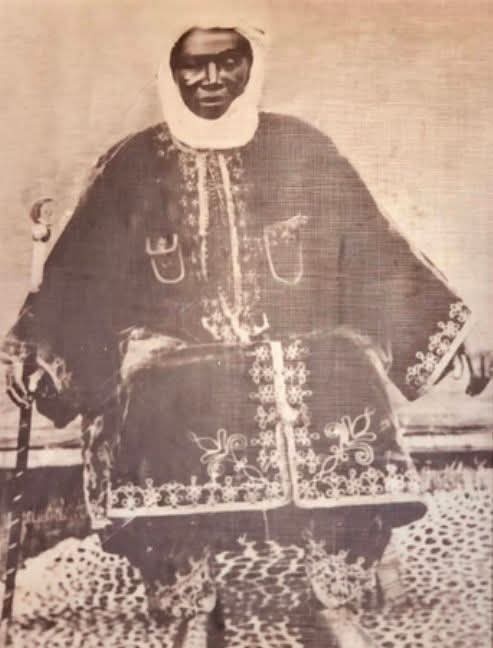
SERIKI WILLIAMS ABASS;THE SLA@V£ WHO LATER BECAME A SL@V£ TRADER
SERIKI WILLIAMS ABASS;THE SLA@V£ WHO LATER BECAME A SL@V£ TRADER
Seriki Williams Abass (born Ifaremilekun Fagbemi; c. 1835 – June 11, 1919) was a prominent 19th-century sl@ve merchant who later became a highly influential politic@l and relig!ous leader, serving as the “Paramount Ruler” of Badagry, Nigeria.
His life represents a deeply complex historical narrative, as he was a capturve who later built an empire by ensl@ving others.
Born in Ijoga Orile (Ogun State), he was c@ptured at roughly six years old during an intertribal w@r by Dahomean raiders.
He was sold to a Dahomean Musl!m sl@ve dealer named Abass, from whom he took his first adopted name. He was later sold to a Brazilian sl@ve ship captain named Williams, who took him to Brazil.
Williams chose to retain him as domestic staff rather than field labor. Under Williams, he became literate and learned to speak English, Dutch, Spanish, and Portuguese.
Williams offered him freedom on one condition: return to West Africa and serve as Williams’ domestic slave trade partner.2.
Abass settled along the lagoon in Badagry and built a 40-room Brazilian Barracoon (sl@ve cell compound) in the early 1840s.
Each tiny, windowless room (roughly 8×9 ft) packed up to 40 ensl@ved Afric@ns chained to the floor, meaning 1,600 people were held there at any given time.
Because £ürope@n sl@ve traders did not use local currency, Abass bartered hum@n l!v£es for imported goods. Local historical accounts note he tr@ded 10 people for a bottle of gin and 40 people for an umbrella.
After converting to Isl@m, his massive accumulation of wealth led the Mus!im community to elect him Seriki Musulumi (Chief of the Musl!m Faithful) of Western Yorubaland in 1897.
Utilizing the Colonî@l “Indirect Rulē” system, the Bri3tish gøvernmēñt officially appointed him the Paramount Ruler of Badagry and the Western District in 1913.
Reflecting his vast wealth and status, he reportedly married 128 wives and fathered 144 children.
Abass d!£d on June 11, 1919, and was bur!ed on his estate
Today his grandchildren have converted the cells, where he once bounded and stocked sl@ves, to livingrooms.
His whole house is also now a museum in Badagry— called Brazilian Baracoon of Sl@ves.