
THE 1993 CO”UP THAT NÉVER HAPPENED — AND HOW GENERAL ABACHA EVENTUALLY TOOK PØWĒR
THE 1993 CO”UP THAT NÉVER HAPPENED — AND HOW GENERAL ABACHA EVENTUALLY TOOK PØWĒR
Nigeria, November 1993.
The country was already in deep politic@l turmoil.
The annulment of the June 12, 1993 presidential election had created a cr1sis that refused to disappear. Ibrahim Babangida had stepped aside in August 1993 and handed power to an interim govern.ment headed by Chief Ernest Shonekan.
But the arrangement was fragile.
Behind the scenes, Nigeria’s politic@l and milit@ry establishment was under enormous pressure.
Then came November 17, 1993.
What happened that day is sometimes described as a co”up — but technically, it was not a conventional milit@ry co”up in the way Nigerians had experienced in 1966, 1975, 1983 or 1985.
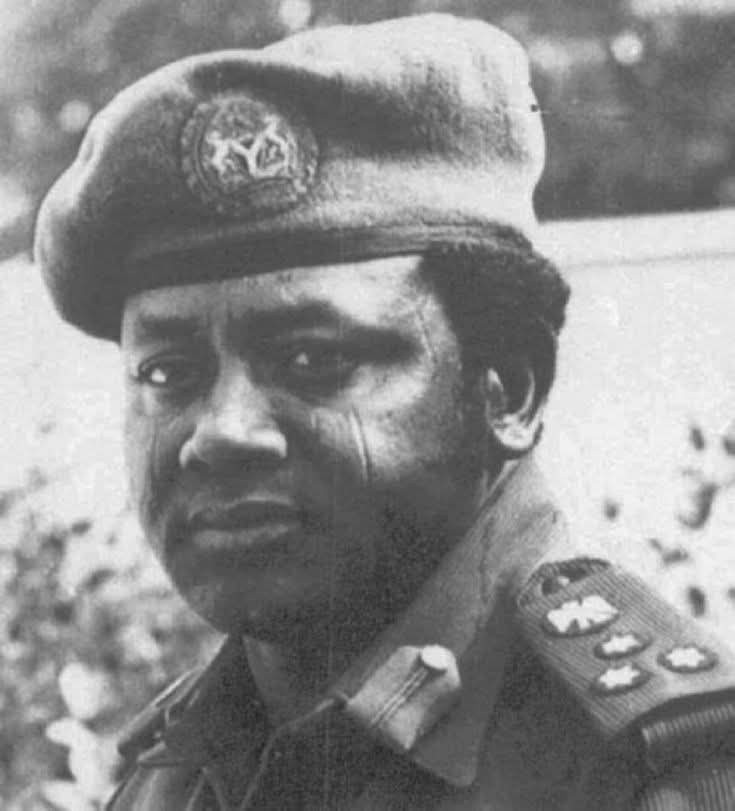
Instead, General Sani Abacha, who was the most senior milit@ry officer in the country and served as Defence Ministēr, moved decisively to take control of the govern!ment.
Shonekan resigned as Head of the Interim National Government.
Abacha then emerged as the new Head of State.
There was no prolonged battle for the presidential palace.
No tanks fighting in the streets of Lagos.
No dramatic midnight radio announcement announcing that the government had been overthrown by a group of young officers.
The transfer of power was remarkably swift.
But here is the fascinating part:
ABACHA HAD ALREADY BEEN AT THE CENTRE OF NIGERIA’S MILI#TARY POWER FOR YEARS.
He was one of the senior officers who played important roles during the milit@ry transitions of the 1970s and 1980s.
He had also been a key figure in the events that brought Babangida to power in 1985.
By 1993, Abacha was no longer a young officer waiting for his opportunity.
He was the most powerful military figure in the country.
When Shonekan’s interim government became increasingly incapable of resolving Nigeria’s political cr1sis, Abacha stepped in.
On November 17, 1993, Shonekan resigned.
Abacha became Head of State.
And Nigeria entered another chapter of military rule.
BUT WHY DO SOME PEOPLE CALL IT A “CO”UP”?
Because the change of government was ultimately backed by the milit@ry.
Abacha did not win an election.
He did not inherit power through a constitutional election.
Instead, the civilian-led Interim National Government coll@psed, and the milit@ry establishment under Abacha assumed direct CONTROL.
For many Nigerians, the distinction between a military takeover and a co”up became almost academic.
The result was the same: milit@ry rule had returned.
Abacha dissolved the Interim National Government and suspended parts of the constitution.
His government promised to restore political stability and eventually return Nigeria to civilian rule.
But the years that followed became some of the most controversial in Nigeria’s history.
Politic@l opposition was heavily restricted.
Critics of the reg!me were @rrested.
The June 12 crisis remained unresolved.
And Moshood Kashimawo Olawale Abiola, the presumed winner of the annulled 1993 election, remained at the centre of the struggle for the restoration of his mandate.
Then came June 1994.
Abiola declared himself President of Nigeria.
He was @rrested by the Abacha government.
He would remain in detention until his death in July 1998.
Abacha himself di£d suddenly on June 8, 1998, while still in office.
His de@th brought an unexpected end to his regime and opened the way for another military transition — eventually leading to the return of civilian government under Olusegun Obasanjo in 1999.
THE STRANGE IRONY
The military had handed power to an interim civilian government in 1993 in an attempt to calm Nigeria’s political crisis.
But only about three months later, the military was back in control.
And the man who took over was the very powerful Defence Minister who had been standing at the centre of Nigeria’s military establishment.
General Sani Abacha didn’t need a long, bloody battle to take power.
The political system around him had already become weak enough to collapse.
And on November 17, 1993, he stepped into the vacuum.
That is the story of the 1993 military takeover — the “coup” that happened without the classic coup drama.
What do you think: Was Abacha’s takeover a co*up, a military intervention, or simply the coll@pse of the Interim National Government?
Drop your opinion in the comments.
 Hi welcome to my website