
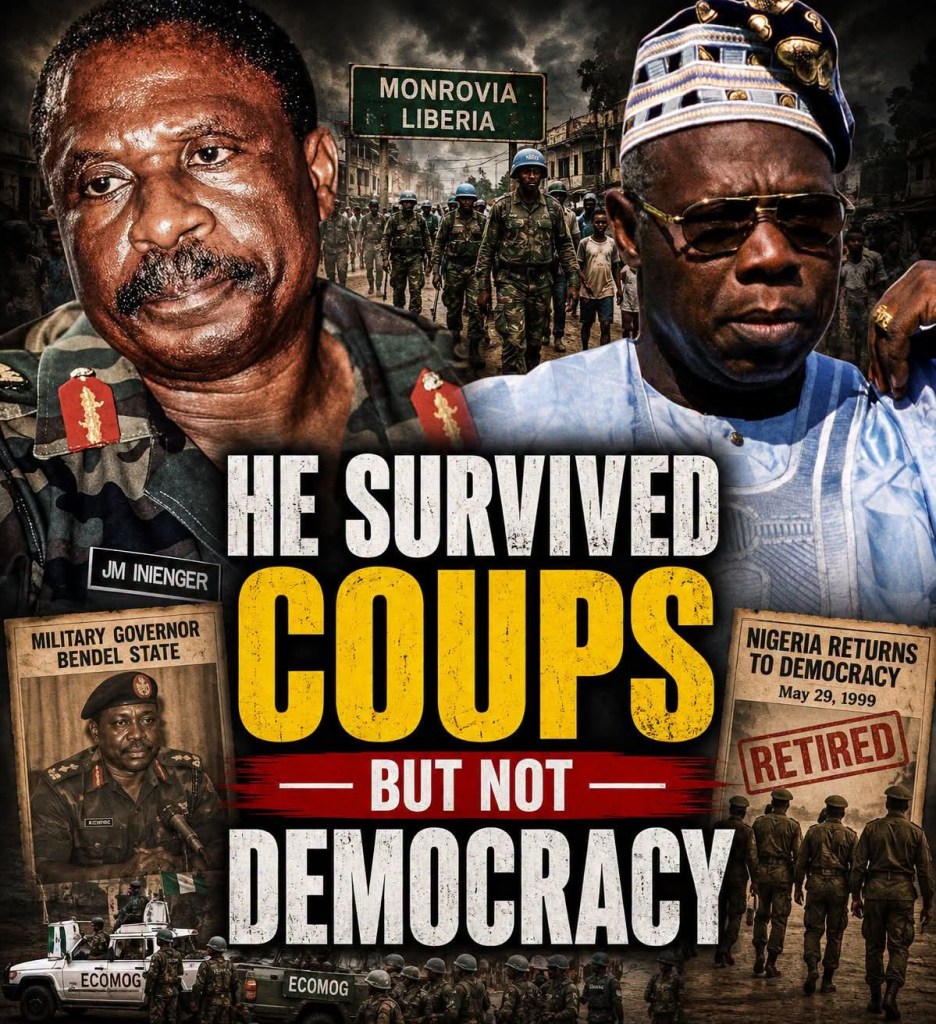
HE GOVERNED A NIGERIAN STATE — THEN SPENT THREE YEARS IN LIBERIA’S WAR
HE GOVERNED A NIGERIAN STATE — THEN SPENT THREE YEARS IN LIBERIA’S WAR
And just weeks after Nigeria returned to democracy, he was forced out of the Army.
In 1985, John Mark Inienger was a Nigerian Army officer who had just helped bring a new military government to power.
By 1993…
He was commanding Nigerian-led troops in someone else’s civil war.
And by 1999…
He was one of the senior officers pushed out when Nigeria finally returned to civilian rule.
His career had followed almost the entire arc of Nigeria’s late military era.
Inienger was born on 16 April 1945 in Mbaduku, Vandeikya, in present-day Benue State.
He trained through the Nigerian Military School and the Nigerian Defence Academy, rising through infantry commands and eventually commanding Nigeria’s battalion on a United Nations peacekeeping mission in Lebanon in 1980–81.
Then came August 1985.
Nigeria’s government was overthrown.
Muhammadu Buhari was removed.
Ibrahim Babangida took power.
And Inienger, then a lieutenant colonel, was identified as having played a role in the coup.
His reward came quickly.
He was appointed Military Governor of Bendel State, serving from 1985 until 1988.
But his most difficult assignment was still ahead.
In December 1993, Inienger took command of ECOMOG in Liberia.
Liberia was deep inside its brutal civil war.
ECOMOG was supposed to help impose peace.
But the force itself was under constant pressure.
Different factions accused it of taking sides.
Some even described ECOMOG as an occupying army.
Inienger pushed back publicly.
He described what he called an “orchestrated campaign of calumny” aimed at destroying the force’s reputation for neutrality and impartiality.
But the situation kept deteriorating.
By April 1996, Monrovia was again descending into chaos.
Militiamen were looting.
ECOMOG troops were struggling to maintain control of parts of the capital.
This was no longer a clean peacekeeping operation.
It was a fight to keep a collapsing city from completely falling apart.
Inienger finally handed over command in August 1996.
He returned to Nigeria and was appointed Commandant of the Armed Forces Command and Staff College, Jaji — moving from the battlefield to training the officers who would lead Nigeria’s military in the future.
Then came the moment that changed everything.
29 May 1999.
Nigeria returned to civilian rule.
Olusegun Obasanjo became president.
And the new government moved quickly to remove senior officers who had occupied political positions under previous military governments.
Inienger was among them.
Within weeks, he was retired along with dozens of other senior officers as the new administration attempted to reduce the political influence of the military and prevent the return of military rule. Contemporary reporting specifically names Inienger among the officers retired in June 1999.
Think about the journey.
A young officer…
A military governor…
A commander in Liberia…
A general responsible for one of Africa’s most difficult peacekeeping missions…
And then, almost immediately after Nigeria’s democracy returned—
retired.
He never got the opportunity to spend his final years rebuilding his career inside the new democratic military establishment.
On 8 February 2002, John Mark Inienger died in a car accident while travelling from Jos toward Makurdi.
He was only 56.
His story is bigger than the positions he held.
It captures the strange fate of Nigeria’s military generation:
The same system that rewarded them for helping run military governments eventually had to remove them when democracy returned.
Inienger spent years defending institutions.
He governed one Nigerian state.
Then he spent nearly three years commanding soldiers trying to hold together a foreign capital.
And finally…
Nigeria’s new democratic government decided that men of his generation could no longer remain at the centre of the military.
He helped build the military era.
Then democracy arrived — and closed the door behind him.
What do you think?
Was Obasanjo right to retire officers who had served in military governments, or should experienced soldiers like Inienger have been allowed to remain in service?
Follow for more forgotten stories from Nigeria’s military history.
 Hi welcome to my website