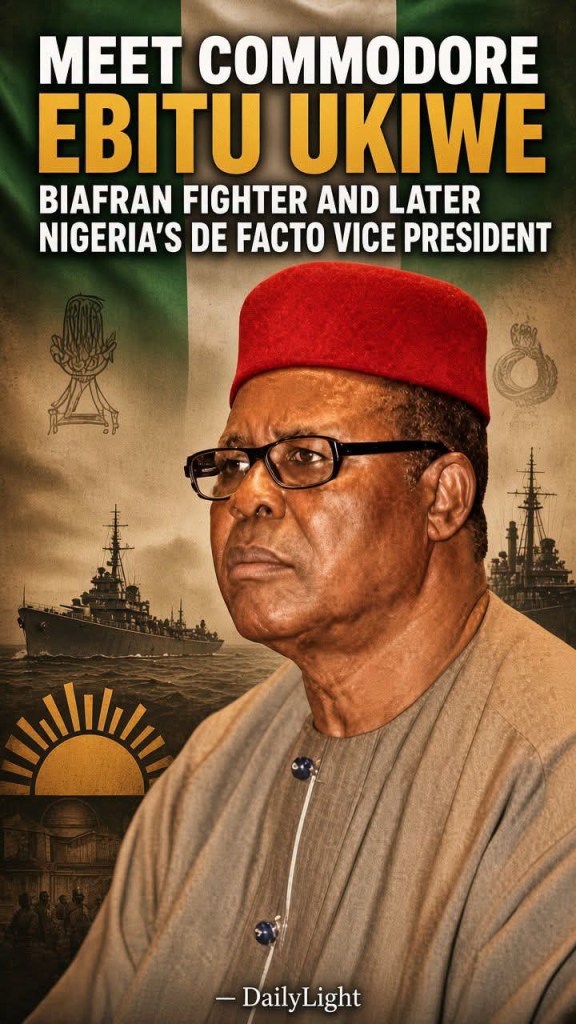
MEET COMMODORE EBITU UKIWE, THE BIAFRAN FIGHTER AND LATER NIGERIA’S DE FACTO VICE PRESIDENT
MEET COMMODORE EBITU UKIWE, THE BIAFRAN FIGHTER AND LATER NIGERIA’S DE FACTO VICE PRESIDENT
This is not a highlight reel. This is the full story, from the beginning.
Born into royalty, in a town built on trade
On Saturday, 26 October 1940, in Abiriba, a town in present-day Abia State known historically as a wealthy trading hub of the old Bende Division, a boy was born who would one day stand two steps from the presidency of Nigeria, and then walk away from it on his own terms.
His father was Chief Ebitu Ukiwe, a powerful traditional ruler in Abiriba who also served as head of the Old Bende Division Local Government Appeal Court. That’s worth sitting with: this wasn’t a man appointed by colonial administrators to keep the peace, he sat in judgment over disputes as a recognized traditional authority, meaning young Ebitu grew up watching his father adjudicate right and wrong for his community. His mother was Aruodo Ukiwe. So from birth, the boy who would later refuse to compromise on principle as one of Nigeria’s most powerful men was raised in a household where his own father’s daily work was deciding what was just.
That matters for how we read everything that came after. Ukiwe didn’t discover integrity as an adult in a military uniform. He was born into a family whose social position existed because of moral authority, not just wealth. Abiriba itself reinforces this, a community of traders and self-made men, not a town that produced soft aristocrats. A child born into royalty there still had to prove himself, the same way any trader in that town had to prove himself through his goods.
Early education, a boy being sharpened for something bigger
Young Ebitu attended the Presbyterian/Church of Scotland Mission School in Abiriba through the late 1940s, then Duke Town School in Calabar. He went on to Enuda College in Abiriba, sitting and passing his West African School Certificate in 1958. From there, according to available records, he pursued advanced studies in Physics and Mathematics at the Seventh-Day Adventist High School in Ihie, before the call to military service pulled him away in 1960.
Look at that education path closely. This wasn’t a boy pushed toward the military by default. Advanced Physics and Mathematics in colonial-era Nigeria meant Ukiwe had the academic profile to go into engineering, science, or the civil service elite track that so many of his generation’s “big men” took. He chose the Navy instead, a young man from a landlocked Igbo trading town joining a colonial naval force just months before Nigeria’s independence in October 1960. That’s a young man betting on discipline and structure over the safer, more familiar path his education had already opened for him.
He trained further at the Nigerian Military Training School and Britannia Royal Naval College, earning certificates in Ocean Navigation and Watch Keeping, and was commissioned an officer by 1964.
1966: the choice that would cost him a decade
By 1966, the Nigeria that had commissioned him was tearing itself apart. When the killings and coups of that year pushed the country toward war, Ukiwe defected to the Biafran side. He fought through the Nigerian Civil War from 1967 to 1970, a young naval officer choosing his people over the uniform that had trained him.
Biafra lost. And what came after the war tells you more about Ukiwe’s character than the fighting itself. Gowon’s government publicly promised “Reconstruction, Rehabilitation, and Reintegration” for returning officers. In practice, the military hierarchy remained deeply suspicious of Igbo officers who had fought for Biafra. When Ukiwe was one of the few re-absorbed into the Nigerian Navy in January 1972, it came with a quiet, brutal condition: he was stripped of every promotion he would have earned between 1966 and 1972. Men who used to salute him were now his superiors, and reportedly, some accused him of arrogance simply because he refused to be visibly bowed by the demotion.
For years, Ukiwe swallowed his pride and took orders from officers he had once outranked. He had two real choices, walk away from the Navy with his dignity intact, or stay and rebuild from a demotion that had nothing to do with his competence. He chose to stay and out-perform his way back up. That climb, more than anything that came after, is the actual test of the man. He rose to become Director of the Naval Faculty at the Command and Staff College, Jaji, then Flag Officer Commanding the Western Naval Command, Nigeria’s largest naval operations zone. He served on the Supreme Military Council from 1975 to 1977 under Obasanjo, then as Military Governor of Niger State, and later Lagos State, from 1978 to 1979.
1985–86: the office, and the line he wouldn’t cross
In August 1985, after General Ibrahim Babangida’s coup deposed Muhammadu Buhari, Ukiwe was appointed Chief of General Staff, the first man to ever hold that newly styled title, functioning as Nigeria’s de facto Vice President. Twenty years after fighting on the losing side of a civil war, the demoted officer had become the second most powerful man in the country.
Then, in early 1986, Babangida quietly moved to enroll Nigeria into full membership of the Organisation of Islamic Cooperation, without bringing it before the Armed Forces Ruling Council. When questioned by the press, Ukiwe stated plainly that the matter had never been discussed or approved by the council. He maintained that Nigeria was a secular state and that smuggling the nation into a religious bloc through the back door was dangerous.
Here’s what deserves real analysis, not just admiration: Ukiwe had no army behind him, no faction, no external backing. Babangida had just proven with a bloodless coup that he was willing to remove anyone standing between him and control. Ukiwe’s title carried no real military force in that political moment. So when he reportedly walked into the council chamber, unbuckled his military belt, laid down his uniform cap, and voluntarily resigned, that wasn’t really a choice made from strength, it was closer to the only weapon he had left. He was officially removed from the CGS post in October 1986 and forced into retirement with the rank of Commodore. Babangida still joined the OIC. Ukiwe still lost his office. What he preserved wasn’t the outcome, it was the fact that history would record someone said no, on the record, at real personal cost.
NADECO, the same instinct, a second time, with more to lose
The lazy version of Ukiwe’s story treats his pro-democracy activism as an unrelated second act. It isn’t. As a businessman after retirement, Ukiwe was the moving spirit behind the Council for Unity and Understanding (CUU), a non-partisan body that pushed for the creation of more states in the East, contributing to the eventual creation of Abia, Enugu, Delta, and later Ebonyi, Rivers, and Bayelsa States. The CUU went on to give birth to NADECO.
When General Sani Abacha annulled the June 12, 1993 presidential election won by M.K.O. Abiola, Ukiwe co-founded and heavily funded NADECO alongside other pro-democracy groups, fighting aggressively against Abacha’s dictatorship. He was reportedly arrested, interrogated, and jailed in late 1993, and even after his release, his homes in Lagos and Abiriba were kept under hostile military surveillance until Abacha’s death in 1998. A man who had already lost his military career once for principle was now risking prison a second time, with no office left to protect.
Rebuilding as a businessman
After the Abacha years, Ukiwe transitioned into corporate life. He became chairman of Bitu Properties, Kobimat, Bitu Promar, and Rudocons, and served for nine consecutive years as the primary consultant and local advisor to Statoil, the Norwegian state oil giant now known as Equinor, helping the company navigate Nigeria’s volatile offshore oil blocks without violating international anti-bribery laws. His reputation for integrity, forged in the OIC resignation, turned out to be commercially valuable in an industry where foreign corporations badly needed a trustworthy local partner.
Family and later honors
Ukiwe is married to Chief (Mrs.) Amina Ukiwe, a Northerner, making theirs a cross-cultural union in a country still learning to normalize that. Together they have five children, two daughters and three sons, including Otisi Ebitu Ukiwe, a security consultant who ran for Abia State governor in 2022/2023 under the ADC. Ukiwe holds the traditional title of Ochiagha of Abiriba and was conferred the “Ofo Ndi Igbo” title in Nri, Anambra, in 2014, a significant honor recognizing him as an elder voice of Igbo people nationally. In 2001, Newswatch magazine reportedly speculated he could run for president in 2003, describing him as a principled personality. He remains alive today, into his mid-80s, still visited by sitting governors like Abia’s Alex Otti as a living elder statesman.
Why DailyLight keeps bringing up our history
Ukiwe’s life isn’t one story, it’s the same choice made twice, at two different scales, decades apart. As a young officer, he chose his people over the safety of the federal uniform, and paid for it with a decade of demotion. As Nigeria’s second most powerful man, he chose the constitution over his own office, and paid for it with the very power he’d spent that decade rebuilding. Both times, the cost was immediate and the vindication was slow, history remembering him, not the system rewarding him.
That’s the part textbooks skip and highlight reels flatten. This is why DailyLight will keep digging into stories like this, not for nostalgia, but because every apprentice under a hard oga, every tradesman watching less-skilled men get promoted over him for who they know, needs proof that the slow, unglamorous climb back from being wronged is still the real blueprint. The resignation gets remembered. The twelve years of rebuilding before it is the part that actually made the man capable of resigning with nothing to prove.
If you had been demoted for something outside your control, not incompetence, just politics, would you have stayed and out-worked it back, the way Ukiwe did, or walked away?
DAILY LIGHT