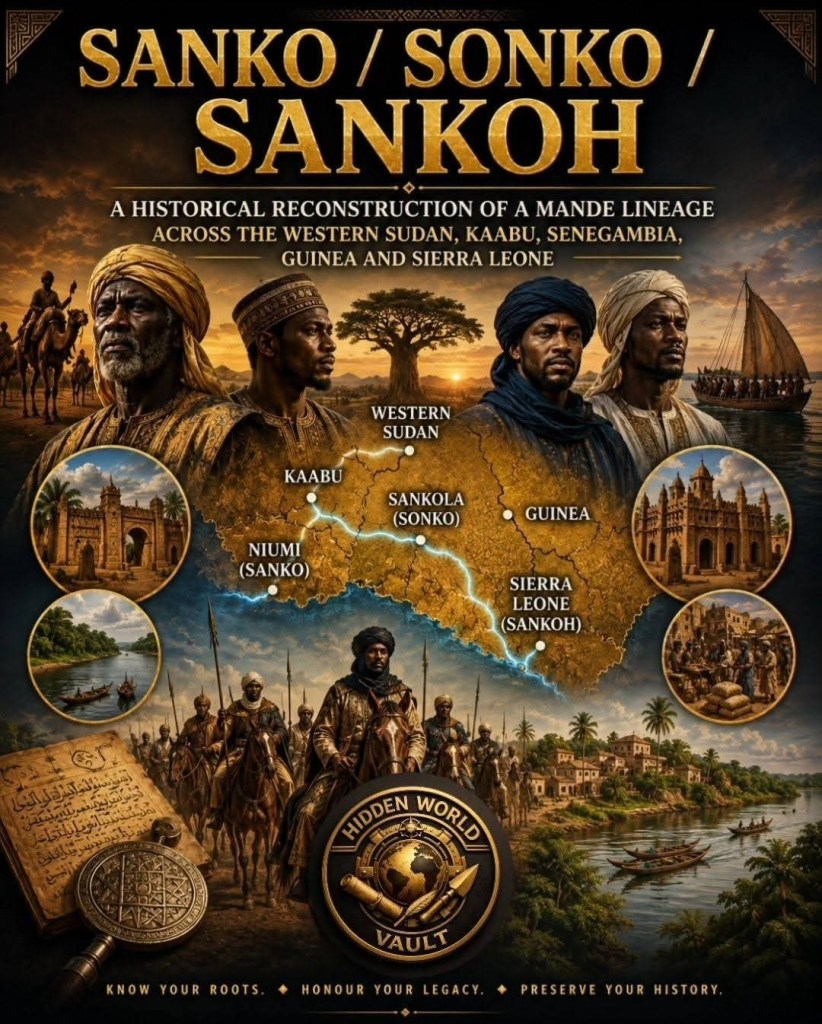
SANKO / SONKO / SANKOH
SANKO / SONKO / SANKOH
A Historical Reconstruction of a Mande Lineage Across the Western Sudan, Kaabu, Senegambia, Guinea and Sierra Leone
For generations, surnames such as Sanko, Sonko and Sankoh have appeared across different parts of West Africa. Today, they are sometimes classified according to the language or ethnicity of the communities where they live. But the historical record tells us that the story is much more complicated, and much more fascinating.
- A NAME THAT CROSSED BORDERS
The forms Sanko, Sonko and Sankoh appear in different historical and linguistic environments across the western Mande world.
They are associated, in different contexts, with:
Sankola, Kaabu, Casamance, Niumi, Guinea and north-western Sierra Leone.
But we must begin with an important warning:
A similar surname does not automatically prove a common biological ancestor.
What makes the story remarkable is that historical evidence places these names within overlapping Mande political, commercial, Islamic and migration networks.
- THE SONKO OF SANKOLA
One of the oldest and most intriguing connections is Sankola, a historical Manding political formation in the Senegambian region.
Oral traditions recorded by Sékéné-Mody Cissoko and Kaoussou Sambou identify Mansa Bourama Sonko with the establishment of Sankola. Other scholarship also connects the Sonko rulers of Sankola with the wider political world of Kaabu.
This is significant because it demonstrates that Sonko was not simply a modern surname.
It was associated with a historical political lineage.
- SONKO AND THE KAABU WORLD
Kaabu was one of the great western Manding political formations, extending across territories that today fall within Guinea-Bissau, Senegal and Guinea.
Historical traditions place the Sonko of Sankola within this wider Manding political environment.
Some traditions even describe the Sonko as related to the princes of Kaabu.
This places the name within a world of:
nobility, provincial administration, warfare, agriculture, trade and dynastic politics.
- THE NIUMI CONNECTION
The story does not end in Kaabu.
Further west, in Niumi, historical traditions preserve Sanko royal houses.
A study of Niumi’s political traditions records that kingship rotated among seven royal houses, including three Sanko houses. One traditional royal list includes Demba Sanko among the rulers of Niumi.
So we encounter a fascinating geographical pattern:
Sankola → Sonko
Kaabu → Sonko
Niumi → Sanko
This does not yet prove one continuous genealogy, but it demonstrates that the name had a significant presence in the western Manding political world.
- THEN WE MEET THE SANKOH OF SIERRA LEONE
The Sierra Leone story is where the historical evidence becomes particularly strong.
Historian Allen M. Howard, in his study of Mande identity formation in north-western Sierra Leone, identifies the Sankoh among Mande kin groups whose earlier connections included Jakhanke and Serakhulle/Soninke-speaking populations.
This is extremely important.
It means that the historical Sankoh of north-western Sierra Leone cannot simply be understood through their later Susu-speaking identity.
Their story reaches deeper into the interior Mande world.
- FROM THE INTERIOR TOWARD THE COAST
Mande-speaking families did not remain confined to one political territory.
Merchants, scholars, warriors, clerics and ruling families moved through enormous networks connecting the interior with the Atlantic coast.
The Sankoh were part of this larger movement.
Their historical trajectory eventually brought them through the Susu-speaking belt toward the Kolente and north-western Sierra Leone.
And here something very important happened:
Language changed, but lineage could survive.
- BECOMING SUSU-SPEAKING
The historical Sankoh became deeply integrated into the Susu-speaking environment.
But this should not be confused with saying that their deepest ancestry was necessarily exclusively Susu.
West African history contains countless examples of families changing language through migration, marriage, settlement and political integration.
The Sankoh story is therefore a powerful example of how:
ancestry, language and political identity are not always the same thing.
- MELIKURI AND THE GREAT SCARCIES
The Sankoh became established around the Melikuri and Great Scarcies/Kolente region.
This was not an insignificant location.
It formed part of a major corridor linking the interior of Guinea with the commercial world of Sierra Leone.
Trade, Islam and migration brought together people from different Mande-speaking communities.
The Sankoh became part of that network.
- From Migrants to Political Actors
Eventually, Sankoh families became established around Sendugu and the Port Loko region.
They were no longer simply travellers.
They became:
landholders, merchants, Muslims, political intermediaries and local authorities.
This transformation is one of the most important parts of their history.
A family could arrive as a “stranger” and, over generations, become one of the most influential houses in the political landscape.
- ISLAM WAS CENTRAL TO THEIR RISE
Islam provided the Sankoh with connections extending far beyond their immediate communities.
Through Muslim networks, they interacted with scholars, merchants and other Mande-speaking communities.
Their identity therefore became multilayered:
Sankoh by lineage.
Susu-speaking by language.
Muslim by religion.
Mande-connected by historical networks.
Port Loko by political home.
These identities could exist simultaneously.
- TRADE CONNECTED THE LINEAGE TO THE INTERIOR
The Sankoh were also connected to long-distance commercial networks.
Port Loko was linked to routes extending toward the interior of Guinea and the Upper Niger world.
Merchants from different Mande communities travelled through these routes, including people identified historically as Serakhulle, Maninka, Mandingo and Dioula.
This helps explain why the Sankoh story cannot be isolated from the wider economic history of the western Mande world.
- MARRIAGE CREATED NEW IDENTITIES
The Sankoh also entered into marriages with local communities, including Temne-speaking families.
This produced descendants with multiple ancestral connections.
A later Sankoh could therefore inherit:
Mande paternal ancestry
and
Temne maternal ancestry
without either side of the family being historically “false.”
This is how African societies actually worked.
People married.
Languages changed.
Families moved.
Political alliances shifted.
But lineage memories could survive.
- THE PORT LOKO CRISIS
The political history of the Sankoh became especially complicated in the nineteenth century.
The rise of Brima Konkori Sankoh and the struggle surrounding the Almami position generated major political conflict.
Contemporary interpretations of the conflict sometimes divided communities into supposedly separate “Susu” and “Temne” camps.
But historians have shown that Port Loko was a much more mixed political environment.
The conflict involved competing families, Muslim networks, local authorities and people of different Mande and Temne backgrounds.
This is a perfect example of why modern ethnic labels cannot simply be projected backward onto precolonial politics.
- SANKO , SONKO AND SANKOH : ONE CLAN?
Now comes the question that makes this history so fascinating.
Could Sanko, Sonko, and, Sankoh represent different regional forms of an older Mande lineage?
It is certainly possible.
We have:
Sonko → Sankola → western Mande/Kaabu
Sanko → Niumi royal houses
and:
Sankoh → Mande-connected groups → Susu-speaking zone → Melikuri → Port Loko.
The geographical connections are historically plausible.
The Mande world was highly mobile, and long-distance migration was normal.
But there is a line we must not cross.
- What We Have Proven — and What We Have Not
The evidence strongly supports that Sankoh was an established Mande-connected lineage in north-western Sierra Leone, with documented connections to Jakhanke and Serakhulle/Soninke backgrounds, a major Susu-speaking phase, Islamic networks, commerce and political authority.
The evidence also demonstrates that Sonko/Sanko lineages existed within the western Manding political world, particularly around Sankola, Kaabu and Niumi.
What remains unproven is whether every Sanko, Sonko and Sankoh descends from one original ancestor.
That requires further genealogical, archival, linguistic and oral-historical investigation.
- THE BIGGER LESSON
The history of Sanko, Sonko and Sankoh teaches us something much bigger than the history of one surname.
It teaches us that African identities were never as rigid as modern borders sometimes make them appear.
A family could migrate from the interior.
It could settle among another Mande-speaking population.
It could adopt a new language.
It could marry into another community.
It could become Muslim.
It could establish a kingdom.
It could become involved in international trade.
And centuries later, its descendants could carry a surname that still preserves a fragment of that older history.
- THE HISTORICAL RECONSTRUCTION
The most responsible reconstruction at present is therefore:
WESTERN SUDAN
↓
WESTERN MANDE NETWORKS
↓
SANKO / SONKO TRADITIONS
↓
SANKOLA AND KAABU
↓
SENEGAMBIA / NIUMI
and, through another historically documented Mande migration network:
INTERIOR MANDE WORLD
↓
JAKHANKE / SARAKULI-SONINKE CONNECTIONS
↓
SUSU-SPEAKING BELT
↓
KOLENTE / MELIKURI
↓
PORT LOKO
↓
SANKOH
This is best understood as a historical network, not yet as one proven genealogical tree.
- WHY THIS MATTERS TODAY
When someone asks:
“Are the Sankoh Susu, Temne, Mandinka or Soninke?”
perhaps the better answer is:
They are Soninké-Manding
But the history is older and more complicated than the question.
A surname can preserve a lineage.
A language can change.
A kingdom can disappear.
A border can divide a people.
But historical memory can travel across all of them.
That is why Sanko, Sonko and Sankoh deserve to be studied not merely as surnames, but as clues to the extraordinary movement of people, power, Islam, commerce and culture across the western Mande world.
And perhaps the greatest question remains unanswered:
Were Sanko, Sonko and Sankoh different branches of one ancient Mande lineage, or related lineages whose histories eventually crossed?
The evidence has brought us to the door.
The next step is to open the archives, listen to the griots, examine the languages, compare genealogies and follow the routes across the old Mande world.
History is not always lost. Sometimes, it is simply waiting to be connected.
REFERENCES
- Allen M. Howard, “Mande Identity Formation in the Economic and Political Context of North-West Sierra Leone, 1750–1900,” Paideuma, Vol. 46 (2000), pp. 13–35.
- Sékéné-Mody Cissoko & Kaoussou Sambou, Recueil des traditions orales des Mandingues de Gambie et de Casamance (1974), including oral traditions concerning Mansa Bourama Sonko and Sankola.
- Donald R. Wright, Beyond Migration and Conquest: Oral Traditions and Mandinka Ethnicity in Senegambia — particularly the traditions concerning Sonko, Sankola, Kaabu, Jarra and Niumi.
- Kelefa Saane, research on Niumi traditions, including the seven royal houses and the three Sanko royal houses.
- Research on the Temne and Port Loko political environment, including scholarship citing Howard, Fyfe, Wylie and related archival materials.