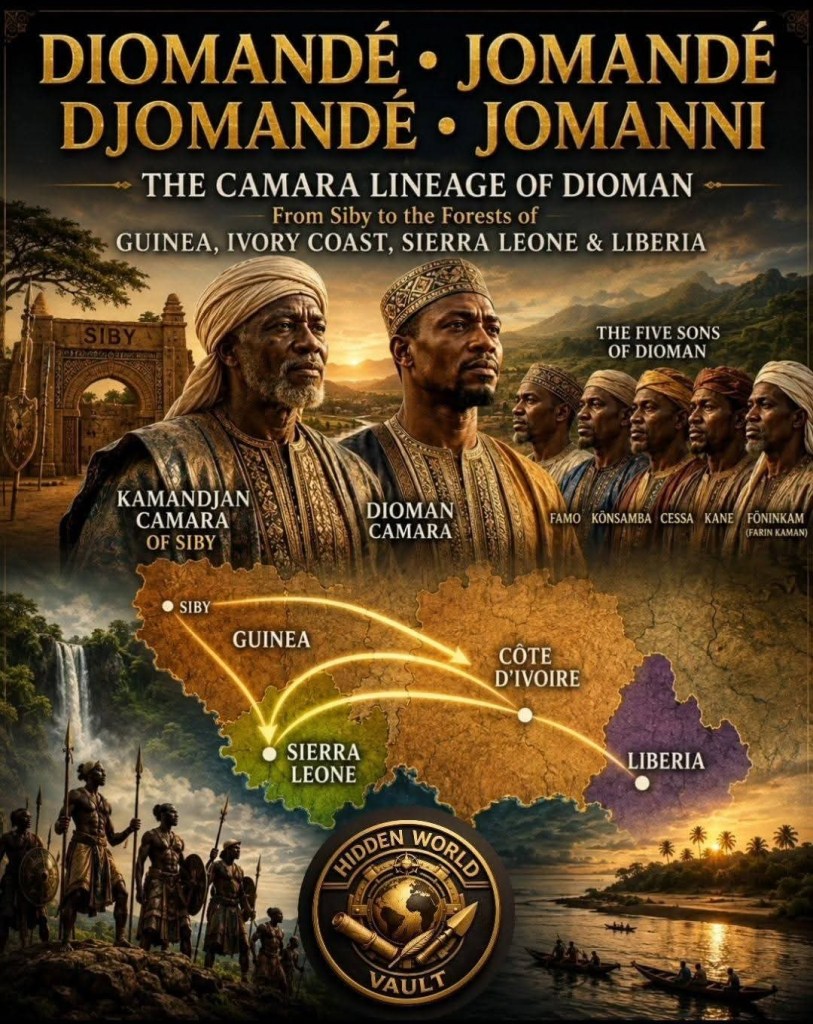
DIOMANDÉ • JOMANDÉ • DJOMANDÉ • JOMANNI
DIOMANDÉ • JOMANDÉ • DJOMANDÉ • JOMANNI
THE CAMARA LINEAGE OF DIOMAN
From Siby to the Forests of Guinea, Ivory Coast, Sierra Leone & Liberia
The history of the Diomandé begins not with a separate people, but with a branch of the ancient Camara lineage of Mandé.
Among the traditions preserved by Camara genealogists, one principle is fundamental:
All Diomandé are Camara, but not all Camara are Diomandé.
The distinction is genealogical.
The Diomandé are traditionally identified as the descendants of Dioman Camara, remembered as a son of Kamandjan Camara of Siby.
- BEFORE DIOMANDÉ, THERE WAS CAMARA
Within Manding oral traditions, the Camara, an original Kakoro family, are remembered as one of the old ruling lineages of Mandé.
The traditions surrounding Kamandjan Camara of Siby place him within a much older Camara political tradition, associated with kingship, warfare, territorial authority and the defence of Mandé.
It is from this Camara house that the tradition places Dioman/Joman Camara.
This is why the history of the Diomandé cannot properly be separated from the history of the Camara.
The name came later.
The lineage came first.
- WHO WAS DIOMAN?
Dioman, also remembered as Joman, is traditionally identified as a son of Kamandjan Camara.
The traditions concerning him differ in detail.
One tradition remembers Dioman as the ancestor whose sons were sent outward to acquire new territories and establish settlements.
Another tradition connects the name to Dioman Tènèn, associated with Kamandjan’s household, whose children adopted her name as part of their identity.
These traditions should not automatically be treated as identical historical accounts. They represent different explanations preserved within the wider oral tradition.
But both preserve the same central memory:
DIOMAN/JOMAN BECAME THE ANCESTRAL NAME OF A DISTINCT CAMARA BRANCH.
- THE MEANING OF DIOMANDÉ
The traditional explanation is beautifully simple.
Dioman + den = Dioman-den
In Manding, den/dɛn is associated with child/offspring.
Thus:
Dioman-den = the children/descendants of Dioman.
Through generations of pronunciation, regional speech and colonial orthographies, the name appears in different forms:
DIOMANDÉ
Guinea • Côte d’Ivoire
DJOMANDÉ
Guinea, particularly in some regional spellings
JOMANDÈ
Sierra Leone
JOMANNI
Liberia
These should not automatically be treated as different clans.
They are regional forms associated with the same historical Dioman/Joman tradition.
The exact phonological development of each form, however, deserves further linguistic study.
- THE FIVE SONS OF DIOMAN
The genealogical tradition recorded by Djiguiba Camara is especially important here.
In Essai d’histoire locale, the descendants of Dioman are traced through a succession leading to Fin Koyfing, whose five sons eventually dispersed. The text explicitly identifies the descendants of Famo Camara in the Touba region as Diomandé, “fils de Dioman.”
The five principal sons traditionally associated with this dispersal are:
- FAMO CAMARA
Associated with the Touba region of Côte d’Ivoire, where his descendants became established in several settlements.
- KÖNSAMBA CAMARA
Associated with the Goye/Beyla region of Guinea, where the elder branch expanded through the surrounding country.
- CESSA CAMARA
Remembered in the traditions as another son who moved toward Côte d’Ivoire.
- KANE/KONÉ CAMARA
Also associated with the southward movement toward Côte d’Ivoire.
- FÖNINKAM / FARIN KAMAN CAMARA
The youngest son, whose story becomes particularly important for the history of Guinea’s Forest Region, Liberia and Sierra Leone.
This dispersal is one of the foundational episodes in the Diomandé tradition.
- THE BROTHERS WHO CHANGED THE MAP
The story of the five brothers is not merely a genealogy.
It is a story of migration, settlement and political expansion.
According to the tradition, the brothers moved away from their father’s territory in search of new lands.
They did not simply disappear into the population around them.
They established settlements.
They became chiefs.
They formed political communities.
And their descendants spread across the southern Mandé world.
This helps explain why Diomandé communities are found today across territories separated by modern international borders.
- THE TWO GREAT BRANCHES
Among the descendants of Dioman, two branches became particularly important in the historical traditions of Guinea:
KÖNSAMBA CAMARA DIOMANDÉ
The elder branch became associated with the savannah and forest transition around Beyla and Konyan.
FÖNINKAM / FARIN KAMAN CAMARA DIOMANDÉ
The younger branch became associated with the Forest Region and later traditions concerning Mandé expansion toward the Atlantic.
The modern borders of Guinea, Côte d’Ivoire, Liberia and Sierra Leone did not exist when these movements took place.
Consequently, the same extended lineage could eventually be found on both sides of what are now international boundaries.
- KONYAN: THE SOUTHERN CAMARA WORLD
The Konyan highlands around Beyla are crucial to the later history of the Diomandé.
This is not merely an oral claim.
Modern historical scholarship has independently identified Kamara Diomande with the southern expansion of Mandinka populations.
Andreas W. Massing’s 1985 study of the Mane movements argues that the Kamara Diomande were the leading element of Mandinka expansion into the southern forest region, particularly during the political transformations accompanying the decline of Mali.
This is one of the most important pieces of evidence connecting the Diomandé tradition to the wider history of southern West Africa.
- THE MANE MOVEMENTS
During the sixteenth century, Manding-speaking warrior groups moved southward toward the regions that are today Sierra Leone and parts of the surrounding Upper Guinea/Upper West African forest zone.
European observers later recorded these groups under names such as Mane/Mani.
The precise identity, composition and chronology of the Mane remain subjects of scholarly debate.
Massing argues that the Mane were connected to Mandinka expansion, and specifically highlights the Kamara Diomande of Konyan as a leading element in the southern expansion.
Other scholars have interpreted the Mane question differently, so the identification should not be presented as completely settled.
But the convergence is striking:
Konyan → Kamara Diomande → southern expansion → Sierra Leone
This is precisely the geographical corridor preserved in the Diomandé traditions.
- FÖNINKAM AND THE ROAD TO SIERRA LEONE
The tradition surrounding Föninkam/Farin Kaman Camara Diomandé becomes especially significant here.
According to the genealogy, he was the youngest son of Dioman.
A conflict among the brothers resulted in his departure toward the Forest Region.
What initially appeared to be exile became, in the tradition, the beginning of a much larger historical movement.
His descendants became associated with southern Mandé political expansion.
And eventually, traditions connected this branch with the movements that entered:
Guinea Forestière → Liberia → Sierra Leone
This is where the Diomandé story becomes directly connected to the history of the Kamara/Jomandè communities of Sierra Leone.
- THE JOMANDÈ OF SIERRA LEONE
In Sierra Leone, the name is commonly encountered in the form:
JOMANDÈ
The spelling reflects the local linguistic and historical environment rather than necessarily indicating a different ancestry.
The Sierra Leone tradition is particularly important because the country became one of the major destinations of southern Mandé migrations during the period associated with the Mane movements.
The descendants of these movements interacted with existing peoples, established settlements, created ruling houses, married locally and contributed to the formation of new political societies.
Therefore, the history of the Jomandè should not be reduced to a simple “migration.”
It was a process of:
conquest → settlement → alliance → intermarriage → political integration → new identities.
- THE JOMANNI OF LIBERIA
Across the border in Liberia, the name appears in the form:
JOMANNI
Liberian traditions preserve numerous memories of Manding-speaking migrations from the interior toward the forest and coastal regions.
Massing’s research is particularly significant because he connects the southern expansion of the Kamara Diomande with the wider process of Manding political and religious expansion in the region.
Other scholarship also discusses the movement of Kamara Diomande groups into the forest regions and their role in the formation of new political communities.
Thus, Jomanni should be investigated as part of the larger southern history of the Diomandé/Camara lineage rather than treated as an isolated Liberian surname.
- DIOMANDÉ AND CAMARA
This distinction is essential.
CAMARA
A much broader and ancient Manding clan name with numerous branches and historical houses.
DIOMANDÉ
A specific Camara lineage traditionally tracing descent from Dioman/Joman Camara, son of Kamandjan.
Therefore:
Every Diomandé belongs to the Camara lineage in this tradition.
But:
Not every Camara is Diomandé.
This is the genealogical key to understanding the entire history.
- FROM KAMANDJAN TO DIOMAN
The lineage can therefore be represented traditionally as:
KAMANDJAN CAMARA
King of Siby
↓
DIOMAN / JOMAN CAMARA
his son
↓
DIOMAN’S DESCENDANTS
↓
CAMARA DIOMANDÉ / JOMANDÉ
↓
KÖNSAMBA BRANCH
Beyla/Konyan and surrounding regions
FÖNINKAM BRANCH
Forest Region and southern expansion
↓
GUINEA • CÔTE D’IVOIRE • LIBERIA • SIERRA LEONE
This is the ancestral framework from which the later history must be understood.
- THE MASSAQUOI CONNECTION
The story does not necessarily end in the Guinea forests.
The southern Camara traditions eventually intersect with the history of Sierra Leone and Liberia’s Manding-speaking ruling families.
This is where the traditions surrounding the Massaquoi royal line, Gallinas, Vai country and the Kamara Diomandé become especially important.
The connection requires separate examination because oral genealogies, royal traditions and European records do not always give identical accounts.
But the historical question is extremely important:
How did a Camara/Diomandé warrior tradition from the Konyan–Forest Region become connected with the later ruling houses of the Sierra Leone–Liberia frontier?
That is the next chapter of the story.
- A LINEAGE THAT CROSSED BORDERS BEFORE BORDERS EXISTED
The modern map gives us:
● Guinea
● Côte d’Ivoire
● Liberia
● Sierra Leone
But the ancestors of these communities lived in a completely different political geography.
Their world was organized around:
Mandé → Konyan → Forest Region → chiefdoms → trade routes → rivers → military alliances → kinship networks.
Colonial borders later divided populations that had been connected for generations.
This is why a single ancestral tradition can survive under different spellings:
DIOMANDÉ
DJOMANDÉ
JOMANDÈ
JOMANNI
Different countries.
Different orthographies.
One remembered lineage.
- WHAT HISTORY CAN AND CANNOT PROVE
There is a crucial distinction between the genealogical tradition and what historians can independently establish.
The genealogy linking Dioman directly to Kamandjan, and the precise sequence of all five sons, belongs primarily to the Camara/Diomandé oral-historical tradition.
However, there is independent historical scholarship confirming the importance of Kamara Diomande groups in southern Manding expansion, particularly in the Konyan–Sierra Leone context. Massing explicitly identifies the Kamara Diomande as a leading element of this expansion.
Djiguiba Camara’s Essai d’histoire locale provides particularly valuable genealogical material, including the tradition that descendants of Famo Camara in the Touba region were known as Diomandé, “sons of Dioman.”
So we have something powerful:
Oral genealogy gives us the family memory.
Historical scholarship gives us the wider political context.
Geography gives us the migration corridor.
And together they allow us to investigate the Diomandé past without pretending that every traditional detail has already been proven.
■ THE LEGACY OF DIOMAN
The Diomandé story is ultimately a story about expansion without disappearance.
The descendants of one Camara ancestor spread across enormous distances.
They entered new territories.
They founded settlements.
They became chiefs and rulers.
They interacted with older populations.
They participated in the formation of new political societies.
And they carried the memory of their ancestor with them.
That memory survived in different forms:
Diomandé.
Djomandé.
Jomandè.
Jomanni.
But beneath the different spellings stands the same traditional idea:
The children of Dioman.
And behind Dioman stands the Camara house of Kamandjan of Siby.
This is why the history of the Diomandé is not merely the history of a surname.
It is a story about Camara kingship, migration, conquest, settlement, kinship and the transformation of the Mandé world across West Africa.
RESEARCH NOTE:
This reconstruction deliberately combines Camara/Diomandé oral traditions with independently published historical research. The genealogical relationship between Dioman and Kamandjan, the five-son genealogy, and some later royal connections should be presented as traditional history. The identification of Kamara Diomande as a major element in southern Mandinka expansion, is also explicitly discussed in modern scholarship, particularly Andreas W. Massing’s study of the Mane and the decline of Mali.
SELECTED REFERENCES
● Djiguiba Camara, Essai d’histoire locale — important genealogical traditions concerning Dioman and his descendants.
● Andreas W. Massing, “The Mane, the Decline of Mali, and Mandinka Expansion towards the South Windward Coast,” Cahiers d’Études Africaines 25 (1985), 21–55.
● David C. Conrad — scholarship on medieval Mandé/Mali traditions and oral historical reconstruction.
● Yves Person — studies of the Mane movements and southern Manding expansion.
● Walter Rodney — research on the historical formation of Sierra Leone and the Mane movements.
HiddenWorldVault #Diomande #Jomande #Djomande #Jomanni #Camara #Kamara #Kamandjan #Dioman #Jomandè #MandeHistory #MandingHistor