The Funkees: The Nigerian Band That Turned Post-War Pain Into Afro-Rock
The Funkees: The Nigerian Band That Turned Post-War Pain Into Afro-Rock
From a military band in post-Civil War Eastern Nigeria to London stages, The Funkees became one of Nigeria’s most exciting Afro-rock groups of the 1970s
In the history of Nigerian music, some bands became household names while others became treasures waiting to be rediscovered. The Funkees belong to the second category.
Emerging from the turbulence of post-Civil War Nigeria, The Funkees transformed themselves from a military-linked band in Aba into one of the most energetic Afro-rock groups of the 1970s. Their music combined electric guitars, funk, rock, soul, percussion and African rhythms, creating a sound that was unmistakably Nigerian but also connected to the international music revolution of the era.
The group became particularly influential in Eastern Nigeria, where they developed a reputation for keeping audiences dancing through long nights. Soundway Records describes them as the leading band in Eastern Nigeria in the early 1970s and notes that they were among the few groups capable of challenging Lagos-based rock acts such as MonoMono and BLO.
Born From the Ashes of War
The story of The Funkees is inseparable from the aftermath of the Nigerian Civil War.
The band was formed around the end of the war by Harry Mosco Agada, who had previously played guitar with Celestine Ukwu’s Music Royals. The early group performed for the Nigerian Army’s 12th Brigade in Aba and went through several changes in personnel as its members searched for the right combination of musicians.
This beginning is particularly significant.
The Nigerian Civil War had left enormous destruction and trauma, especially across the former Eastern Region. Yet as the war ended, a new generation of young Nigerians began searching for ways to rebuild ordinary life.
Music became part of that process.
The Funkees represented a youthful energy that emerged from this difficult period. Their music was lively, electric and heavily focused on dancing. Rather than allowing the darkness of the period to define everything around them, they helped create a new atmosphere in which young people could gather, dance and enjoy themselves again.
The Guardian’s photographic history of 1970s Nigerian rock notes that The Funkees played their first show around the time the Civil War effectively ended and quickly became one of the most beloved bands in the former Biafra.
The Sound of a New Generation
The Funkees were not simply a highlife band.
Their music drew from several international and African influences, including funk, rock, soul, Afrobeat and highlife. Their arrangements were driven by electric guitars, bass, organ, drums and percussion.
Their lyrics could move between Igbo and English, giving the music both a local identity and a wider accessibility.
This mixture was central to their appeal.
A listener could hear the influence of Western rock and funk while still recognising the African rhythmic foundation underneath it.
The result was Afro-rock—a style that was particularly vibrant in Nigeria during the late 1960s and 1970s.
The Musicians Behind the Sound
The Funkees went through several line-up changes during their existence.
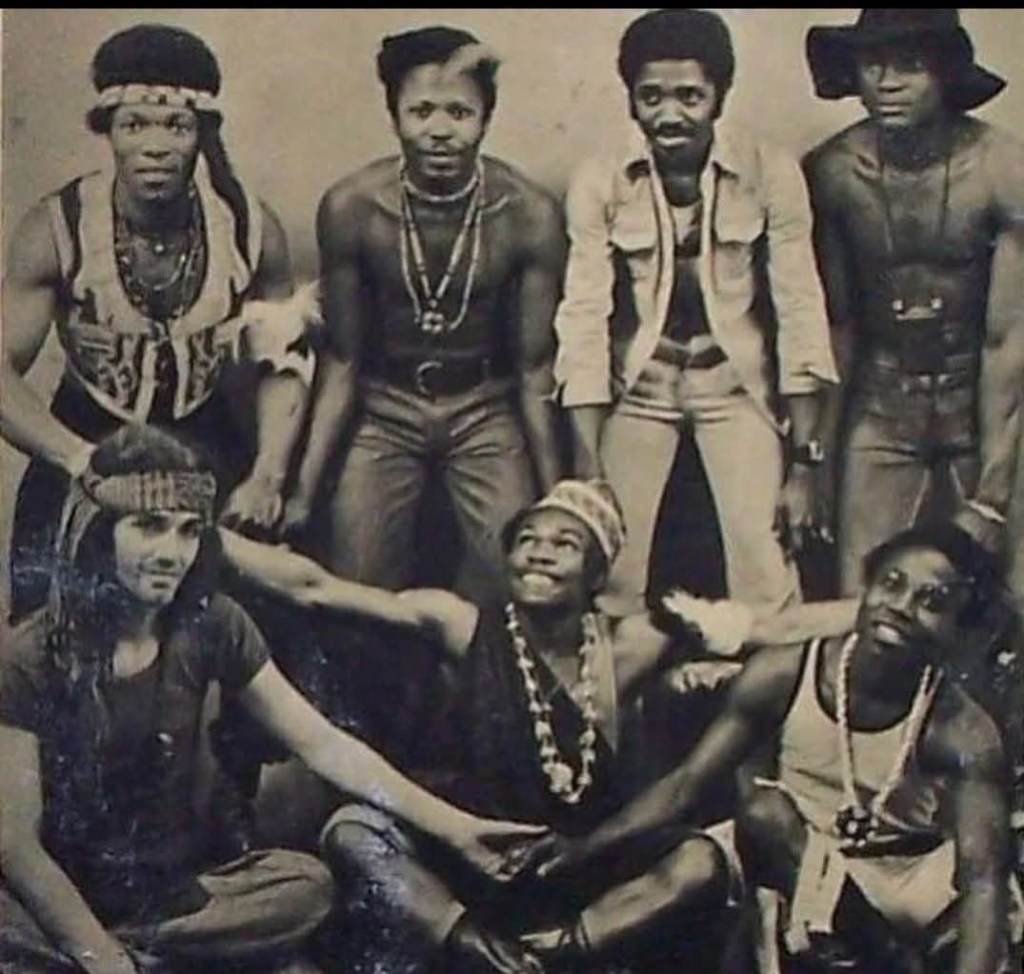
Among the important members associated with the band were Harry Mosco, Jake N. Sollo, Chyke Madu, Mohammed Ahidjo, Sonny Akpabio, Danny Heibs, Tony Mallett, Roli Paterson and Sunny Akpan.
Harry Mosco was particularly important to the band’s formation and identity, serving as a guitarist, vocalist and bandleader.
Another major figure was Jake Sollo, whose work as a guitarist, organist and vocalist would later become important beyond The Funkees.
The concentration of talented musicians within the group is one reason The Funkees have become so interesting to historians and collectors of Nigerian popular music.
The band was not simply a successful musical group; it was also a training ground for musicians who would continue making their mark after its eventual breakup.
They Wanted You on the Dance Floor
If there was one thing The Funkees understood, it was how to make people move.
Soundway Records notes that the group’s priority was the dance floor and that they could perform for extremely long periods, sometimes playing through the night.
Their songs were therefore built around strong grooves.
Tracks such as “Akpankoro,” “Onye Mmanya,” “Akula Owu Onyeara,” “Dancing Time,” “Mimbo” and “Slipping Into Darkness” demonstrate the band’s ability to take familiar musical ideas and turn them into energetic Afro-rock performances.
Their version of War’s “Slipping Into Darkness” is particularly notable. The band took an American funk song and gave it their own Nigerian interpretation, demonstrating how musicians of the period were actively exchanging ideas between Africa and the wider world.
From Aba to London
The Funkees’ growing reputation eventually attracted attention outside Nigeria.
In the early 1970s, the band relocated to London, joining a wider movement of African musicians who travelled to Britain in search of larger audiences, better recording opportunities and international exposure.
The move transformed their career.
In London, they developed a strong following among West African and Caribbean communities and became known for their energetic live performances. Soundway Records notes that they quickly established a strong reputation on the London live circuit.
The band also performed alongside major international acts, including Kool & the Gang and Osibisa, according to Soundway Records.
For musicians who had started out playing in post-war Eastern Nigeria, this represented an extraordinary journey.
They had gone from playing for soldiers and local audiences in Aba to performing for international audiences in London.
“Point of No Return”
In London, The Funkees recorded their first major album, Point of No Return, released in 1974.
The title itself would eventually acquire an almost symbolic quality.
The album captured the band’s Afro-rock identity and helped introduce their music to listeners beyond Nigeria.
Its recordings demonstrated the band’s ability to combine African rhythms with the heavy guitar sounds, funk grooves and psychedelic influences that were popular during the 1970s.
The album remains one of the key documents of Nigerian Afro-rock from the period.
“Now I’m a Man”
The band followed with Now I’m a Man, released in 1976.
The album’s cover, showing members of the group dressed in unmistakable 1970s fashion, has itself become part of the visual history of Nigerian popular music.
Together, the two albums provide an important record of the group’s development during its London years.
They also show how Nigerian musicians were not merely receiving foreign musical influences—they were actively transforming those influences and sending something new back into the international music scene.
FESTAC ’77
One of the most significant moments associated with The Funkees came in 1977, when the band returned to Nigeria during the Second World Black and African Festival of Arts and Culture, FESTAC ’77, held in Lagos.
FESTAC brought artists, musicians and cultural representatives from across Africa and the African diaspora to Nigeria.
For The Funkees, appearing in Nigeria during such a major international celebration of Black culture was a significant moment.
However, the period also coincided with the final stages of the group’s existence. The Funkees eventually broke up in 1977, bringing a relatively short but remarkable chapter to an end.
A Band That Became Bigger After Breaking Up
One of the fascinating things about The Funkees is that their reputation did not disappear when the group ended.
Instead, their music gradually became a collector’s treasure.
For decades, their original vinyl records were difficult to find. Then, as international interest in vintage African music increased, record labels began searching through Nigeria’s musical archives.
In 2012, Soundway Records released Dancing Time: The Best of Eastern Nigeria’s Afro Rock Exponents 1973–77, a compilation containing 18 tracks drawn from the band’s Nigerian singles and two albums.
The reissue introduced The Funkees to a new generation of listeners.
Tracks that had once been heard primarily in Nigerian clubs and dance halls were suddenly being played by DJs, collectors and music enthusiasts around the world.
Why The Funkees Matter Today
The Funkees matter because they demonstrate that Nigerian music history was never a single straight line.
While Lagos was developing its own influential rock, highlife and Afrobeat scenes, Eastern Nigeria was producing musicians with completely different experiences and musical perspectives.
The Funkees captured the spirit of that environment.
They were young, experimental and energetic. Their music reflected a generation that had experienced war but was determined to dance again.
Their sound also demonstrates how Nigerian musicians adapted international genres rather than simply copying them.
Rock became Afro-rock.
Funk became Nigerian funk.
Western guitar techniques were placed alongside African percussion.
English was mixed with Igbo.
And the result was something that belonged to Nigeria.
More Than a Vintage Band
Today, The Funkees are often mentioned alongside the great Nigerian Afro-rock and Afro-funk groups of the 1970s.
But their importance goes beyond their recordings.
They represent a particular moment in Nigerian history: the years immediately following the Civil War, when a young generation was rebuilding its social life and creating new forms of popular culture.
Their story also reminds us that some of Nigeria’s greatest musical achievements were created outside the conventional spotlight.
The Funkees came from Eastern Nigeria, crossed into the international music scene, recorded influential albums and eventually disappeared as a group.
Yet their music refused to disappear.
The Rhythm Lives On
The story of The Funkees is ultimately a story of movement.
From military performances in Aba to clubs across Eastern Nigeria.
From Nigeria to London.
From vinyl records to digital streaming.
From obscurity to rediscovery.
And from the aftermath of war to dance floors filled with young people.
Their career may have lasted only a few years, but those years produced a body of music that continues to attract listeners more than four decades after the band broke up.
The Funkees proved that Nigerian musicians could take the sounds of a changing world, mix them with their own cultural experiences and create something entirely new.
They did not merely play Afro-rock. They helped define what Nigerian Afro-rock could become.
And every time one of their old records spins again, the dance floor of 1970s Nigeria comes alive.
Sources
Soundway Records — Dancing Time: The Best of Eastern Nigeria’s Afro Rock Exponents 1973–77.
Soundway Records — The Funkees artist profile and discography.
The Guardian — Lighting up Lagos: the stars of 1970s Nigerian rock music.
Exclaim! — review of Dancing Time.
Nigerian Music Digital Archive — The Funkees historical profile.
Photographs: The images above include an archival photograph of The Funkees and original/vintage album artwork. The Now I’m a Man cover dates from the band’s 1970s recording period, while Dancing Time is a later archival compilation using historical Funkees imagery.