Traditional Leadership & How Pre-Colonial Kings Ruled
Traditional Leadership & How Pre-Colonial Kings Ruled 👑🌍
Before any colonial administrations and modern government structures existed, southern Africa was organized around chiefdoms and kingdoms — political systems with their own laws, courts, and lines of succession 👑
Kingship was almost always hereditary, passing through a royal bloodline, but who exactly inherited power wasn’t always simple. Succession was typically patrilineal, though a king often identified closely with his mother’s clan as well, and disputes between half-brothers or rival houses over the throne were common rather than rare 🏛️
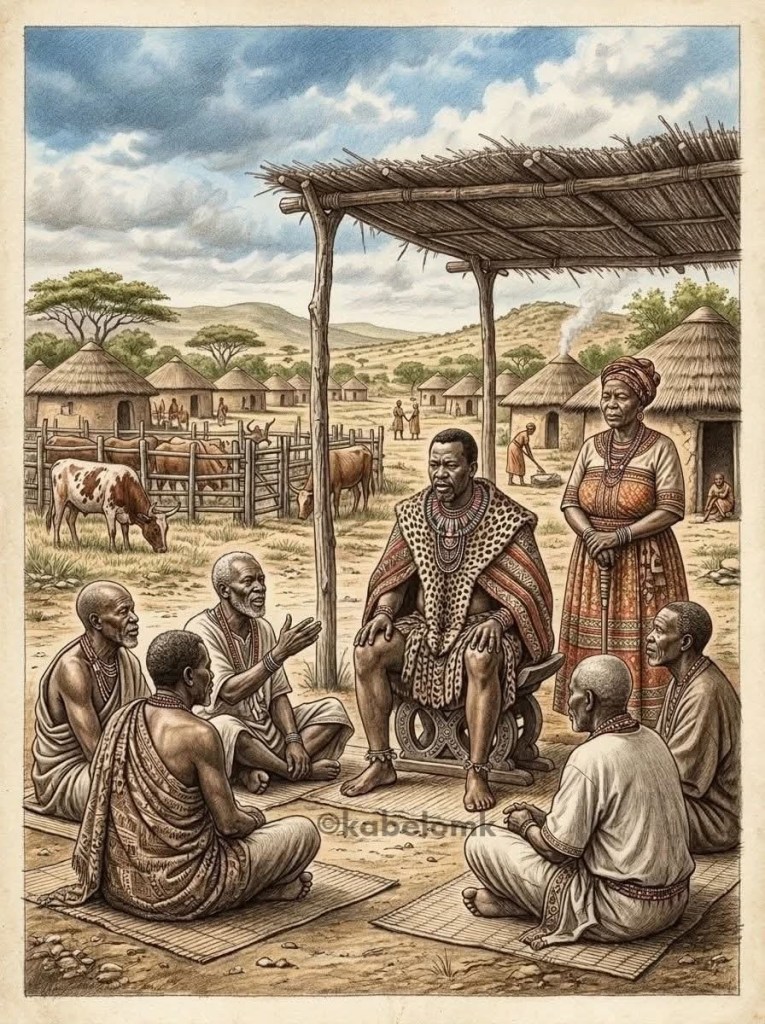
A king rarely ruled alone. He was supported by senior advisors, known among Nguni-speaking peoples as izinduna, who acted as a bridge between the king and his people — carrying messages, offering counsel, and representing the crown in outlying districts 🗣️
These advisors also carried real judicial weight: local disputes like theft were handled by subordinate izinduna, while serious matters such as murder were escalated to the king himself, often only after consultation with an inner council of trusted elders. Justice, in other words, moved through layers, not from one man’s word alone ⚖️
Territory was managed the same way. Chiefdoms were divided into smaller subdivisions called izigodi, each overseen by a headman, with these structures together forming what became known as a Tribal Authority that helped the chief govern. A kingdom this size couldn’t be run from one homestead — it needed layers of local leadership reporting upward 🗺️
Perhaps the most dramatic example of centralized kingship in South African history came with Shaka, widely known as the founder of the Zulu Kingdom. Shaka broke from the old confederacy system by subordinating hereditary chiefs from groups he incorporated, instead appointing loyal izinduna to govern districts on his behalf — binding these officials to the throne through personal loyalty rather than bloodline.
Later kings like Cetshwayo formalized councils of izinduna for deliberation while still holding onto ultimate royal authority, overseeing more than a million subjects through a network of over 200 appointed headmen.
Women, too, held meaningful — if often uncredited — power within these systems. Most royal rulers were men, but women held considerable influence as wives and mothers of kings, and in some cases governed directly as regents when a king was too young to rule.
Within Shaka’s own royal settlements, senior women of the royal family held administrative authority jointly alongside a trusted induna in the king’s absence.
Kingship also carried a spiritual dimension that Western ideas of monarchy don’t fully capture. Kings were often viewed as custodians of cultural heritage and intermediaries between their people and the divine, deriving legitimacy from custom and ritual rather than any electoral process — meaning a king’s authority rested as much on ceremony and ancestral connection as it did on military or political strength 🌿
Succession disputes were rarely as tidy as “eldest son inherits.” In several documented cases, including the Bapedi kingship, the usurpation of a throne through conflict was still recognised — after the fact — as a legitimate path to power, showing that succession functioned less like a fixed rulebook and more like a contested process shaped by strength, alliances, and popular support.
What’s clear across all these systems — Zulu, Xhosa, Pedi, Sotho, Tswana, and beyond — is that “king” never meant unchecked, solitary power.
Advisors, councils, headmen, and even royal women all shared in the work of governing, long before any colonial administrator arrived to redraw how leadership would work. 🇿🇦