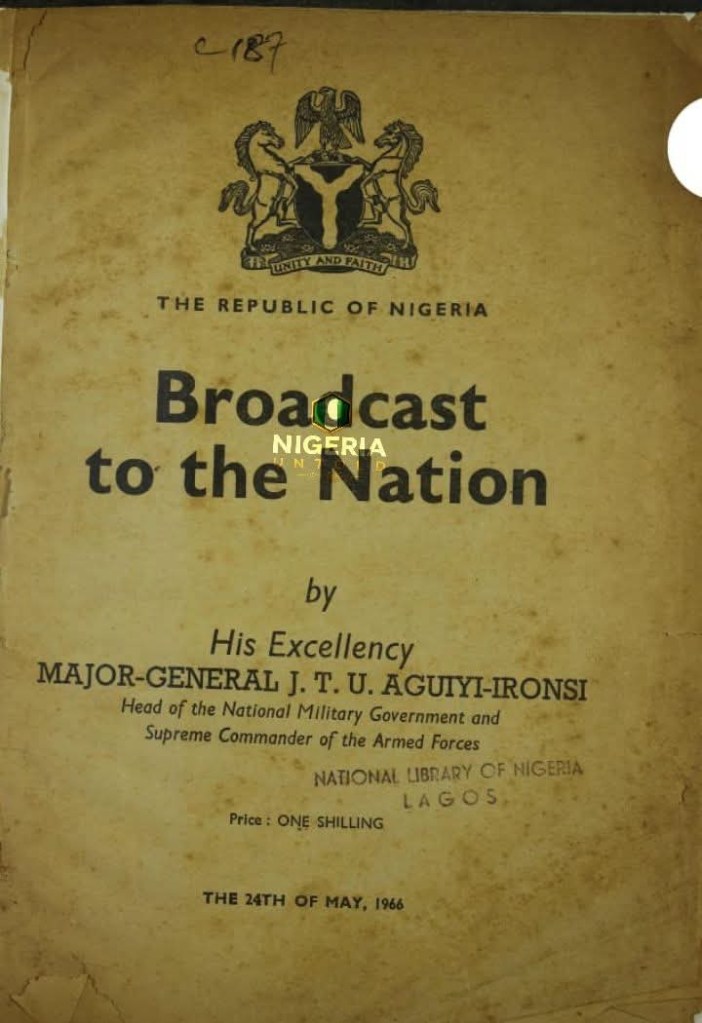
𝗧𝗛𝗘 𝟭𝟵𝟲𝟲 𝗕𝗥𝗢𝗔𝗗𝗖𝗔𝗦𝗧 𝗧𝗢 𝗧𝗛𝗘 𝗡𝗔𝗧𝗜𝗢𝗡
𝗧𝗛𝗘 𝟭𝟵𝟲𝟲 𝗕𝗥𝗢𝗔𝗗𝗖𝗔𝗦𝗧 𝗧𝗢 𝗧𝗛𝗘 𝗡𝗔𝗧𝗜𝗢𝗡
𝗣𝗔𝗥𝗧 𝟭 — 𝗪𝗛𝗔𝗧 𝗗𝗜𝗗 𝗜𝗥𝗢𝗡𝗦𝗜 𝗪𝗔𝗡𝗧 𝗙𝗢𝗥 𝗡𝗜𝗚𝗘𝗥𝗜𝗔’𝗦 𝗘𝗖𝗢𝗡𝗢𝗠𝗬?
Before reading this part, here is what you need to know.
In this section of his 1966 broadcast, Major General Johnson Aguiyi-Ironsi was explaining what his government wanted Nigeria’s next development plan to achieve.
The focus was clear:
Economic growth.
Industrialisation.
More food production.
Reducing unemployment.
And less dependence on foreign funding.
Now, here are his exact words:
The main objectives of the next Plan will be a high overall rate of growth with a view to achieving “self-sustained growth” before the end of the Perspective Plan ; the rapid industrialisation of the economy ; increased production of food for domestic consumption without relaxing efforts in the export sector, and drastic reduction in the magnitude of the present unemployment problem.
Other objectives include increased diversification of the economy, a more equitable distribution of incomes among persons and the maintenance of a reasonable measure of stability through appropriate instruments of policy.
As it is realised that all these specified objectives are not entirely consistent, efforts will be made to strike a reasonable balance between them.
A high rate of growth is, however, regarded as the most important objective of the Plan, so that in most cases a high priority will be accorded to projects capable of generating a high growth rate.
Accordingly, in the allocation of investment during the next Plan, agriculture and industry will be given high priority while social and administrative sectors will be given a low priority since some of these have already claimed more than is proportionately due to them under the current Plan.
In other words, Ironsi’s government was placing agriculture and industry at the centre of Nigeria’s economic future.
But there was another problem.
Where would the money come from?
That was what he addressed next.
Very careful attention will be given to the estimation of available resources. While every effort will be made to attract and utilise foreign aid, it is considered that the bulk of the burden of implementing the next Plan will be borne by Nigerians themselves.
Judging by the experience so far gained in the implementation of the current Plan, it is not expected more than 40 per cent of the capital required for implementing the next Plan will come from foreign resources.
The plan, however, would require sacrifices.
And Ironsi made that clear:
A plan of the magnitude envisaged cannot succeed without the goodwill and support of all sections of the community. Efforts will, therefore, be made as far as possible to ensure that the whole community will be involved in the planning exercise and to bring the Plan to the homes of all citizens of the country as every Nigerian will have to make some sacrifices.
Steps will, however, be taken to ensure that the sacrifices which people will be called upon to make in different parts of the country keep in step with each other.
This was how Ironsi described the economic direction he wanted Nigeria to take in 1966.
I’ll leave that with you.
𝑻𝒐 𝑩𝒆 𝑪𝒐𝒏𝒕𝒊𝒏𝒖𝒆𝒅…
ℹ️ Nigeria Untold