BEFORE YOU CALL EGYPT THE WHOLE STORY, REMEMBER KUSH.
BEFORE YOU CALL EGYPT THE WHOLE STORY, REMEMBER KUSH.
Let’s make this uncomfortable for a moment.
Most of us can name Egyptian pharaohs. We know the pyramids, the temples, the mummies and the mythology.
But how many people know that a powerful African kingdom south of Egypt eventually took control of Egypt itself?
That kingdom was Kush.
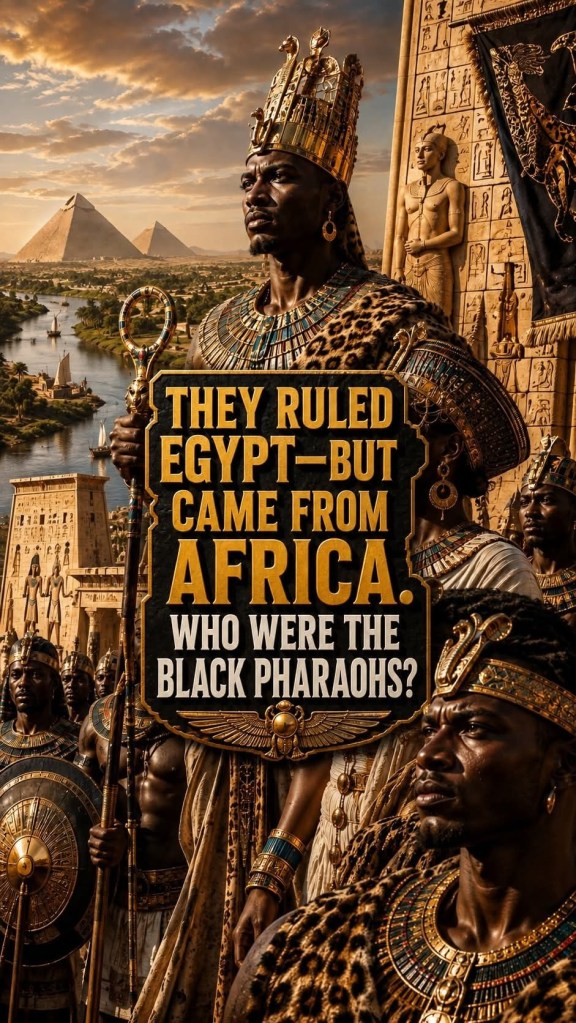
This isn’t a modern invention or social-media legend. Piye marched north from Kush, defeated rival rulers and brought much of Egypt under Kushite control. His successors—including Shabaka, Shebitku, Taharqa and Tantamani—ruled Egypt as the 25th Dynasty.
And then we get to Taharqa.
He wasn’t merely sitting on a throne. The Kushite king ruled Egypt while facing the enormous military power of the Assyrian Empire.
Stop and think about what that means.
A kingdom centered in what is now Sudan had become powerful enough to control Egypt and confront one of the ancient world’s major imperial powers.
But here’s another part people sometimes misunderstand: the Kushites didn’t simply invade Egypt and erase everything that came before them.
They adopted Egyptian royal traditions. They supported temples. They worshipped Egyptian deities. They commissioned monuments and presented themselves as legitimate pharaohs.
And when Kush eventually lost Egypt, Kush itself survived.
Its rulers returned south, and the civilization continued for centuries. At Meroë, the Kushites constructed pyramids, temples and palaces while developing a civilization with its own distinctive identity.
So here’s where I want the debate to begin.
Why is the history of ancient Egypt so frequently discussed without giving equal attention to the African civilizations that surrounded it, interacted with it—and, at one point, ruled it?
And if someone says, “Kushites weren’t Egyptians,” that’s actually an important distinction.
They weren’t.
They were Kushites.
That’s precisely why their story matters.
A distinct African civilization became powerful enough to conquer Egypt and establish the 25th Dynasty.
Recognizing Kush doesn’t require denying Egypt.
Celebrating Egyptian history doesn’t require erasing Kush.
Both histories belong in the story of the ancient Nile Valley.
So tell me what you think:
🔥 Has the story of the Black Pharaohs been overlooked in discussions of African history?
🔥 Why do you think Kush receives so much less popular attention than ancient Egypt?
🔥 And perhaps the biggest question: If Kush was powerful enough to conquer Egypt, what other chapters of ancient African history have received far less attention than they deserve?