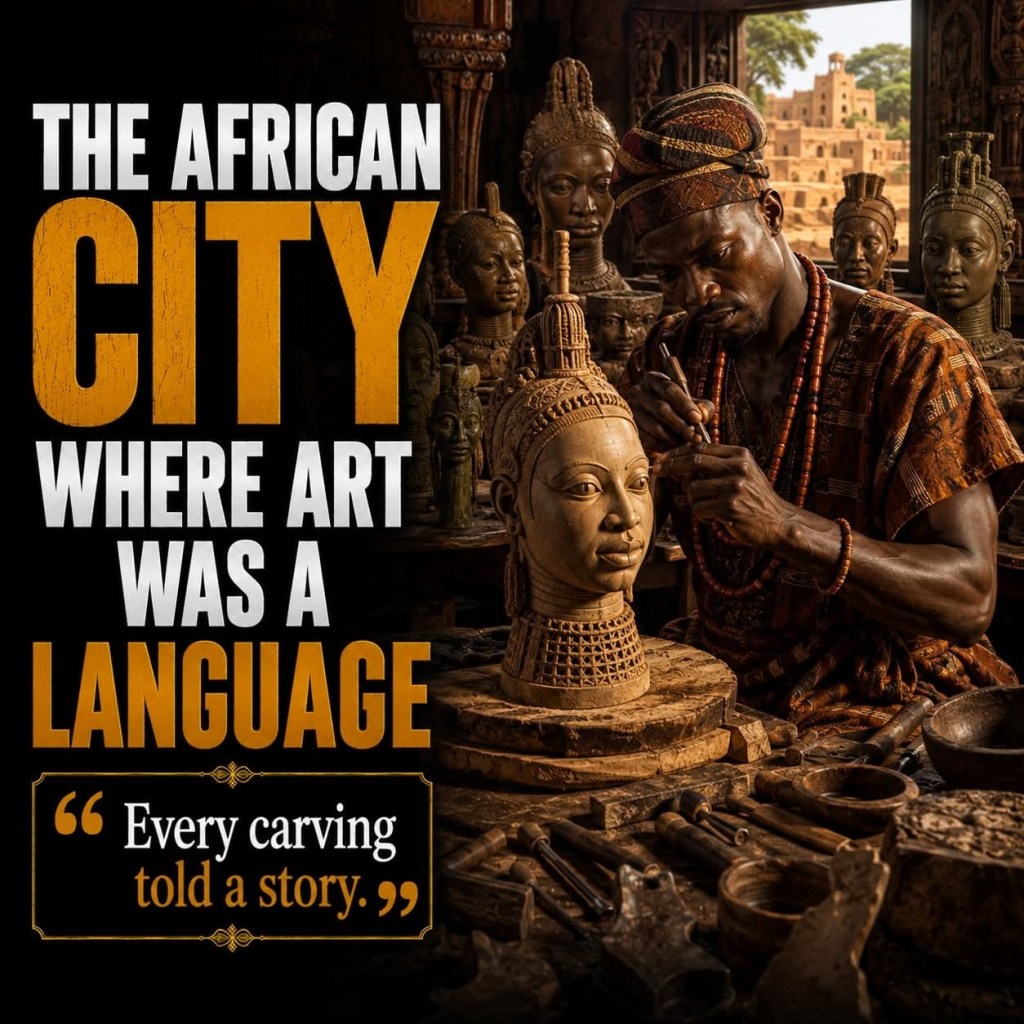
THE AFRICAN CITY WHERE ART WAS A LANGUAGE
THE AFRICAN CITY WHERE ART WAS A LANGUAGE
What if I told you that some African artworks were never meant to be just beautiful?
A sculpture could tell you who a king was.
A carved figure could preserve the memory of an ancestor.
A symbol could represent power.
A mask could carry spiritual meaning.
And a royal artwork could record a story that had never been written down.
In many African societies, art was a language.
It spoke without a single word.
One of the most remarkable examples can be found in the ancient city of Ife, in present-day Nigeria.
Between roughly the 12th and 15th centuries, Ife became an important political and cultural center of the Yoruba world.
And its artists produced works that still amaze historians and art experts today.
They created remarkably detailed sculptures in terracotta, stone, and metal.
Some human heads are so naturalistic that they immediately challenge the old idea that sophisticated naturalistic art was somehow foreign to Africa.
But the real story is deeper than artistic skill.
These objects carried meaning.
They could represent rulers, ancestors, important individuals, spiritual ideas, or moments of political and cultural significance.
And then there was Benin.
In the royal court of the Benin Empire, artists produced extraordinary brass and bronze works for the royal palace.
Some of the famous Benin works depicted kings, queens, warriors, officials, Portuguese visitors, and important events.
They were not simply decorations.
They helped preserve the memory of the kingdom.
Imagine entering a royal palace where the walls themselves were telling you:
Who ruled here.
Who came before them.
What battles were fought.
Which relationships mattered.
What the kingdom valued.
That is the power of visual history.
In societies where much knowledge was transmitted orally, art could become another way of preserving memory.
A skilled artist could communicate information through:
👑 Royal figures
⚔️ Weapons and military symbols
🪶 Ceremonial objects
🐆 Animals associated with power
🌀 Religious and cultural symbols
🎭 Masks and sculptures
The details mattered.
The clothing mattered.
The posture mattered.
The objects held by a figure mattered.
Even the position of a person within a composition could communicate status.
In other words…
The artwork had a vocabulary.
And people who understood that visual language could read meanings that a stranger might completely miss.
That is why African art should not be viewed only through the question:
“How beautiful is it?”
There is another question we should ask:
👉 “What is it saying?”
Because behind the bronze…
Behind the terracotta…
Behind the carved wood…
There could be an entire history.
A king.
A battle.
An ancestor.
A belief.
A political message.
A memory passed from one generation to another.
And that makes African art more than decoration.
It makes it evidence.
Evidence that civilizations across the continent developed their own sophisticated artistic traditions, systems of symbolism, and ways of recording and transmitting knowledge.
Some stories were written in books.
Others were spoken by elders.
And some…
were carved into wood, shaped from clay, cast in metal, and preserved for centuries.
So the next time you see an ancient African sculpture, don’t just look at it.
Listen to it.
Because it may have been speaking long before you arrived.
If you discovered an ancient African sculpture, what would you want to know first?
👑 Who made it?
📖 What story does it tell?
🕰️ How old is it?
🙏 What did it mean to the people who created it?