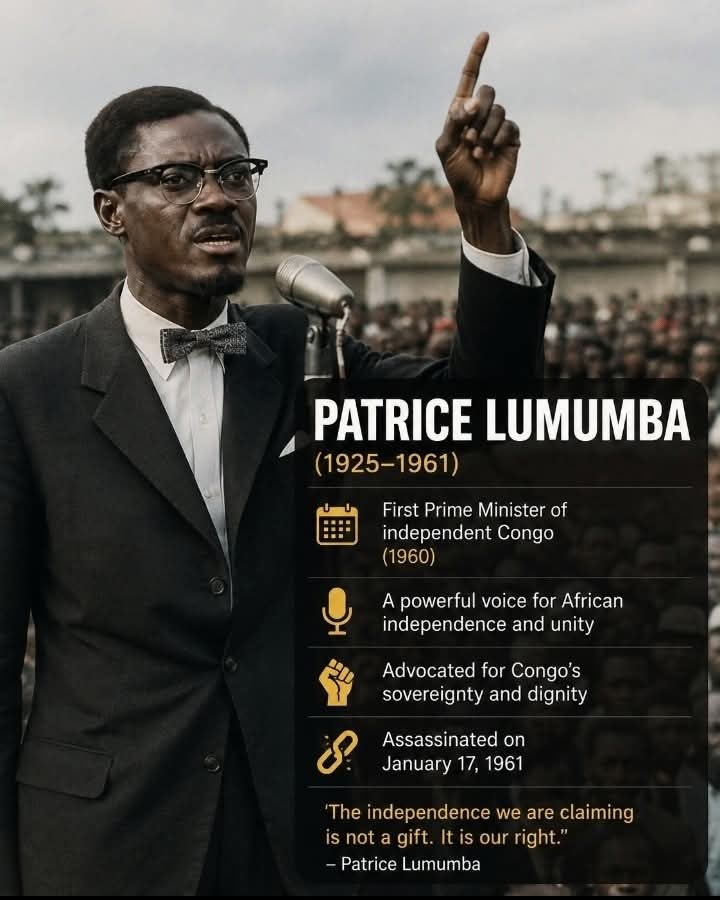
HE BECAME PRIME MINISTER OF THE CONGO AT JUST 34 — AND LESS THAN SEVEN MONTHS LATER, HE WAS DEAD.
🔥 HE BECAME PRIME MINISTER OF THE CONGO AT JUST 34 — AND LESS THAN SEVEN MONTHS LATER, HE WAS DEAD.
But Patrice Lumumba’s story is far more complicated than simply saying, “He was killed because he wanted a free Congo.”
His life, political rise, and brutal assassination became one of the defining tragedies of African independence — and a major episode of the Cold War.
Here is the story of Patrice Émery Lumumba.
🇨🇩 WHO WAS PATRICE LUMUMBA?
Patrice Lumumba was born on 2 July 1925 in Onalua, in the Belgian Congo.
He grew up during a period when the Congo was under Belgian colonial rule and Africans were subjected to severe political and social discrimination.
Lumumba worked as a postal clerk and later became increasingly involved in politics and the struggle for greater rights for Congolese people.
Unlike many colonial subjects who were expected to accept a limited political role, Lumumba developed a powerful vision:
The Congo should belong politically and economically to the Congolese people.
In 1958, he helped establish the Mouvement National Congolais (MNC), or Congolese National Movement.
The movement advocated for a united and independent Congo rather than allowing the country to be permanently divided along ethnic or regional lines.
🇨🇩 THE CONGO BECOMES INDEPENDENT
The Congo became independent from Belgium on 30 June 1960.
Joseph Kasa-Vubu became President.
Patrice Lumumba became the country’s first Prime Minister.
He was only 34 years old.
The independence ceremony was expected to be a moment of celebration.
But Lumumba shocked the audience with a speech that directly confronted the realities of colonialism.
While King Baudouin of Belgium praised Belgium’s role in developing the Congo, Lumumba reminded his audience that independence had not simply been handed to the Congolese people as a generous gift.
He spoke about colonial oppression, humiliation, forced labor, discrimination and violence.
His message was unmistakable:
Political independence had to mean real freedom and dignity for Congolese people.
For many Africans, Lumumba’s speech became a symbol of uncompromising anti-colonial nationalism.
For some Belgian interests and Western policymakers, however, his politics were increasingly alarming.
⚠️ THEN EVERYTHING STARTED FALLING APART.
Only days after independence, the Congo descended into crisis.
The army mutinied.
Belgian troops intervened.
The mineral-rich province of Katanga, under Moïse Tshombe, declared its secession with significant Belgian backing and economic interests surrounding the region.
The Congo was suddenly facing political instability, military rebellion, foreign intervention and territorial fragmentation.
Lumumba appealed to the United Nations for assistance.
The UN established the United Nations Operation in the Congo (ONUC) to help preserve the country’s territorial integrity and political independence.
But Lumumba soon became frustrated with the UN’s refusal to use its forces to crush the Katanga secession.
The crisis became increasingly international.
And because this was 1960, the world was also in the middle of the Cold War.
The United States and Soviet Union were competing for influence across the globe.
Lumumba’s decision to seek Soviet assistance after Western and UN support failed to meet his expectations made Washington increasingly suspicious of him.
🇺🇸🇧🇪 WAS LUMUMBA REALLY A COMMUNIST?
This is where history becomes more complicated.
Lumumba was a radical anti-colonialist and African nationalist, but describing him simply as a Soviet communist is misleading.
His primary political objective was Congolese national independence and unity.
However, during the Congo Crisis, his willingness to seek Soviet assistance was enough to make him a serious concern to Western governments during the Cold War.
The CIA did develop plans concerning Lumumba.
Declassified American records have established that the CIA was involved in efforts to remove Lumumba, and American intelligence officials considered assassination as one possible means of eliminating him. Even the CIA’s own historical publication acknowledges that the agency was involved in a plot against him.
But this does not mean the CIA physically carried out the execution.
That distinction matters.
The evidence surrounding Lumumba’s death points to a much broader network of Congolese, Belgian and foreign actors rather than a simple one-country assassination story.
🔒 THE FALL OF LUMUMBA
In September 1960, President Kasa-Vubu dismissed Lumumba.
Lumumba rejected the dismissal.
The political crisis intensified.
Colonel Joseph-Désiré Mobutu — later known as Mobutu Sese Seko — intervened and seized power.
Lumumba was placed under increasing pressure and eventually captured in December 1960.
He was imprisoned.
Then came the final and most horrifying chapter.
On 17 January 1961, Lumumba, along with his associates Maurice Mpolo and Joseph Okito, was transferred to Katanga.
According to the later Belgian parliamentary investigation, Lumumba was executed that same night, only hours after arriving in Katanga. The investigation concluded that the killing was a premeditated murder carried out by Katangan authorities, with Belgian officials present.
The three men were killed.
Their bodies were later secretly disposed of in an attempt to prevent their graves from becoming political symbols.
For years, the exact circumstances surrounding Lumumba’s death remained surrounded by secrecy, conflicting accounts and political controversy.
🇧🇪 WHAT DID BELGIUM LATER ADMIT?
This is one of the most important parts of the story.
In 2000, the Belgian Parliament established a special commission to investigate the circumstances surrounding Lumumba’s assassination and possible involvement by Belgian political authorities.
The commission’s work continued into 2001–2002.
Its conclusions were devastating.
The commission found that certain members of the Belgian government and other Belgian actors bore moral responsibility for the circumstances that led to Lumumba’s death.
It also concluded that Belgian authorities knew about important developments surrounding Lumumba’s transfer and execution and failed to intervene.
The investigation determined that Lumumba was probably executed on the evening of 17 January 1961, approximately five hours after arriving in Katanga.
This transformed the historical conversation.
Lumumba’s death could no longer simply be dismissed as an unexplained African political assassination.
There had been substantial foreign involvement in the Congo Crisis, and Belgian actors played a significant role.
💔 BUT LUMUMBA’S STORY DID NOT END WITH HIS DEATH.
In fact, his death helped create his legend.
Across Africa and beyond, Lumumba became a symbol of:
✊🏿 African independence
✊🏿 Anti-colonial resistance
✊🏿 National sovereignty
✊🏿 Pan-African aspirations
✊🏿 Resistance to foreign interference
His image appeared on posters, murals, books and political movements.
To many Africans, Lumumba represented something larger than one politician.
He represented the possibility that newly independent African nations could control their own political destiny and natural resources.
🇨🇩 THE TRAGEDY OF THE CONGO
The Congo was — and remains — enormously rich in natural resources.
Copper, cobalt, diamonds, gold, uranium and other minerals have made the country strategically important to global powers and corporations.
But immense natural wealth did not automatically translate into prosperity for ordinary Congolese people.
The Congo Crisis became one of the clearest examples of how the politics of colonialism, natural resources, nationalism and the Cold War could collide with devastating consequences.
After Lumumba’s death, Joseph Mobutu eventually consolidated power and ruled the country for decades.
The country was renamed Zaire under Mobutu.
Lumumba, meanwhile, remained a powerful symbol of the alternative path the Congo might have taken.
🕊️ THE MOST POWERFUL LESSON FROM LUMUMBA’S LIFE
Patrice Lumumba was not a perfect man.
He was a young politician operating in an extraordinarily dangerous political environment.
He made controversial decisions.
He had political enemies.
He faced enormous pressure.
But reducing his story to “a communist killed by the CIA” is also an oversimplification.
The historical record reveals something more complicated:
A newly independent country.
A struggle over national unity.
A battle over natural resources.
Belgian interests.
Congolese political rivalries.
Cold War competition.
CIA operations.
Katangan separatism.
Mobutu’s military intervention.
And international institutions struggling to respond to a rapidly deteriorating crisis.
All of these forces collided around one young Congolese prime minister.
And on 17 January 1961, Patrice Lumumba was dead.
He was only 35 years old.
🔥 BUT HERE IS THE QUESTION THAT STILL HAUNTS HISTORY:
What would the Congo have become if Patrice Lumumba had survived?
Would he have succeeded in building a strong, united and genuinely independent Congo?
Or would the political divisions of the country eventually have defeated him?
We will never know.
And perhaps that is one of the saddest things about history.
Sometimes, we do not lose only a person.
We lose the future that person might have built.
🇨🇩 Patrice Lumumba: 1925–1961.
A man whose political career lasted only a few years…
…but whose name survived for generations.
👇🏿 WHAT DO YOU THINK?
Was Lumumba primarily an African nationalist, a Cold War radical, or a combination of both?
And most importantly:
Do you think Africa would have looked different if Patrice Lumumba had lived?
Share your thoughts in the comments.
PatriceLumumba #AfricanHistory #AfricanIndependence #BlackHistory #ColdWar