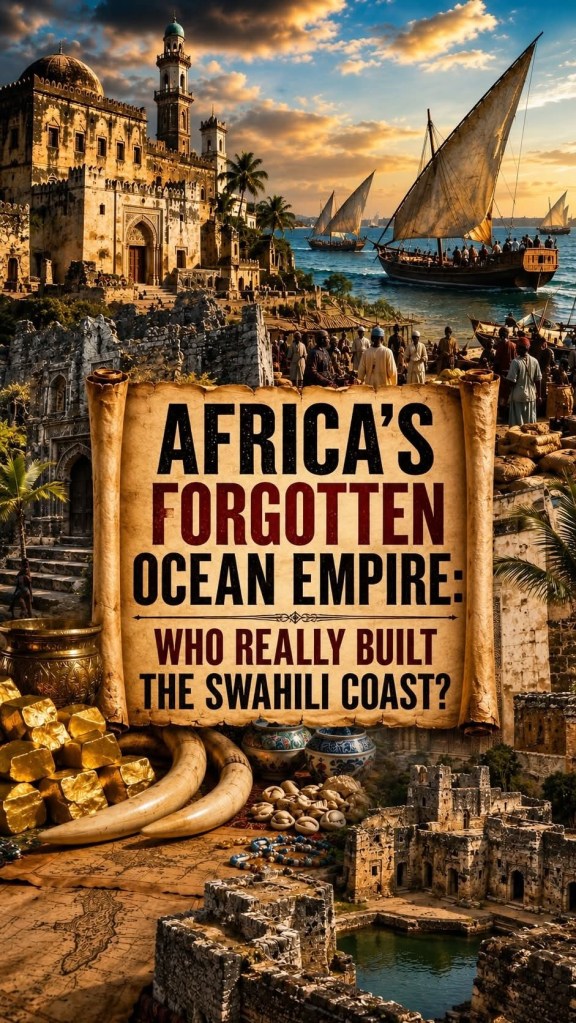
THE AFRICAN CIVILIZATION THEY FORGOT TO TELL YOU ABOUT
THE AFRICAN CIVILIZATION THEY FORGOT TO TELL YOU ABOUT
Let me ask you a question…
What if I told you that, centuries before European colonial powers dominated Africa, Africans were already building wealthy cities, sailing across the Indian Ocean, minting coins, trading with Arabia, Persia, India and China—and living in sophisticated urban societies?
Would that surprise you?
Because this is the story of the Swahili Coast.
And no… it wasn’t simply “Arabs living in Africa.”
That’s one of the biggest misconceptions about Swahili history.
The Swahili civilization developed along the eastern African coast through centuries of interaction between African societies and the wider Indian Ocean world.
From modern-day Somalia and Kenya to Tanzania and Mozambique, and across islands such as Zanzibar, Pemba and Kilwa, African coastal communities built a network of powerful trading cities.
And these weren’t just villages waiting for foreigners to arrive.
They had mosques, palaces, merchant houses, wells, streets, sophisticated water systems, skilled craftsmen and enormous trading networks.
Take Kilwa Kisiwani.
This African city became one of the most important commercial centers in the western Indian Ocean.
Gold from the African interior moved through its networks.
Ivory moved through its ports.
Foreign merchants arrived with textiles, ceramics, glassware and luxury goods from distant lands.
And here’s where the story gets uncomfortable for anyone who still believes Africa had no sophisticated economic systems before European intervention:
Kilwa minted its own coins.
Yes.
Coins.
In medieval Africa.
And archaeological discoveries have found Chinese porcelain, Persian ceramics, Indian goods and other foreign materials at Swahili sites.
So ask yourself:
How “isolated” was Africa if African cities were participating in a trading system stretching across the Indian Ocean?
And then there’s Gedi in modern Kenya.
Archaeologists have uncovered mosques, palaces, houses, streets, wells and sophisticated water-management systems.
These weren’t accidental settlements.
Urban civilization requires organization.
You need food.
You need water.
You need builders.
You need craftsmen.
You need political authority.
You need trade.
You need people with specialized skills.
And the Swahili Coast had all of these.
Then there’s the language.
Kiswahili.
Its grammatical foundation is Bantu, reflecting its deep African roots, while centuries of contact introduced many Arabic and other loanwords.
That’s the beauty of Swahili civilization.
It wasn’t simply African OR Arab.
It was an African civilization shaped by centuries of interaction across the Indian Ocean.
And here’s where the story takes another dramatic turn.
The Swahili cities weren’t wealthy simply because ships arrived from overseas.
They were wealthy because they connected the resources of the African interior to international markets.
Gold.
Ivory.
Iron.
Timber.
Agricultural products.
These resources moved toward the coast.
Then ships carried them across the Indian Ocean.
So the Swahili Coast wasn’t sitting on the sidelines of global history.
It was one of Africa’s gateways into the global economy.
Then, in the late 15th century, the Portuguese arrived.
They weren’t simply tourists.
They wanted control of the Indian Ocean trade.
Portuguese military intervention disrupted established trading networks, and Kilwa was eventually seized.
But here’s another myth we need to kill:
Swahili civilization didn’t suddenly disappear.
Its political and economic structures changed.
Some cities declined.
Others survived.
Zanzibar later became enormously important.
Mombasa remained significant.
Lamu survived.
And Kiswahili went on to become one of the most important languages of Africa.
So when someone says:
“Africa had no cities.”
Remember Kilwa.
When someone says:
“Africans weren’t involved in international trade.”
Remember the Indian Ocean.
When someone says:
“Civilization came to Africa from outside.”
Remember Gedi.
Remember Kilwa.
Remember the Swahili Coast.
Because history is much bigger than the version many of us were taught.
The Swahili Coast wasn’t an African civilization waiting for Europeans to make it “civilized.”
It was an African civilization already connected to a vast international world.
And that leaves us with one uncomfortable question:
If medieval African cities were trading with Arabia, Persia, India and China, why were generations of Africans taught to imagine precolonial Africa as isolated and primitive?
Let’s debate.
Do you believe the Swahili Coast should be taught alongside civilizations like Rome, Greece and medieval Europe?
YES or NO—and tell me WHY.
👇🏿 I want to hear your argument.