
The Belgian colonizers who impregnated thousands of African women and then stole their children
The Belgian colonizers who impregnated thousands of African women and then stole their children
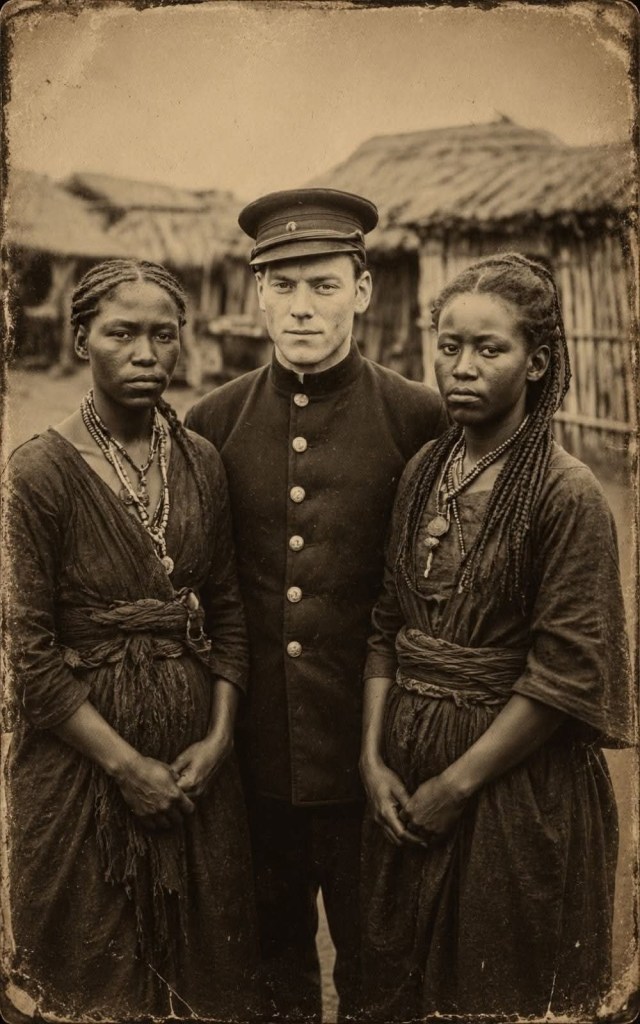
Between 1920 and 1960, thousands of Belgian colonizers arrived in the Congo. These men—engineers, officers, civil servants, and laborers—were almost exclusively single and living far from their families back in Europe. Upon arrival, a dark and common pattern emerged: they would take an African woman into their homes under the guise of household labor—to clean, cook, and serve—but also for purposes that were never spoken of aloud. These relationships frequently resulted in pregnancies. Consequently, thousands of African women gave birth to mixed-race children, the offspring of Belgian fathers who refused to acknowledge them. These children were born with skin lighter than their mothers, bearing the physical features of white men who walked past them in the streets, pretending they were strangers.
By 1948, the presence of these children had become a perceived problem for the colonial administration. They were living, breathing proof that the policy of racial segregation was a failure. They stood as undeniable evidence that the “civilized” white men who preached racial superiority were sleeping with the African women they officially deemed inferior. The Belgian state decided to address this issue in the only way it knew how: through force. If the fathers would not claim these children and the State deemed them a social anomaly, the State would simply take them by force. The world watched, or perhaps looked away, as a European country orchestrated the systematic kidnapping of 20,000 children. The question remained: what did they do to these children after tearing them from their mothers? And what became of them when the Congo achieved independence in 1960 and the Belgians evacuated en masse? The answers are rooted in the events of 1948, when the first trucks began to rattle into remote villages, signaling a fate that mothers soon learned was impossible to outrun.
The Congo was a Belgian colony from 1908 to 1960. During those 52 years, Belgium extracted vast quantities of rubber, ivory, minerals, and timber, building national wealth upon the backs of millions of exploited Africans. There were strict, uncompromising rules: white people resided in designated European neighborhoods, while Africans were confined to their own. Interracial relationships were strictly prohibited; miscegenation was officially illegal. Yet, this was merely a paper law. In practice, thousands of Belgian colonizers lived with African concubines, impregnated them, and raised families in secret. By 1940, there were thousands of these mixed-race children, known as métis, scattered throughout the Congo, living in villages with their African mothers. Their Belgian fathers often saw them from a distance but never offered a surname, never registered them as legitimate heirs, and faced no repercussions for their abandonment.
Everything changed in 1948 when the colonial government created a special agency: the Office de Protection des Métis (the Office for the Protection of the Mestizos). Its official mandate was to protect children of mixed origin, provide them with an education, and prepare them to become “useful citizens.” The reality, however, was far more sinister. The agency began compiling meticulous lists—recording the children’s names, ages, villages of residence, physical descriptions, and the names of the Belgian fathers who had never acknowledged them.
Consider the story of Henri, an engineer who arrived in the Congo in 1943 at the age of 28. His path was identical to thousands of other settlers. Hired by a mining company with the promise of a high salary and a luxurious house, Henri saw the Congo as a safe haven to build a fortune while war tore Europe apart. When he arrived in Leopoldville, the capital, the stark reality of segregation was the first thing he noticed. The white population lived in Kalina, a district characterized by spacious houses with gardens, paved roads, electricity, and running water. The Africans lived in the Cité Indigène, confined to cramped zinc-and-mud shacks on dirt roads that lacked basic sanitation. Between these two worlds lay an invisible line that no one dared cross—or at least, no one admitted to crossing.
Henri was assigned to supervise a copper mine 200 kilometers from the capital. The company provided him with a large, empty house. Living alone, he dealt with his isolation like most other settlers: he hired an African woman to clean, cook, and wash his clothes. This arrangement included the unstated expectation of sexual service. In May 1944, Henri hired a 16-year-old girl named Sala from a nearby village. Her family was in desperate need of money, and working for a white settler offered the highest pay available. Initially, Sala worked only in the household, maintaining a professional distance and responding to Henri’s brief, cold orders. However, as the months passed, the isolation of the large house created an environment where Henri felt empowered to cross the forbidden line.
At 17, Sala had no real choice. Henri was her employer; in this colonial hierarchy, her survival and the financial support of her family depended entirely on him. When he summoned her to his room that night, she complied because refusal meant unemployment and potentially worse. By January 1945, Sala discovered she was pregnant. Henri showed no emotion—no surprise, no anger—simply telling her to continue working as long as possible. In September 1945, she gave birth to a daughter, Monique. The baby was visibly mixed-race, possessing Henri’s eye shape and nose, with skin much lighter than the other children in the village. Anyone who saw them together could deduce the truth, yet Henri never acknowledged the child. Legally, Monique was registered only under her mother’s name, with no father recorded. There was no official link between the Belgian engineer and the baby growing up in the African village. Everyone in the mine and the village knew the truth, but it was a secret kept behind a wall of silence.
By 1946, there were thousands of such children across the Congo. They occupied an agonizing middle ground—too light-skinned to be accepted by the African community and too African to be recognized by the colonial society. Monique grew up sensing this divide. Other children stared at her, and village mothers whispered when she passed. Sala did her best to protect her daughter, teaching her the local language, Kikongo, and instilling in her the customs of the village, hoping she would feel part of the community. But resentment persisted; Monique was living proof of the hypocrisy of the white settlers who preached moral superiority while violating their own laws of segregation.
The year 1948 marked a turning point. The colonial government decided that the métis population was a liability. They were tangible evidence that racial segregation was a sham. The administration sought to make them disappear from the public sphere, creating the agency to categorize and remove these children from their mothers under the guise of “protection.” Officials were sent to every corner of the Congo with instructions to compile comprehensive lists. By March 1948, they had identified 4,000 children between the ages of two and ten. They chose to start with the youngest—those between two and five years old—believing they would be easier to “mold” and would have less memory of their mothers.
Thousands of children were taken away under the promise of a “better life”… but decades later, their search for the truth uncovered a heartbreaking chapter of history that many never knew existed. Discover their forgotten story:
 Hi welcome to my website