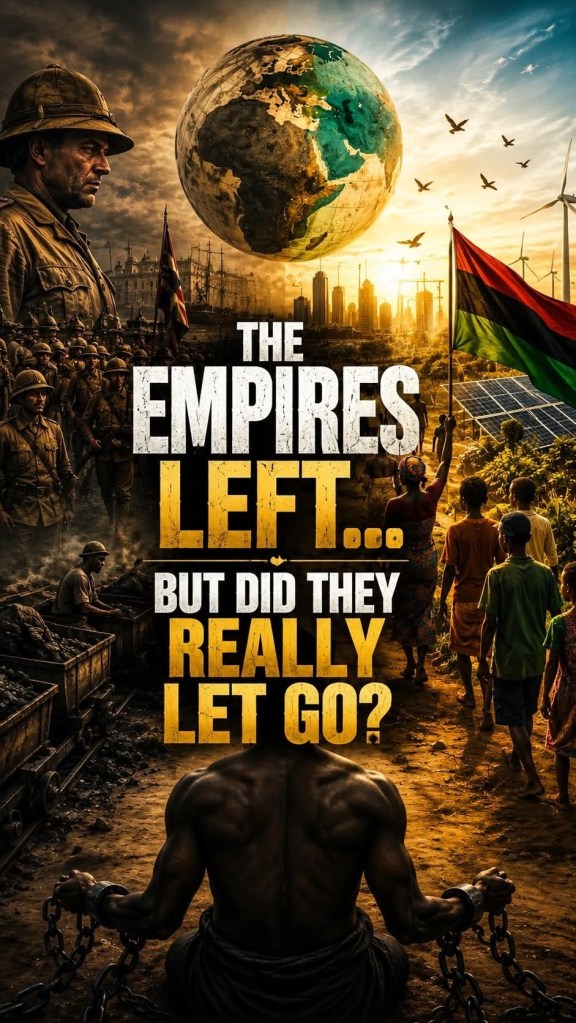
THE WORLD AFTER EMPIRE — DID COLONIALISM REALLY END?
THE WORLD AFTER EMPIRE — DID COLONIALISM REALLY END?
Let me ask you a question…
When the colonial flag came down, did colonialism really disappear?
Think about it.
For decades, European empires ruled enormous parts of Africa and Asia.
They controlled governments.
They controlled trade.
They controlled land.
They extracted minerals, crops, oil, and other resources.
Then something changed.
After the Second World War, European empires began collapsing.
One country after another gained independence.
New flags went up.
New presidents appeared.
New national anthems were played.
And the world celebrated:
“Africa is free!”
But hold on…
Free to do what?
Because political independence and economic independence are not necessarily the same thing.
Imagine inheriting a house that legally belongs to you—but almost everything inside it was designed for someone else’s benefit.
The roads were built to move your resources toward the ports.
Your economy was structured around exporting raw materials.
You imported finished products at much higher prices.
Your borders were largely inherited from colonial rule.
Your new government inherited institutions that were never designed by you in the first place.
So when the colonial administrator left…
Did the entire system leave with him?
That is where the debate gets uncomfortable.
Look at Ghana.
When Kwame Nkrumah led Ghana to independence in 1957, he understood something many people still argue about today:
A nation can possess a flag without possessing real economic power.
And then look at the Congo.
The Congo became independent in 1960.
But independence did not bring immediate peace.
Instead came political crisis, secession, Cold War competition, foreign intervention, and the tragic assassination of Patrice Lumumba.
And here’s where things get REALLY interesting.
The Cold War was raging.
America wanted to contain communism.
The Soviet Union wanted greater influence.
Europe still had economic and strategic interests.
And newly independent African countries suddenly found themselves standing between global powers.
So ask yourself:
Were these countries truly free to choose their own path—or were powerful nations still competing over their resources and political direction?
Now let’s talk about Africa’s natural wealth.
Gold.
Diamonds.
Copper.
Cobalt.
Oil.
Uranium.
Lithium.
Rare minerals.
Agricultural land.
Africa has never been an empty continent waiting for somebody else to “develop” it.
The continent has always possessed enormous wealth.
But here’s the contradiction:
How can a place be rich in resources and still have millions of people living in poverty?
That’s the question we should be asking.
And before someone says, “Blame Europe for everything,” let’s be honest.
That’s not history either.
African governments have made decisions.
African elites have stolen public money.
Some leaders became dictators.
Some governments destroyed institutions.
Some countries experienced devastating civil wars.
Some leaders made terrible economic choices.
And some countries have made remarkable progress.
So no…
Africa’s problems cannot simply be blamed on colonialism.
But here’s the other extreme that doesn’t work either:
Pretending colonialism left no lasting consequences.
That’s equally dishonest.
Colonialism shaped borders.
It shaped economies.
It shaped institutions.
It shaped languages.
It shaped patterns of trade.
And many of those structures survived independence.
That doesn’t mean Africans have no agency.
It means history has consequences.
Now here’s the question I really want you to debate:
DID THE EMPIRES ACTUALLY LEAVE?
Or did the old empires simply evolve into something different?
Because today, nobody needs to plant a colonial flag over a country to have influence.
You can have influence through:
💰 Money.
⛏️ Resource contracts.
🏦 Debt.
🌍 Trade.
🏢 Multinational corporations.
🪖 Military alliances.
📡 Technology.
And political pressure.
That’s why some people call the modern system neocolonialism.
Others reject that argument completely and say:
“No. This is simply globalization, capitalism, and international trade.”
And honestly?
That’s where the real debate begins.
Because not every foreign investment is exploitation.
Not every trade agreement is colonialism.
Not every international partnership is manipulation.
But neither should we pretend that power doesn’t matter in international relations.
Power has ALWAYS mattered.
So perhaps the biggest question of the post-imperial world isn’t:
“Did colonialism end?”
Maybe the better question is:
“WHO CONTROLS THE FUTURE?”
Because political independence answered:
“Who governs us?”
But economic sovereignty asks a much harder question:
“Who controls the resources, industries, technology, money, and systems that determine our future?”
And that question isn’t just about Africa.
It’s about Asia.
It’s about Latin America.
It’s about the Middle East.
It’s about the entire developing world.
The age of European empire may be over.
But the struggle for power, resources, sovereignty, and influence never ended.
So I’ll leave you with this:
🔥 When the colonial flags came down, did the system change—or did the players simply change?
Don’t just read this.
Tell me what you REALLY think.
👇 Did colonialism truly end—or did it simply evolve?